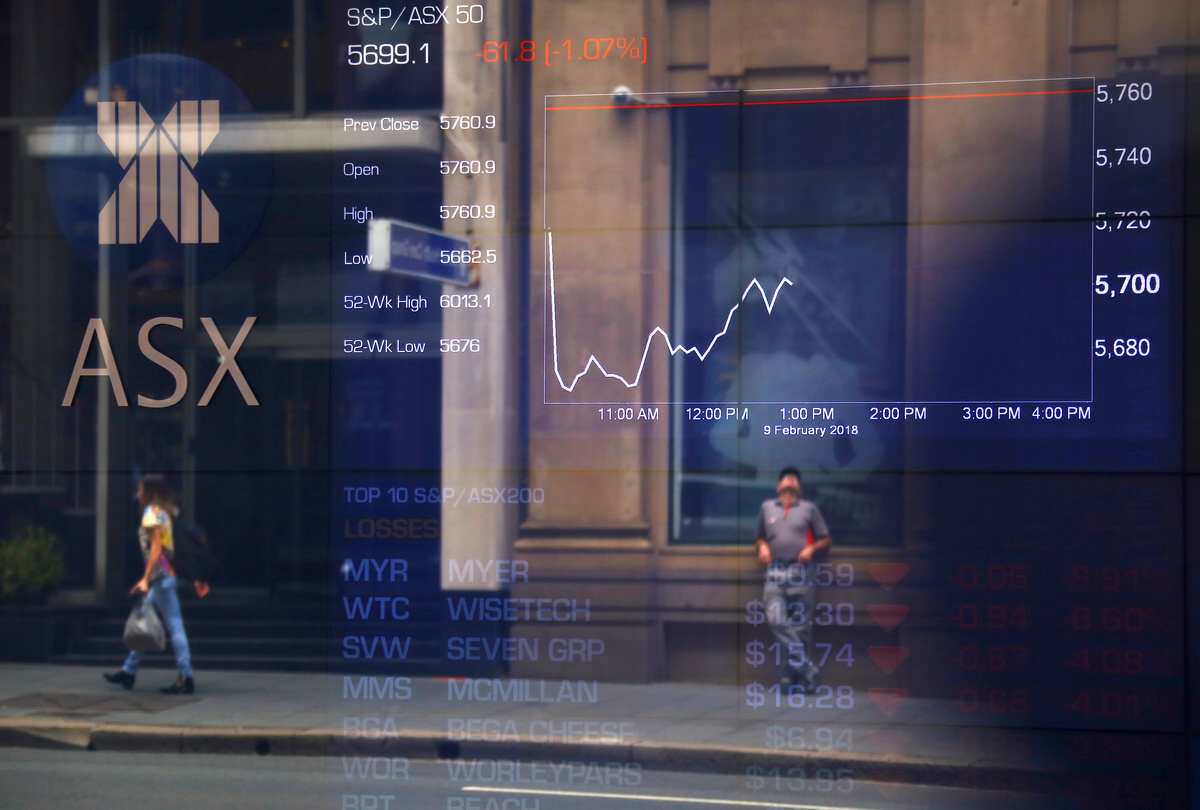
Australian shares fell 5% on Friday, their most in five weeks, as risk sentiment was battered by threats of new tariffs from U.S. President Donald Trump against China and a slew of bleak data out of the world's top economy.
Trump made clear his concerns about China's role in the origin and spread of the novel coronavirus were taking priority over efforts to build on an initial trade agreement.
Fresh U.S. tariffs could delay a return to normalcy from the virus-driven downturn for China, Australia's biggest trading partner, and thereby, hurt Australia too, said Mathan Somasundaram, market portfolio strategist at Blue Ocean Equities.
The S&P/ASX 200 index <.AXJO> settled at 5,245.9, posting its fifth weekly gain in six.
Data released overnight showed millions more Americans filed claims for unemployment benefits last week, while consumer spending in March suffered a record collapse.
The U.S. Dow Jones Industrial Average <.DJI> fell 1.17%, the S&P 500 <.SPX> lost 0.92% and Nasdaq <.IXIC> slipped 0.3%.
In Australia, miners <.AXMM> fell more than 7%, with heavyweights BHP Group <BHP.AX> and Rio Tinto <RIO.AX> losing 6.6% and 5.1%, respectively.
Financial stocks <.AXFJ> also dropped, with the "Big Four" banks falling between 4.8% and 6.8%.
The top percentage loser on the benchmark index was shipbuilder Austal Ltd <ASB.AX>. Its shares fell nearly 20% after the company lost out on a more than $5.5 billion U.S. Navy contract to build 10 frigates.
The number of issues on the ASX that advanced were 451 while 1,188 declined.
The Aussie dollar was 0.83% stronger against the U.S. dollar to A$0.65.
Across the Tasman Sea, New Zealand's benchmark stock index <.NZ50> finished the session 0.8% lower at 10,449.01, but gained 0.3% for the week.
Casino operator SkyCity Entertainment Group <SKC.NZ> was among the top losers even after the government agreed to declare COVID-19 a force majeure event for the construction of a major project.
(Reporting by Soumyajit Saha in Bengaluru; Editing by Subhranshu Sahu)