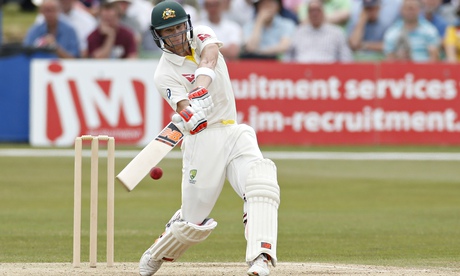
“I don’t feel like there’s any extra pressure at all,” says Steve Smith, who knows the bounty placed on his head this Ashes series could not be higher. The Australia No3, once the butt of English jokes, heads into Wednesday’s first Test sitting at the top of the world rankings and the most talked about batsman on either side.
“My game’s developed a lot over the last couple of years,” he says, in his softly spoken manner. “That’s happened through a lot of hard work. I’m very hard on myself. The rankings don’t bother me too much as long as I’m scoring runs and we’re winning games.”
Developed is something of an understatement with the right-hander having enjoyed an almost rocket-fuelled ascent into the batting stratosphere in the past 18 months. Originally plonked down at No8 as a leg-spinning all-rounder on his Test debut against Pakistan at Lord’s in 2010, Smith will walk out to bat in Cardiff after Australia’s first opener is removed as the man who must not be allowed to bed in.
Smith is the most deceptive of players. His looks, even at 26, remain that of a schoolboy, his second middle name, Devereux, attracts sniggers on social media and the reason given for his selection during the 2010-11 Ashes – his captain, Ricky Ponting, hoped he could lighten the mood of a downbeat dressing room – has been eternally referenced. The joke is now on world cricket, with 1,617 runs in his last 23 innings at an average of 89.83 kickstarting a fresh search for any weaknesses.
Can his homespun technique, one that remains fidgety at the crease despite the removal of bat tap in his trigger movement, stand up to the rigours of the swinging Dukes ball on English pitches? This is the question that has been posed by Stuart Broad and the now-retired Graeme Swann and one which, for the sake of series-publicising opprobrium, has been read as rhetorical, with the implication being that England, despite serving the ball up for three of his nine Test centuries, do not rate him.
“It’s obviously pre-Ashes. Guys come out and say a lot of things,” says Smith, remaining as cool as during his last Test outing when he scored 253 runs in two innings in Jamaica, 199 of which came in the first innings. “I’m just going to go out there and try to do what I’ve been doing over the last 12-18 months, and that is scoring runs, keep letting my bat doing the talking.”
While his bat has had plenty to say for itself since his maiden Test century at the Kia Oval in 2013, Smith, it must be said, has chirped up in recent times too. “After beating them so convincingly in Australia it’s going to be nice to go into their backyard,” he said back in April. “If we continue to play the same way we’ve played over the last 12-18 months, I don’t think they’ll come close to us.”
Now, he rows back somewhat. “I might have got my words a little bit wrong there,” he says. “England are very tough in these conditions. We haven’t won here in 14 years. It’s going to be a tough series, they play very well in their own backyard and we’re going to have to be at our best if we’re going to triumph.”
With a healthy lick of poetic licence, the Sydney-born Smith can be viewed as the one that got away. His mother hails from West Malling in Kent and he played second XI cricket for the county in 2007, where the academy director at the time, and now the England assistant coach, Paul Farbrace, claims he tried to sign him permanently using that dual-nationality route.
Smith recalls only a contract offer from Surrey, whose second string he also turned out for that summer. Either way, any overtures to become an Englishman were always going to fall on deaf ears. “I went home and got offered a rookie contract with New South Wales,” he says. “I always dreamed of playing for Australia, so the decision wasn’t too difficult. I would have enjoyed playing some county cricket and learning my art that way, but I never had any ambitions at all to play for England, that’s for sure.”
It was at the Sydney Cricket Ground where he got to know England’s new head coach, Trevor Bayliss, who went on record this week to state his admiration for his former player in all of the Dukes-related chuntering. Smith, who began the tour with an ominous 111 against Kent before retiring his wicket, is more than happy to repay the favour. “From my experiences with him, Trevor has been a very good coach. He’s taught me a lot about the game of cricket,” says Smith. “He talks about the game of cricket non-stop.
“His emotions, as a coach, are a great trait to have. You wouldn’t know if you’d had a good day or a bad day at the end if you’re looking at him. He understands the game as well as anyone I’ve come across, so I think he’ll be really good for England.”