Darren Lehmann could probably be excused a lack of deep forensic knowledge of British TV light entertainment of the 1970s. Still, it was slightly unfortunate Australia’s coach should choose to brush aside concerns over the trajectory of a team described by some as a Dad’s Army by echoing the favoured catchphrase of the doddery but dogged Lance Corporal Jones. Don’t panic!
Australia may have been out-batted, out-bowled, out-caught and out-captained in Cardiff. There may be concerns over the fitness, form and general infirmity of assorted senior players. But as Australia prepared to leave Wales, Lehmann was still insisting, publicly, that a 169-run defeat in the first Ashes Test was simply “a minor hiccup”.
And with good reason, too. In these circumstances it may be tempting to paint Australia’s coach as a kind of Comical Darren, patiently explaining that the enemy are still miles from the city walls even as the ministry of defence is reduced to rubble behind him. But right now Australia’s coach has no choice but to remain bullish, not least when his team’s main strength in recent times has been its bullishness, the good times built out of aggression, positivity and all-round brio.
And yet something has shifted between these teams. The nature of Australia’s strengths is well known. None of them materialised in Cardiff. The fast bowlers may yet find a pitch, or more importantly a length, that suits them better. The batsmen may click into gear. But England will play without fear from here. These are not, at least not over here, the muscle-cricket bullies of the Green-wash series. In fact, exactly how good Australia really are is perhaps not clear to either team.
In the build-up to the series Australia were repeatedly described as the best in the world, bafflingly given South Africa’s clear blue water at the top of the Test rankings. In Cardiff they looked like the alternate Australia of the last few years, Bad Australia, the team cuffed around the Emirates by Pakistan, winners of two of their last 16 Ashes Tests in England, whose best recent moments – the 5-0 series, the win in South Africa – were based around a few outstanding areas of strength, rather than the thoroughbred grace and depth of the best Australian teams.
Without a little fear in the mix, the series certainly takes on a very different tone. If Cardiff looked a less than intimidating piece of scheduling, suddenly Lord’s looks like the perfect next stop for England, who have lost two of their past 19 Tests there. This against an Australian bowling attack that has little experience of a Test ground with some very specific requirements.
Mitchell Johnson seemed startled by the slope during his one previous Ashes appearance there, a fast, wild spell of three for 132 at six an over in 2009 that in effect revived Alastair Cook’s career after a long dip. Of the other bowlers Josh Hazlewood has never played there. Mitchell Starc has never played there. And Nathan Lyon – let’s see – has never played there.
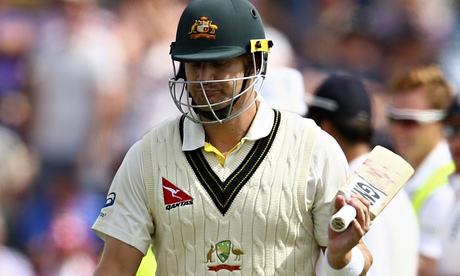
Of the current lot only Shane Watson has had any real success at Lord’s, taking five for 40 five years ago against Pakistan swinging the ball on a full length. And yet Watson is also a standard bearer for the most obvious weakness in this team. Tiptoe down that batting order and there is a very distinct sense of diminishing marginal returns.
The top is robust. Chris Rogers is a point of strength in England. David Warner will simply continue to play like David Warner, dishing out his cultured violence, learning on the job. Steve Smith will get runs. Michael Clarke, at a slightly rickety 34, perhaps needs to temper his urge to leap out to the spinners from ball one.
The problems start at No6 and stretch down. Cricket’s own prisoner of lbw, Watson has in recent times become a kind of matinee idol of the decision review system, hero of the big screen. More serious is his lack of fluency or permanence at No6. With the remains of the batsman formerly known as Brad Haddin just below, Australia have no Test hundred from numbers 6-11 since January 2013. Worse, they have an undeniable, and very un-Australian, tail. This is not quite a case of four out all out (indeed, there is an argument for elevating the two Mitches, Starc and Johnson, above Haddin and Watson on recent form). But where England cowered at the sight of the lower order in the last series, here they will attack.
Australia have other options for Lord’s, albeit not many. Mitchell Marsh could come in for Watson, although it feels like a big call this early on. Jettisoning a senior player is always hardest when he’s close to the captain. So, perhaps a little easier in this case, then. If Starc fails to recover Peter Siddle could provide some reliable workhorsery. The other option, Pat Cummins, is a thrilling talent but he hasn’t played a first-class match since August 2013. Either way, there has been a shift of gravity that goes beyond simply a 1-0 scoreline. Australia may well come back and win this series. But they will play from here on a level field, a team with its own knots to unravel, and with the bruises of the last Ashes series no longer tender to the touch.