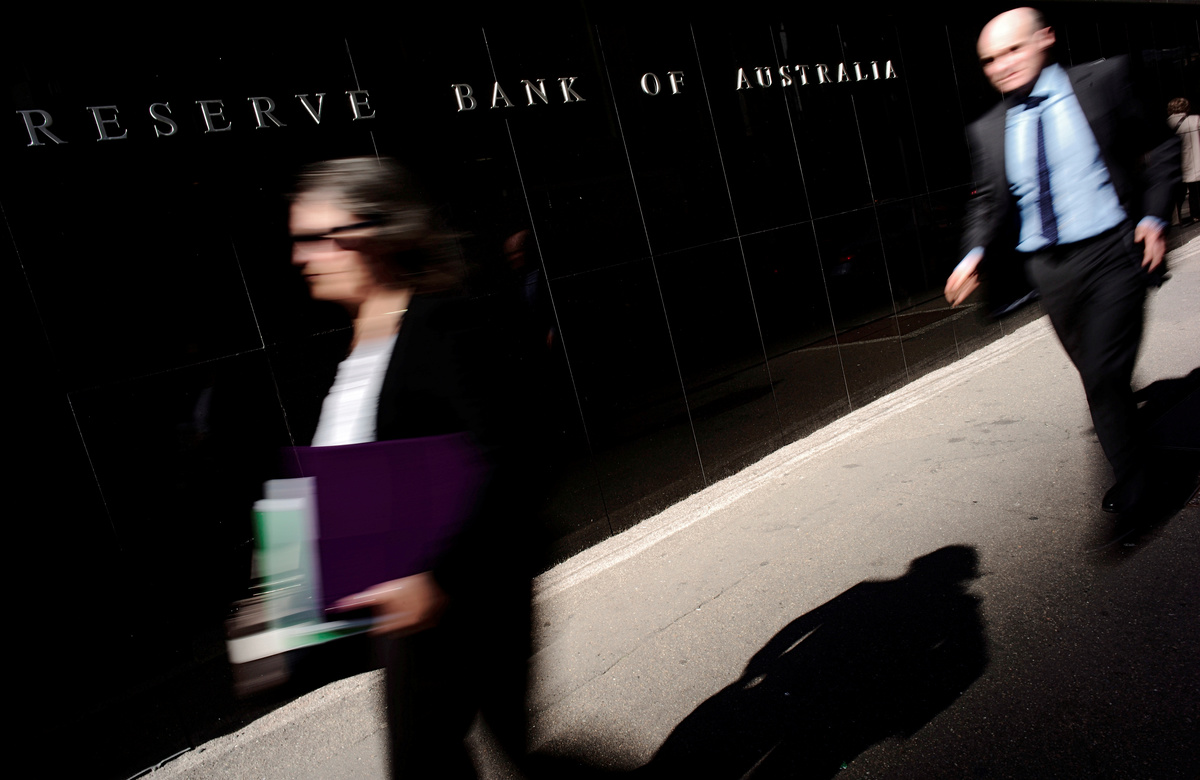
SYDNEY, Oct 15 (Reuters) - Australia's central bank decided a weak global growth outlook, tepid domestic inflation and considerable labour market spare capacity made the case for a rate cut at its October meeting.
Minutes of the meeting released on Tuesday also showed the Reserve Bank of Australia (RBA) was ready to consider further easing to support growth and achieve its 2% to 3% inflation target.
The RBA began its latest easing cycle in June and has since lowered its benchmark rate to 0.75%. Financial market pricing implies a 40% chance of a fourth cut next month while a 25-basis-point reduction to 0.50% is considered certain by early 2020.
The minutes showed board members discussed a range of arguments for not easing at the meeting, including the need to reserve some firepower for any future negative shocks and the possibility that monetary stimulus might be less effective now than in the past.
Fuelling an asset bubble was another risk emanating from very low interest rates.
"Members concluded that these various factors did not outweigh the case for further easing of monetary policy at the present meeting," the minutes showed.
"Members judged that lower interest rates would help reduce spare capacity in the economy by supporting employment and income growth and providing greater confidence that inflation would be consistent with the medium-term target."
The RBA also reiterated its forward guidance, saying it was "reasonable to expect that an extended period of low interest rates would be required in Australia to reach full employment and achieve the inflation target."
Board members noted lower rates had been effective in keeping theAustralian dollar at its lowest in a decade, thus supporting exports and the mining industry.
Tuesday's minutes showed board members were concerned about the protracted Sino-U.S. trade war, which has rattled investor and business confidence and hurt manufacturing activity around the world.
On domestic issues, they discussed labour market spare capacity, noting the RBA's most recent forecasts suggested the unemployment and inflation outcomes over the next couple of years were likely to be short of its goals.
"CLOSE MONITORING"
Australia's A$1.95 trillion ($1.3 trillion) economy has dodged recession since the early 1990s but has now hit a soft spot with growth slowing, inflation and wage growth lukewarm, consumer spending sluggish and unemployment ticking higher.
Despite three rate cuts since the middle of this year, surveys of business and consumer sentiment have weakened while there are little signs of green shoots outside of the housing market.
Investors are now squarely focused on September employment data due on Thursday which is likely to show the jobless rate stuck at a one-year high of 5.3%, much higher than the RBA's aspiration of 4.5%.
On the same day, RBA Deputy Governor Guy Debelle will give a speech on 'Housing and the Economy'.
The RBA is hopeful that improved sentiment in the housing market, where prices, auction clearance rates and credit growth have all rebounded in recent months, will feed through to broader activity.
"Perhaps Debelle will further clarify the Bank's thinking here, particularly given ongoing concerns around the level of private leverage," RBC Chief Economist Su-Lin Ong wrote in a note on Monday.
The minutes showed RBA board members saw only a "limited risk" of excessive leverage at the current juncture as borrowing capacity was still weak given subdued household disposable income and robust bank lending standards.
"Nonetheless, members assessed that close monitoring of this risk was warranted," the RBA said. (Reporting by Swati Pandey, editing by Wayne Cole)