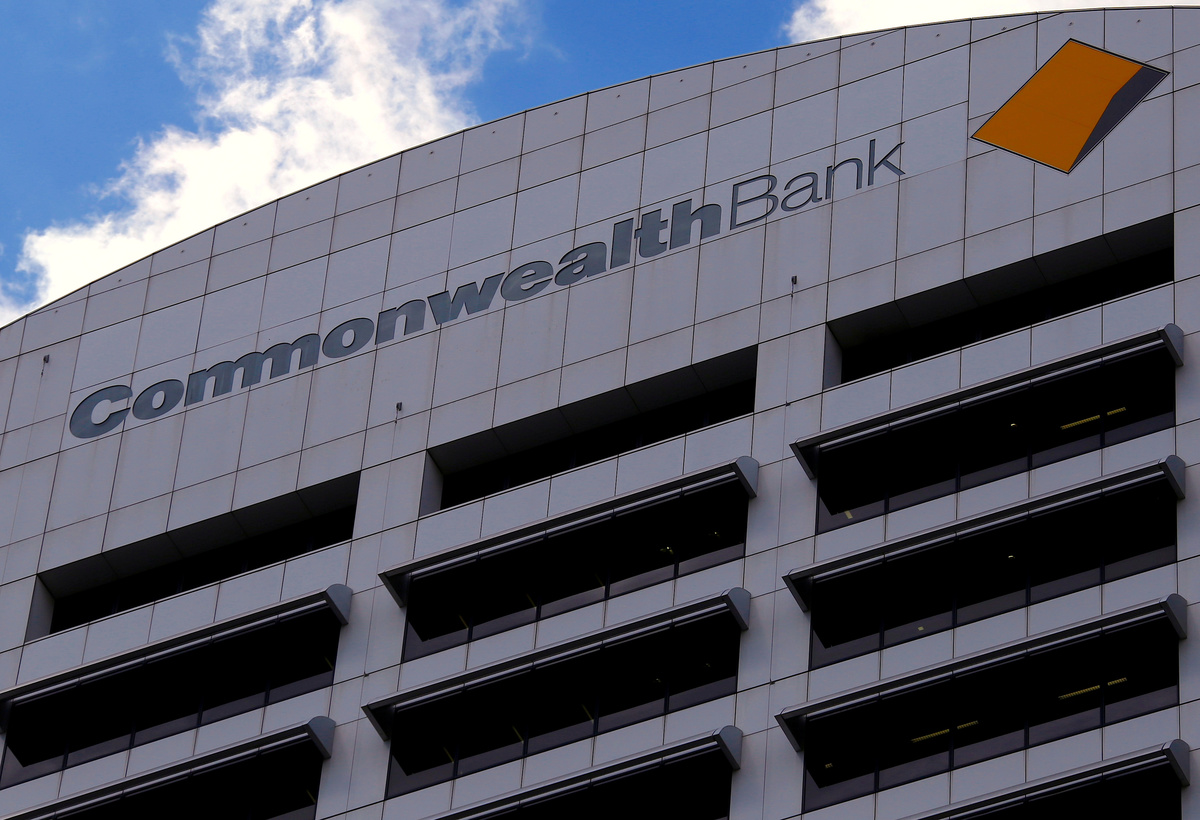
SYDNEY (Reuters) - Commonwealth Bank, HSBC and Citi are betting that Australia's central bank will cut interest rates more steeply than previously thought as global trade tensions ratchet up and domestic hiring intentions slow.
Economists at CBA <CBA.AX>, Australia's biggest bank by market capitalisation, said in a note on Thursday they expect one 25 basis point (bps) easing in November followed by a second in February, taking the key rate <AUCBIR=RIC> to 0.5%. Earlier, they had predicted just one cut to 0.75%.
HSBC and Citi followed up with a similar predictions of two cuts.
HSBC had expected the Reserve Bank of Australia (RBA) to halt its current easing cycle after two back-to-back reductions in June and July to a record low of 1%. Citi had earlier forecast another easing to 0.75%.
With the RBA pledging to do more if needed, the revised expectations from these banks now match financial market pricing <0#YIB:>.
"There has been further escalation in the trade and technology tensions between the U.S. and China, which is now having a more distinct impact on currency markets too," HSBC chief economist Paul Bloxham said in a note.
"We expect the local labour market and global downside risks to motivate the RBA to cut further," Bloxham added.
The clear and present danger to the economy prompted RBA Deputy Governor Guy Debelle to warn of the growing risks from the trade war. In a speech on Thursday, Debelle said a slowdown in business investment decision risked a self-fulfilling global downturn.
HSBC's change in view was led by an abrupt escalation in the trade war this month when U.S. President Donald Trump slapped tariffs on $300 billion of Chinese imports. That led to a sharp depreciation in the yuan, prompting Washington to label China a "currency manipulator."
The rising tensions have heightened fears that a significant economic slowdown in China would severely hurt Australia's growth as the two economies are closely intertwined.
Further raising concerns about domestic momentum, official data on Thursday showed Australia's jobless rate was stuck at a disappointingly high 5.2% in July even as employment surged past expectations.
"The leading indicators of the labour market are pointing to reasonable jobs growth. But they are running at a level that suggests progress in reducing labour market slack will stall," CBA's economics team wrote.
Australia's economy has dodged a recession since the early 1990s thanks to insatiable appetite from China for its key commodities but growth has now slowed to the weakest since the global financial crisis.
The protracted Sino-U.S. trade war has fuelled fears of a global recession, hammering financial markets overnight and pulling yields on 10-year Treasuries below those on two-year paper. That inversion of the curve has been a reliable predictor of recessions in the past.
Financial markets are pricing in policy easing by all major central banks.
"The global backdrop looks more risky," Citi economist Josh Williamson said.
"The domestic economy requires more policy accommodation."
(Reporting by Swati Pandey; Editing by Richard Borsuk & Shri Navaratnam)