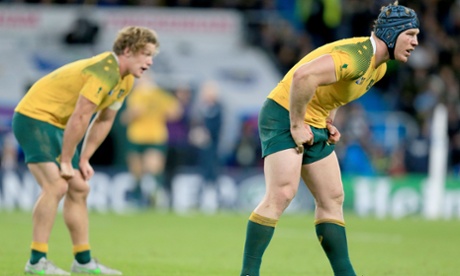
When New Zealand last met Australia in the World Cup, four years ago in the semi-final at Eden Park, David Pocock was penalised twice at the breakdown in the opening 10 minutes. The tone was set and a player who the previous week had won nine turnovers during the victory over South Africa was marginalised as the hosts made it through to their first final in 16 years.
Pocock was on the openside then – three of Australia’s five starting survivors from that day will be in different positions on Saturday, Adam Ashley-Cooper on the wing at full-back, the prop Sekope Kepu on the other side of the scrum and Pocock at No8 – but is now part of a back-row trident that has been one of the most impressive features of a side that a year ago appeared to have as much chance of winning the World Cup as the Conservative party had of claiming an outright victory in the following May’s general election.
Craig Joubert was the referee in Auckland in 2011. The buildup to the game was dominated by claims that Pocock was a serial cheat, straight faces kept in the land of Richie McCaw who had spent the previous decade fending off the same accusation.
The Springboks’ management led the way, blaming the referee Bryce Lawrence for over-indulging Pocock at the breakdown for their early elimination and ignoring their bone-headed tactics that saw a wealth of possession squandered.
Pocock was pretty much on his own then, a force of nature, but now he is backed up by Michael Hooper, a serial tackler, and Scott Fardy, the minder who clears a path for Pocock. And Nigel Owens is in charge, a referee who allows a contest for possession at the breakdown. If the All Blacks are overrun there as they were in the first-half in the semi-final against South Africa, they will be fortunate to only be behind by five points at the break.
The All Blacks are the favourites for a reason: World Cup holders, No1 in the world rankings by a considerable margin and beaten only three times in the last four years. They perform to a consistently high level, far above those below them who in contrast oscillate, but a cup competition is not about form or what has gone before. It is all about what happens on the day and Australia have shown in the 12 months that Michael Cheika has been in charge that they have the capacity to rise above any side on a one-off occasion.
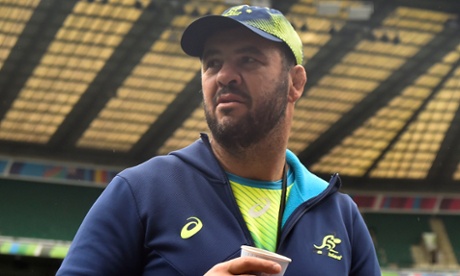
Cheika has transformed a side that appeared to be in danger of doing a France, losing sight of itself. He is a hard and smart operator which is why it is easy to imagine the pictures of Australia’s “gameplan” were less of a blunder and more a practical joke on the media he has enjoyed jousting with this tournament.
Key figures in Australia’s team are only playing because of Cheika’s insistence: Matt Giteau has added knowhow and craft to the backline, a foil for Bernard Foley, who has been one of the most improved players of the tournament; Drew Mitchell has provided finishing power on the wing; and Kane Douglas is a hirsute version of Martin Johnson in the muscular way he invades the dark areas.
The Wallabies have become more like the All Blacks, still capable of cutting defences but more physical in their approach. Cheika has coaxed form back into Will Genia, giving Foley experience inside and outside him, and Australia have a scrum again, as well as a lineout, at least as long as Rob Simmons is on the field. They are worthy finalists, bidding for a hat-trick of victories in the final on British soil.
New Zealand’s grip on the Webb Ellis Cup will take some weakening. The All Blacks will not be overcome by the emotion of so many players making their final appearances in the jersey, among them McCaw, a warrior whose thirst for battle is never quenched, and the incomparable Dan Carter, who is 80 minutes away from his holy grail. Add in Ma’a Nonu and Conrad Smith, a centre combination to compare with any era and the back rowers from 2011, Kieran Read and Jerome Kaino, and the task facing Australia is put into perspective. And then come the players capped since the last World Cup, Julian Savea, Nehe Milner-Skudder, Aaron Smith, Dane Coles, Brodie Retallick, game changers all.
It is no wonder Australia are long odds to win, but like the All Blacks they have only lost once this year and Cheika knows how to win cup finals from his days with Leinster and the Waratahs. The weather is set fair for the two old foes, the last dusting of summer a fitting tribute to a World Cup that has been shining from the opening weekend.