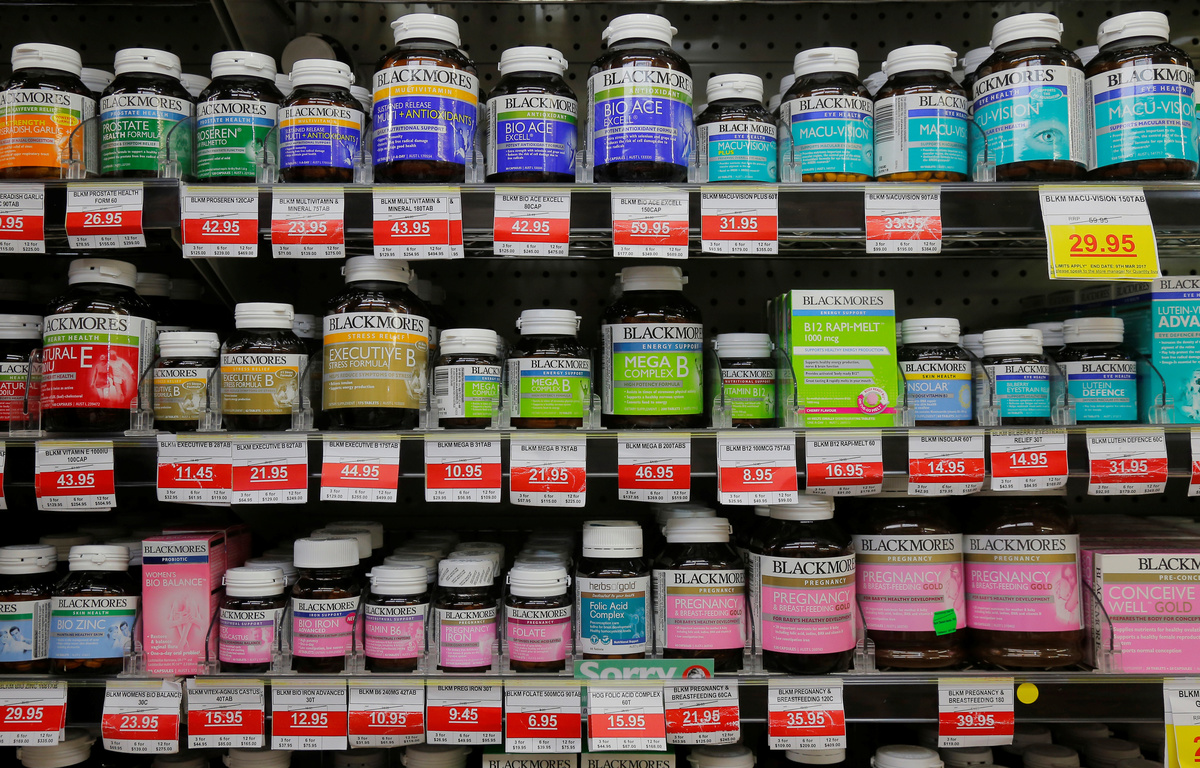
Blackmores Ltd <BKL.AX> scrapped its dividend on Wednesday and said it expects this year's profit to more than halve as the coronavirus hits its supply chain, sending the Australian vitamin maker's shares down by the most in nearly a year.
Shares of the company, which have been on trading halt since Monday, fell more than 23% at the open but regained some ground to trade 16.2% lower at A$74.92 by 0255 GMT.
The stock was the worst performer on the broader market index <.AXJO>, which was up 0.6%.
Blackmores will now have to adjust its operations in China as the epidemic has hindered movement of products to and within the country as a determined Chinese government scrambles to stem the spread of the virus.
Sales took a hit after some of its e-commerce partners cancelled or modified promotions amid a slowdown in China's freight traffic due to the outbreak, Blackmores said.
While the virus outbreak has resulted in increased demand for key immunity products in Australia and Asia, sales have been hurt by supply chain disruptions, the Sydney-based company said in a trading update.
These disruptions are expected to last for at least two to three months, it said.
"This is disappointing given a new management team is now in place and there was some thought that some of Blackmores' products were trading well on the back of the coronavirus," Morgans analyst Belinda Moore said in a note.
The company expects to report an after-tax net profit for the full financial year ending June of A$17 million to A$21 million ($11.41 million to $14.10 million). It had reported a profit of A$53 million last financial year.
The underlying profit for the half-year ended Dec. 31, 2019 fell 48 percent to A$18 million.
"We acknowledge that these results are completely unsatisfactory, and we have much work to do to restore confidence in Blackmores," Chairman Brent Wallace said.
China's strong demand for vitamins and health products had fuelled double digit annual sales growth at the company and made its shares very attractive, but Blackmores has recently struggled with Beijing's tougher import rules.
Those rules have led to lower sales through the company's "daigou" network of informal exporters, which make tens of billions of dollars a year selling foreign goods online.
Australian companies heavily exposed to China have started flagging hits to their business from the epidemic that has killed more than 1,000 people and disrupted business activity in the world's second-largest economy.
($1 = 1.4896 Australian dollars)
(Reporting by Renju Jose in Sydney and Nikhil Kurian Nainan in Bengaluru; Editing by Sam Holmes and Jacqueline Wong)