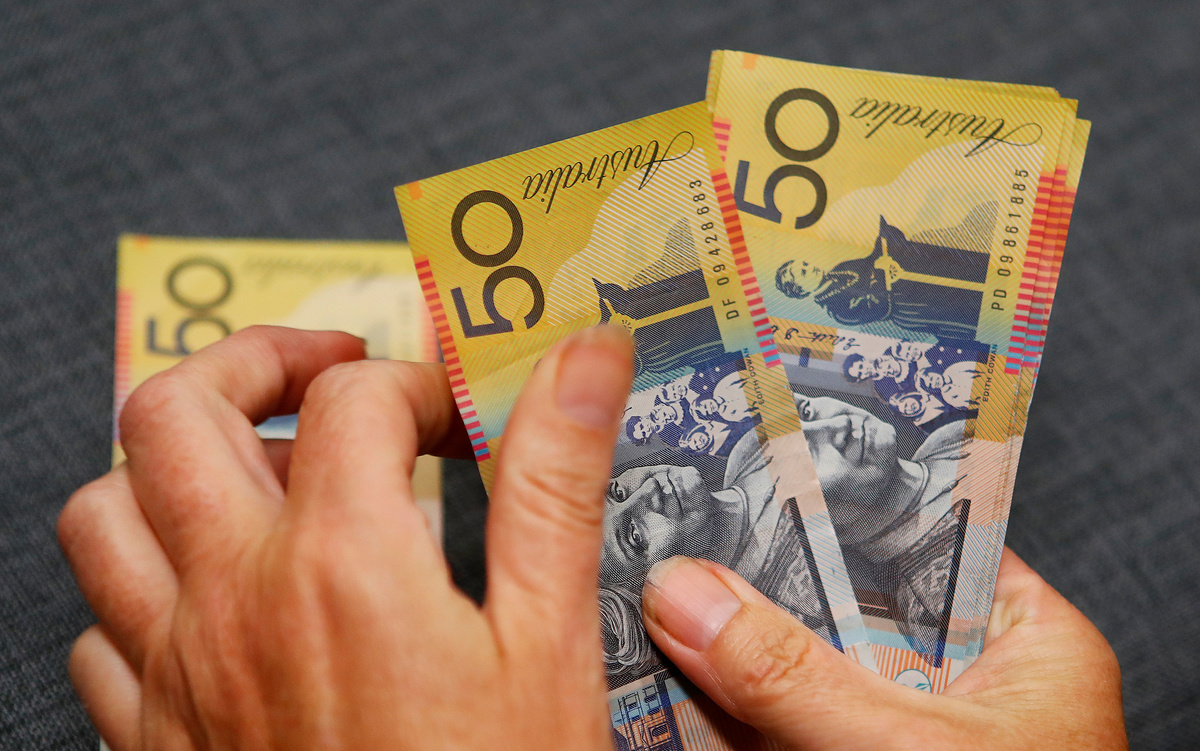
SYDNEY/WELLINGTON (Reuters) - The Australian and New Zealand dollars edged up on Tuesday as investors wagered that U.S. President Donald Trump's threatened tariffs might not prove as disruptive as first feared, reviving the appetite for risk.
The Aussie dollar <AUD=D4> crept up 0.2 percent to $0.7780, off last week's two-month trough at $0.7713, supported by a bounce in Asian share markets as Trump faced growing pressure from political and nation-state allies to pull back from proposed steel and aluminium tariffs. [MKTS/GLOB]
There was little reaction to the Reserve Bank of Australia's widely-expected decision to leave interest rates at 1.5 percent, but there were concerns the Aussie could come under pressure as the RBA sounded a cautionary note on growth at its monthly policy meeting.
"We would expect to see some softening in the Aussie as markets digest what appears to be a tweak in the RBA's GDP growth forecast over the next couple of years from 'to average a bit above 3 percent' to 'faster in 2018 than it did in 2017'," said Westpac's head of financial market strategy, Robert Rennie.
Figures due Wednesday were forecast to show Australia's gross domestic product (GDP) expanded by around 0.6 percent in the December quarter. But following recent disappointing economic indicators, analysts are now looking for a rise of around 0.5 percent, with annual growth slowing to 2.4 percent.
Data out Tuesday was too mixed to provide much of a lead.
Retail sales for January disappointed with a rise of 0.1 percent, versus analysts' expectations of around 0.4 percent.
The country's current account deficit also widened by more than expected in the December quarter to A$14 billion ($10.89 billion), while net exports shaved 0.5 percentage points from GDP which was a little less than forecasted.
On the bright side, government spending rose strongly in the quarter and lessened the risks of a major downside surprise for the full GDP report.
Futures markets <0#YIB:> continue to price in only a minimal chance of a rise in rates by August and a 50-50 probability by year-end.
The kiwi dollar <NZD=D4> firmed 0.15 percent to $0.7235, slowly edging away from its recent low at $0.7186.
"The NZD remains a by-stander amidst more interesting global developments ... Price action over the past six weeks or so shows some pretty well-defined technical ranges, with key support at $0.7175 and resistance at $0.7440," Jason Wong, markets strategist at BNZ Bank, said in a research note.
More action was expected from a dairy auction due to take place in the early hours of Wednesday morning. Analysts expect prices for the country's top export, whole milk powder, to fall around 2 percent, which could weigh on the kiwi.
New Zealand government bonds <0#NZTSY=> eased, sending yields 4.5 basis points higher at the long end of the curve.
Australian government bond futures slipped in line with Treasuries. The three-year bond contract <YTTc1> eased 4 ticks to 97.885, while the 10-year contract <YTCc1> lost 7 ticks to 97.2000.
(Reporting by Wayne Cole; Editing by Himani Sarkar)