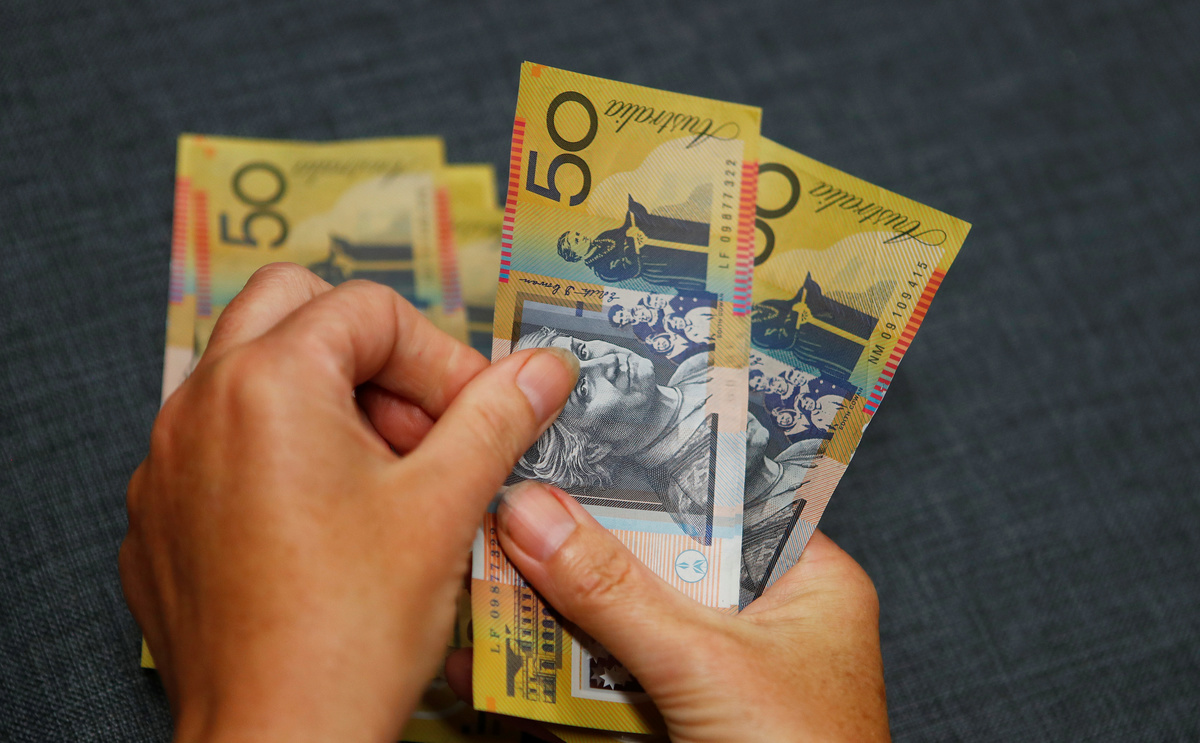
The Australian and New Zealand dollars steadied on Thursday after a run of losing sessions as an easing in tensions in the Middle East lessened one potential risk to the global economic outlook.
The Aussie inched up to $0.6872 <AUD=D3> and off Wednesday's trough of $0.6849, but was not far from it given the broad reduction in risk aversion. It had also lapsed below its 200-day moving average at $0.6894, which now acts as resistance.
The kiwi dollar held at $0.6650 <NZD=D3> having bounced from a low of $0.6619 overnight, which stands as support. Resistance lies in the $0.6670/80 zone.
Both had suffered on Wednesday when Iran launched missiles at U.S. bases in Iraq, but the mood lightened when President Donald Trump suggested Iran was "standing down" and stopped short of military retaliation.
Investors reacted by paring back wagers on another cut in interest rates from the Reserve Bank of Australia (RBA).
Futures implied around a 44% chance of a quarter-point easing to 0.5% in February, down from near 60% at the height of the crisis. A move was still fully priced in by June.
Markets have been narrowing the odds of a cut recently as bushfires scorched large chunks of the country and threatened to undermine consumer spending and economic growth.
"The size, intensity and duration of the current Australian bushfires mean that they will almost certainly have a larger economic impact than past fires," said David Plank, head of Australian economics at ANZ.
This, however, would be offset over time by government assistance and insurance payments, along with a pledge of A$3 billion ($2.06 billion) in rebuilding funds from the federal government and New South Wales.
Plank estimated the drag on economic growth was unlikely to be more than 0.1 to 0.2 percentage points for both the last quarter of 2019 and the first quarter of this year.
"There might be a case for a monetary policy response if the fires trigger ongoing national effects, such as a sustained loss in consumer confidence," he said. "As it happens, we were already forecasting a 25 basis points February rate cut."
On a brighter note, data out on Thursday showed the country's trade surplus swelled to a surprisingly strong A$5.8 billion in November, buoyed by exports of iron ore and liquefied natural gas.
Australian government bond futures eased in line with risk aversion and the three-year bond contract <YTTc1> dipped 2.5 ticks to 99.220. The 10-year contract <YTCc1> lost 5 ticks to 98.7500.
($1 = 1.4554 Australian dollars)
(Reporting by Wayne Cole; Editing by Arun Koyyur)