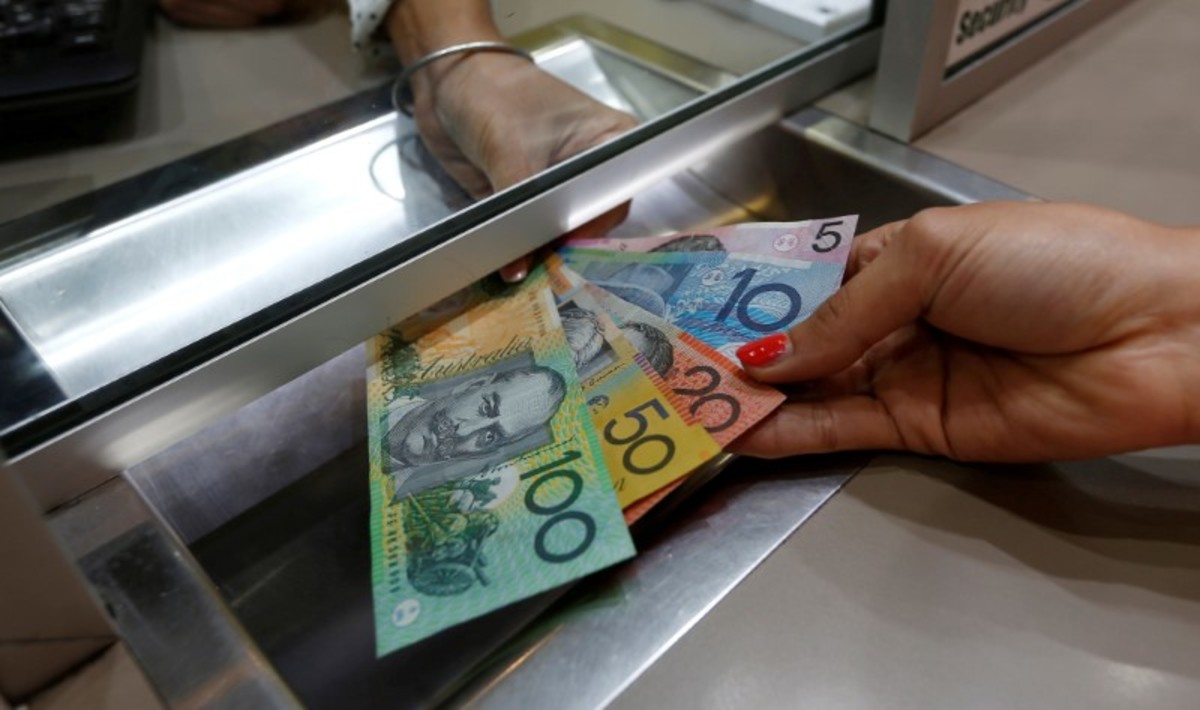
SYDNEY (Reuters) - Analysts have again lifted their forecasts for the Australian and New Zealand dollars, yet are still lagging the market as the currencies barrel ahead to two-year peaks.
A Reuters poll of 46 analysts predicted the Australian dollar <AUD=D4> at $0.7800 in one month, up from $0.7600 in the July poll and $0.7400 in the survey before that.
Yet the Aussie was already trading at $0.7930 on Thursday and recently hit a top of $0.8066. Back in July the highest forecast in the poll, from OCBC, had been for $0.7750 in one month.
Analysts also upgraded their forecasts for three months ahead to $0.7700, with $0.7600 now pencilled in on a six- and 12-month horizon. At the start of 2017, the Aussie had been seen at $0.7300 in six months and $0.7200 in a year.
The New Zealand dollar <NZD=D4> was forecast at $0.7340 in a month, not far from current levels of $0.7399 and up from $0.7200 in the previous poll. It climbed to $0.7557 last week, the highest since May 2015.
Median forecasts for further out were closely grouped, with the kiwi seen at $0.7275 in three months and at $0.7200 on both a six- and 12-month horizon.
The two currencies have surged dramatically this year against a beleaguered U.S. dollar <.DXY> which has succumbed to 13-month lows on political woes and expectations of a slow pace of tightening by the Federal Reserve.
The antipodean currencies have also soared on the back of carry trades where investors purchase higher yielding currencies by borrowing in perceived safe haven assets such as the yen.
Australia's commodity driven currency, in particular, has also found support from higher price of iron ore - the single biggest export earner - which has boosted the country's national income.
However, most analysts assume the currencies will eventually be undermined given the likelihood that interest rates will remain at record lows in the two countries.
Australia's central bank has reiterated the need to keep interest rates at 1.50 percent for a while as inflation is stuck below its long-term target band of 2-3 percent.
The Reserve Bank of New Zealand, which slashed rates throughout 2016 to an all-time trough of 1.75 percent, has also signalled it will keep rates on hold, possibly until 2010.
This means the yield advantage that Australia and New Zealand currently enjoy could be whittled away as some of their rich-world peers unwind stimulus.
Canada recently raised its rates and the Federal Reserve still aims to hike once more before year end.
"The velocity of the recent rally means that on a tactical basis, we see some downside risks for the AUD," said Daniel Been, head of forex strategy at ANZ.
Been said that the current risk-on environment with plentiful liquidity and all-time low volatility is unlikely to stick for too long.
"Risk reward does not favour selling the U.S. dollar at these levels. We remain of the view that a rebound in the USD will come once the liquidity tap starts to turn off or when risk aversion rises. This will see AUD, NZD, and Asian currencies impacted more."
(Polling by Shaloo Shrivastava and Khushboo Mittal; Editing by Wayne Cole & Shri Navaratnam)