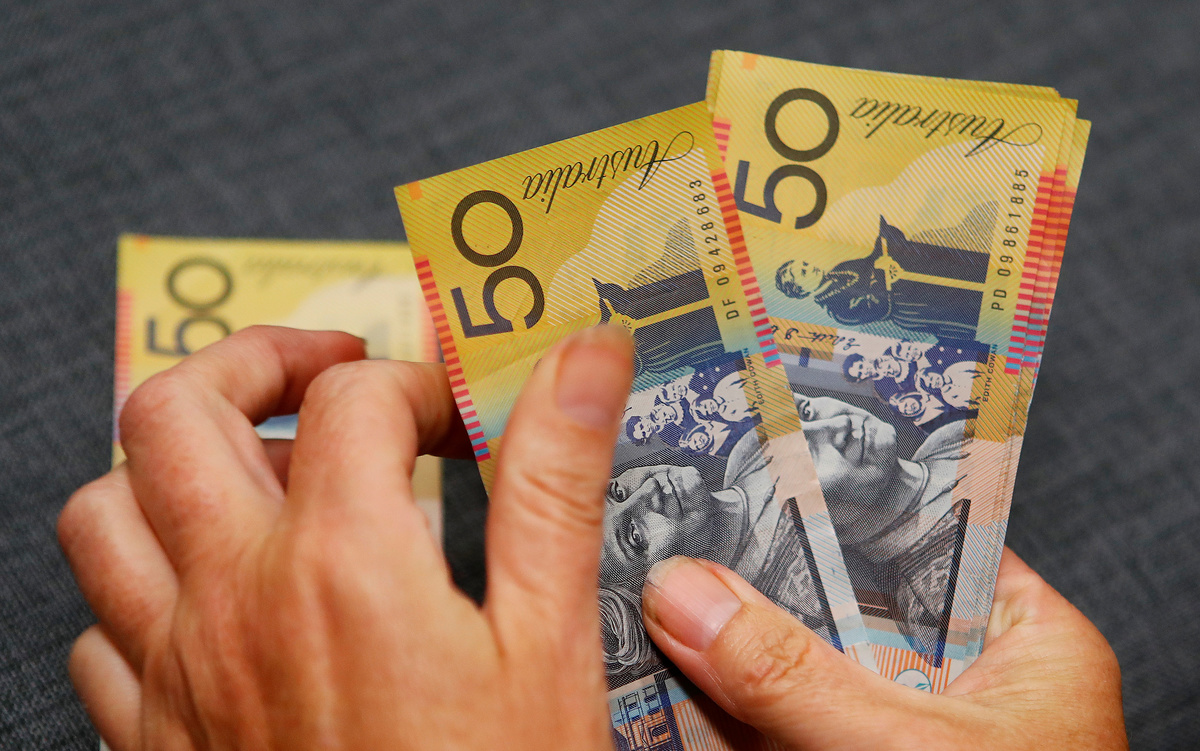
SYDNEY/WELLINGTON (Reuters) - The Australian and New Zealand dollars were under pressure on Monday amid strains in emerging market currencies and the lingering threat of a Sino-U.S. trade war.
The Aussie dollar <AUD=D4> was pinned at $0.7192 after touching a new trough at $0.7165, the lowest since January 2017. Support now lay at $0.7160 and $0.7145, respectively lows from December and May of 2016.
The Aussie shed 1.8 percent last week as currency contagion spread from Turkey to South Africa to Argentina, India and Indonesia, among others.
The Australian and, to a lesser extent, New Zealand dollars are often used as a liquid proxy for trading emerging market and China risk reflecting in part the countries' reliance on resource exports.
Analysts at NAB warned that the Aussie could fall a lot further should U.S. President Donald Trump follow through on a threat to impose tariffs on $200 billion of Chinese imports.
"If Trump goes 'full bore' this month then it is realistic to believe that sub-$0.70 will be seen," they wrote in a note.
"It will determine whether the currency breaks below the mid and end-2016 lows in the $0.7140-60 area and then goes on to test its 2015 and early 2016 lows beneath $0.69, or recovers back toward - but unlikely all the way to - $0.75."
The shift to safe havens was stark on the yen and Swiss franc. The Aussie hit its lowest since early 2016 against the franc <AUDCHF=> having lost 3.3 percent in just one week. It also fell 2 percent on the yen <AUDJPY=> last week.
Adding to the pressure on Monday was a disappointing reading on Australian retail sales, which were flat in July when analysts had looked for a rise of 0.3 percent.
Other data on company profits and wages for the second quarter were more upbeat and underpinned expectations for economic growth of around 0.6-0.7 percent when the full GDP report is released on Wednesday.
The New Zealand dollar <NZD=D4> was on the defensive at $0.6605, having dropped 1 percent last week.
Local data missed forecasts with the country's terms of trade rising 0.6 percent in the second quarter, when analysts had hoped for an increase of around 1 percent.
New Zealand government bonds <0#NZTSY=> gained, sending yields 1 basis points higher at the long end of the curve.
Australian government bond futures remained well bid thanks to safe haven demand and speculation the uncertainty in emerging markets will make the Reserve Bank of Australia (RBA) even more reluctant to raise rates.
The central bank holds its September policy meeting on Tuesday and is considered certain to keep rates at 1.5 percent.
The three-year bond contract <YTTc1> was up 2 ticks at 98.025, while the 10-year contract <YTCc1> rose 1.5 ticks to 97.4950 having hit its highest since July 2017.
(Reporting by Wayne Cole in SYDNEY and Charlotte Greenfield in WELLINGTON; Editing by Darren Schuettler)