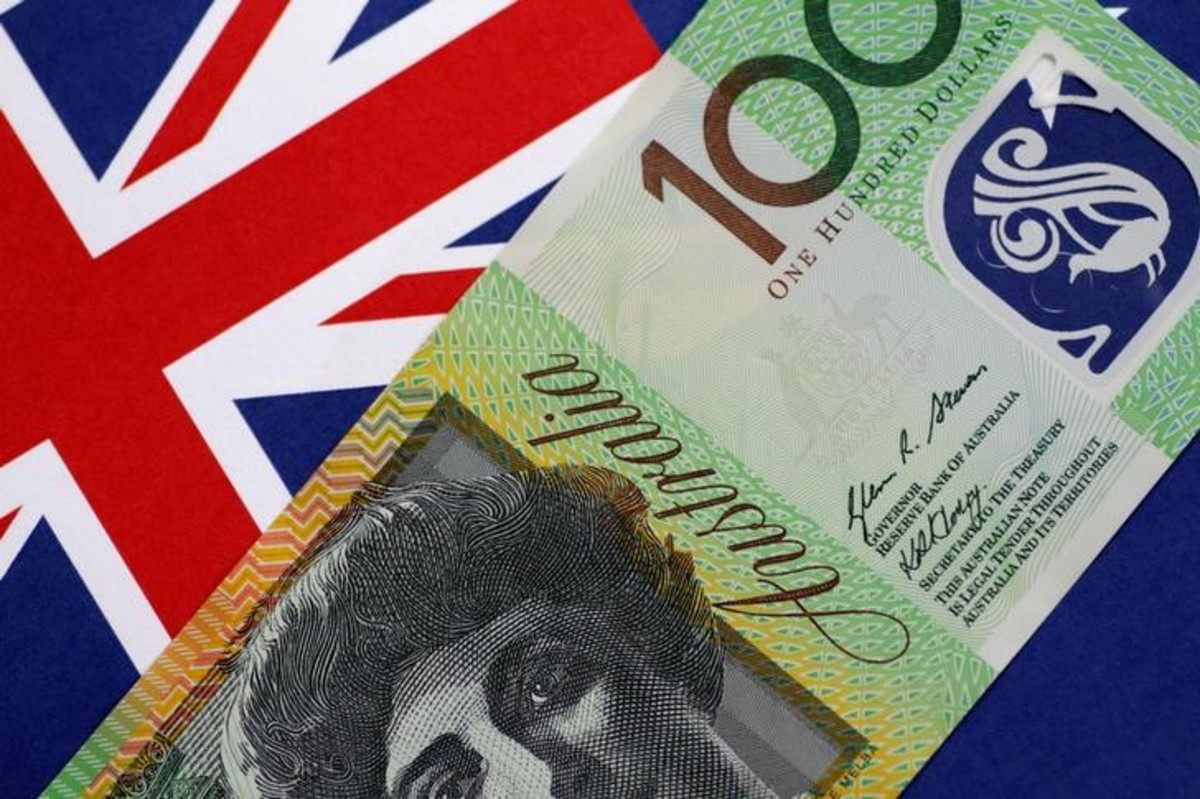
SYDNEY (Reuters) - The Australian dollar slipped to more than 1-1/2-year lows against the euro on Monday as the single currency held firm across the board on an improving political and business outlook in Germany, Europe's biggest economy.
The euro went as high as A$1.5684 <EURAUD=>, a level not seen since February 2016. For the month, the common currency is on track to clock a gain of more than 3 percent, the best since May.
Against the New Zealand dollar, the euro rose to NZ$1.7371 <EURNZD=>, near to last week's top of NZ$1.7408 which was the highest since late 2015.
The German business confidence index compiled by Ifo economic institute hit a record high in November.
The upbeat data was followed by positive developments on the political front after German Chancellor Angela Merkel was handed a political lifeline by the Social Democrats (SDP), after a fourth term for her was plunged into doubt a week ago.
Indicators for all of the eurozone were strong, too.
"Eurozone business conditions PMIs rose further in November and are near as high as they ever get. Consumer sentiment also rose to a 20-year high," said AMP Capital Chief Economist Shane Oliver.
"Very strong business and consumer sentiment point to further growth acceleration. In fact, based on business conditions readings and inflation, the Eurozone is in an even better 'sweet spot' than the United States."
Against the U.S. dollar the Aussie <AUD=D4> was down 0.25 percent at $0.7593, but stayed above a recent five-month trough of $0.7529.
The Aussie rose 0.6 percent last week, though it was on track to end November in the red for its fourth straight monthly loss.
The New Zealand dollar <NZD=D4> was a tad firmer at $0.6857, having bounced from a near 1-1/2 year trough of $0.6781 touched earlier this month.
The kiwi is barely changed in November so far, after posting hefty losses in October.
Overall, the antipodean currencies have lost their appeal as a carry currency in recent weeks, with diverging policy outlooks in the United States and Australia/New Zealand.
The U.S. Federal Reserve is committed to its tightening path, including a rate hike as early as next month, while policymakers in Australia and New Zealand are seen holding rates at record lows for a long time to come.
The U.S. two-year bond yields <US2YT=RR> last week surpassed Australian yields <AU2YT=RR> for the first time since 2000.
New Zealand government bonds <0#NZTSY=> eased, with yields on the long-end up 1-1.5 basis points.
Australian government bond futures were mixed, with the three-year bond contract <YTTc1> flat at 98.070. The 10-year contract <YTCc1> inched 1.5 ticks higher to 97.4650.
(Editing by Kim Coghill)