What we learned, Friday 5 June
We’re going to close the blog now. Before we go, here are today’s big headlines:
-
Barnaby Joyce and a One Nation colleague have struggled to explain the party’s housing policy, with Joyce requesting a second TV appearance to do so and Senator Sean Bell being cut off during what a radio host described as a “trainwreck” interview.
-
Bondi attack hero Ahmed al-Ahmed says he’s “shocked” after being charged with assaulting his father.
-
A police sergeant has avoided jail over the death of 16-year-old Indigenous teenager Jai Wright.
-
More than 100,000 live exotic cockroaches have been seized from a commercial breeder in New South Wales in a record-breaking bust linked to the pet trade.
-
Australia may be in for a slushy snow season, with experts warning climate change and El Niño could make for less snowfall and a shorter season.
Thanks for joining us and see you next time.
WA man charged over allegedly sending racist emails to federal MP
A 70-year-old WA man has been charged with allegedly sending offensive emails to a federal parliamentarian, according to the Australian federal police (AFP).
The AFP began investigating in April after a federal MP’s electorate office received eight allegedly offensive emails containing racist remarks.
Officers executed a search warrant at a home in Yanchep today. The man was arrested and granted bail to appear in the Perth magistrates court on 10 July.
He has been charged with five counts of using a carriage service to menace, harass or cause offence – a charge that carries a maximum penalty of five years in prison.
The AFP acting inspector, Fleur Jennings, said abusive remarks towards elected officials would not be tolerated:
Like all employees in this country, public officials deserve to be able to go to work and conduct their business in a safe environment.
People should not think they can engage in offensive behaviour online and remain anonymous.
Updated
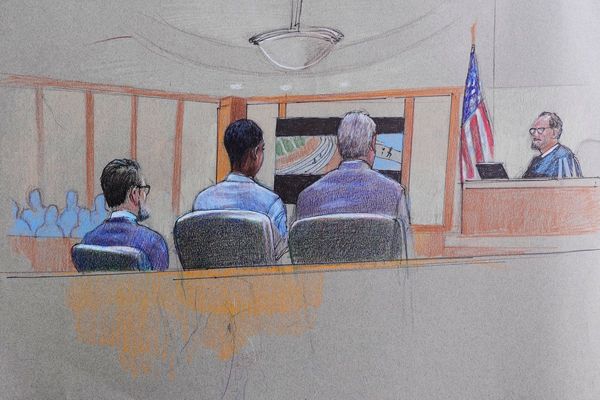
Police sergeant avoids jail over death of 16-year-old Indigenous teenager Jai Wright
A wail rung out through a courtroom as a police officer was sentenced for killing an Indigenous teenager, in a New South Wales first.
Benedict Bryant was found guilty in November of dangerous driving occasioning death after he parked his unmarked car in front of a stolen trail bike ridden by Jai Wright in 2022.
The 16-year-old Bunghutti man was thrown off the bike when he collided with the car, sustaining critical head injuries. He died in hospital the next day.
An emotional cry rang out from the gallery as the officer was sentenced to a two-year intensive corrections order – a term of imprisonment served outside jail.
Read more:
-Australian Associated Press
Updated
Allegra Spender defends decision to vote against government’s tax legislation
Independent MP Allegra Spender has defended her decision to vote against the Albanese government’s tax legislation in the House of Representatives yesterday, pushing back against accusations she has performed an “Olympic-level backflip” on tax reform.
On ABC’s Afternoon Briefing program, the member for Wentworth said she does support narrowing the CGT discount but believes the government’s indexation model is flawed.
Spender dismissed suggestions she had been influenced by her wealthy electorate, arguing she is holding out for a model that supports risk-taking enterprises while using the raised revenue to permanently lower marginal tax rates for workers. She said:
I’ve always wanted to see tax reform, and I commend the government for putting tax reform on the table ... but how you do it matters too …
I don’t think the government’s model has got the balance right. It particularly doesn’t work for really those high innovative businesses that we need to encourage and support. So that’s what I think the government needs to fix, and that’s why I didn’t support the model yesterday.
The MP said she would be open to supporting the upcoming second tranche of the legislation, provided the government commits to “giving tax cuts as part of this model”.
If you really want to help young people, you actually need to lower the tax burden and that means using all the money that you raise as tax cuts for people who are earning.
Updated
Australia urged to step up climate leadership on oceans to fill void left by US
Australia is being urged to use its prominent international climate diplomacy role to show leadership on ocean health and fill a void left by the United States, AAP reports.
Ahead of mid-year climate talks in Germany, oceans expert Terry Garcia said the global community could not count on the US as a reliable partner and leader on ocean and climate policy in the next two and a half years.
“If progress is to be made, others will have to shoulder the burden,” the former senior bureaucrat with the top US climate and weather agency said while delivering the Talbot Oration at the Australian Museum. He said on Thursday in Sydney:
In that regard, Australia and the Asia-Pacific region have the credibility, institutions and scientific capacity this moment urgently requires.
Updated
Tech companies invoke possibility of Trump’s wrath in fight against Labor’s media laws
Tech companies are invoking Australia’s free trade agreement with the US and threats of Trump administration retaliation in an attempt to kill off the federal government’s proposal to force them to pay news companies.
The news media bargaining incentive is designed to force Meta, Google and TikTok to make commercial deals with Australian media outlets or pay a dedicated 2.25% levy on local revenues.
The Albanese government has been consulting on the draft legislation since April, with submissions closing late last month.
Meta, the parent company of Facebook, Instagram and WhatsApp, has argued that the news media bargaining incentive is a “discriminatory tax” that is “poorly designed” and “grossly unfair”.
Read more from Josh Taylor and Amanda Meade here:
A uni professor admitted using AI to write an opinion piece. Here’s what it revealed about trust in the technology
When a university vice-chancellor this week admitted to using AI in writing an opinion piece for a major Australian masthead, but did not disclose that use prior to publication, it highlighted the growing gap between people’s use of AI and trust in the technology.
Data from Roy Morgan this week showed 13.6m or 58% of the population older than 14 now use AI each month, with ChatGPT being the most popular, followed by Google’s Gemini and Microsoft Copilot.
Australians between the ages of 25-34 were most likely to use AI (74%) followed by 35-49 (72%), showing most of the workforce are those who are now using these tools.
Guardian Australia has covered extensively how it is affecting industries across the board – from healthcare to the legal system. As large language models are embedded into products we already use – whether we want it or not – people are going to use them.
Read more:
‘Long shadow’ recalled at ex-governor general Peter Hollingworth’s funeral
The family of a former governor general who resigned over his handling of child sexual abuse in the Anglican church has reflected on the shadow cast over his final years, AAP reports.
Peter Hollingworth served as the Archbishop of Brisbane for more than a decade before being appointed governor general in 2001.
He died after a fall on 19 May, aged 91, and was farewelled at a requiem eucharist at Christ church, in Melbourne’s South Yarra, on Friday.
Appointed governor general by John Howard in 2001, Hollingworth’s tenure was short-lived, as he resigned less than two years into the role amid scrutiny of his handling of child sexual abuse complaints within the Anglican church.
Delivering a eulogy on behalf of the family, Deborah Hollingworth reflected on the “long shadow” overhanging her father’s final years. She said:
He became the public face and lightning rod for the institutional failures to prevent and address child sexual abuse.
He bore that burden heavily, as did we …
He knew that in the public imagination he had come to stand among the bad men, and that knowledge grieved him profoundly.
And yet he understood how it had happened and why.
He also knew that there was a dark shadow over the church that he had served and been committed to.
Updated
Reputational damage cost ANU $100m, interim VC says
Interim vice-chancellor of the ANU, professor Rebekah Brown, says that the reputational damage to ANU over a series of high-profile scandals and governance failures has cost the university $100m.
It comes after several reports into poor culture at the university, allegations of bullying by the former chancellor Julie Bishop, made at a Senate inquiry, and its management of a controversial $250m cost-cutting program.
The later led to the resignation of former vice-chancellor Genevieve Bell, while Bishop separately announced her resignation earlier this year.
Brown tells Senate estimates there’s no doubt that “things are very challenged at the ANU”, particularly the impact on the university’s donor pipeline and the ability to attract international students.
It is very significant, and we are still modelling the impact, the impact is still live. Our modelling from the end of last year ... it’s in the order of $100m.
Updated
Good news for 2SER
Sydney Educational Radio, which is owned by UTS, was struggling to stay afloat beyond July after failing to find a new backer when it was abandoned by its funding partner Macquarie University last year.
The 2SER board now says it has approved a model that will enable the much-loved station, which has fostered dozens of broadcasting careers over decades, to continue operating, albeit with a smaller staff and funding pool.
A transitional director, Tony Duke, has been appointed to conduct an independent review. Prof James Bennett, the dean of the faculty of design and society and a 2SER board member, said: “Feedback and input of station staff, volunteers and the community has been critical in this process.
Read more from the latest Weekly Beast here:
Confidence in ANU governance ‘seriously damaged’, acting chancellor says
The ANU has acknowledged confidence in its governance has been seriously damaged and trust has been lost after a series of scandals at the university, Senate estimates has heard.
The university has been heavily scrutinised over its culture and governance in recent years, including a scathing review by the national audit office that found the ANU council approved a controversial $250m cost-cutting program without “clear evidence” it was needed or urgent.
The acting chancellor, Andrew Metcalfe – a former government department secretary – told estimates:
I want to acknowledge plainly that confidence in the governance of the ANU is seriously damaged in the last few years; staff and students have felt hurt, disillusioned and not valued; trust has been lost and the council has a duty to confront that directly.
Updated
Measles alert issued for Sydney airport and CBD
NSW Health has issued a measles alert after a confirmed case from Queensland visited several locations across the Sydney CBD and Sydney airport while unknowingly infectious.
NSW Health’s director of communicable diseases, Dr Christine Selvey, urged anyone who has been in these areas to monitor closely for symptoms. It can take up to 18 days for them to appear after exposure.
Symptoms to watch out for include fever, sore eyes, runny nose, cough and a red, blotchy rash that spreads from the head and face to the rest of the body.
Selvey said:
If symptoms develop and you’ve been at one of the locations at the time listed on the website, see your doctor or health service, including an emergency department. Call ahead to let them know that you may have come into contact with measles so you don’t spend time in waiting rooms with other patients.
A full list of locations is available on the NSW Health website.
NSW has recorded 49 confirmed cases of measles since 1 January.
If you are experiencing symptoms or have concerns, contact your GP or call Healthdirect on 1800 022 222.
Updated
Entrepreneurs won’t leave Australia over CGT changes, Albanese says
Staying with the PM’s appearance at a Sky News forum, Anthony Albanese has defended key budget measures and not ruled out changes on some contentious proposals.
He said consultation continued on the capital gains tax changes, with discussions ongoing with small businesses, venture capital and startups. The first tranche of budget legislation passed the lower house of parliament yesterday, and will soon go to the Senate. Albanese said the government was still “working that through” on possible changes, saying it would be scrutinised through a Senate inquiry and there would likely be follow-up legislation, which could contain some changes.
Asked if he thought startup companies or entrepreneurs would leave Australia, as some have threatened to do, Albanese replied flatly “no”.
Asked about potential changes to the treatment of family trusts, with Labor planning to change tax settings around some of those arrangements, the PM replied: “We will do nothing that impacts negatively on inheritances.”
Updated
Albanese paints budget as antidote to One Nation ‘grievance politics’
Prime minister Anthony Albanese says Australians may keep shifting to populist alternatives such as One Nation if they feel left out of the economy, arguing the major structural tax changes in the federal budget were needed to rebalance the scales.
Albanese appeared at a Sky News forum in Sydney today, giving a speech and participating in a Q&A. Asked about the One Nation threat, with the rightwing party beating Labor in some opinion polls, he said he was alive to their rise.
If government stands still, the world will go past.
What we’re concerned about is if people think the economy isn’t working for them and they’re working their guts out and they’re not getting opportunity, I tell you what, they will turn to more simplistic, grievance-based politics, and that is the context in which my government’s saying ‘No, no, we’re going to deliver real change for the better’.
Albanese said he wouldn’t criticise people thinking about voting for One Nation, acknowledging “frustration” for many people.
I’m critical of the leaders of that political movement [One Nation], but I’m never critical of voters. Voters are sending a message ... that they don’t think that the economy is working for them, and they don’t want to work for the economy.
Updated
Teen may become first child in Victoria to face trial on terror charge
A teen who allegedly attempted to hijack a plane may become the first child in Victoria to face trial accused of planning a terrorism plot after his matter was uplifted to a higher court, AAP reports.
He was aged 17 when he allegedly carried weapons, including a shotgun, knives and a fake bomb, onto a Jetstar flight bound for Sydney in March 2025.
As the aircraft was in its final stages of boarding at Melbourne’s Avalon airport, with 173 passengers onboard and six crew members, he walked up the plane’s front stairs, a children’s court was told on Friday.
The teen, who cannot be named for legal reasons, allegedly told the crew he had a bomb and demanded access to the cockpit before it is claimed he began to assemble a shotgun, but was restrained before he could get any further.
Defence lawyers argued the teen’s case should remain in the children’s court as sentencing there would be adequate because of his mental health conditions, youth and lack of priors.
However, prosecutors claimed exceptional circumstances existed which warranted the matter to be uplifted to the county or supreme court, which a magistrate agreed with on Friday.
He is the first child to have terrorism offences uplifted to a higher Victorian court, and the first accused of preparing for and possessing items connected to planned terrorism, the magistrate said.
The teen, now aged 19, remains in custody and will return to a children’s court for a committal mention on June 19.
Updated
‘That’s a bad combination’: why Australia may be in for a slushy snow season
There was optimism across Australian alpine resorts this week as their social media channels filled with footage of snow flurries that arrived just in time for the opening of the ski season this weekend.
“We couldn’t be more excited,” said the Instagram account of Perisher, the southern hemisphere’s biggest ski resort, in Kosciuszko national park in New South Wales, as hands swept the fresh snow from outdoor tables.
While the spectacular wintry scenes will bring enthusiasm, the outlook for the rest of the winter – and the coming decades – is not quite so positive.
With an El Niño looking likely to form in the coming weeks, the odds are stacked in favour of drier and warmer conditions though winter and spring.
Read more:
Asic launches investigation into KPMG
The corporate regulator has launched a formal investigation into KPMG amid whistleblower claims the firm improperly used confidential information from a client to win other work.
The Australian Securities and Investments Commission chair, Sarah Court, told Senate estimates today that the regulator was “trying to get to the bottom of the evidence”.
Court said: “We’ve now commenced a formal investigation this week in relation to KPMG and a number of the registered company auditors that sit within it.”
“I can assure you that Asic has been engaging proactively with KPMG and that level of engagement has intensified.”
KPMG’s Australian chief, Andrew Yates, stepped down last week after taking responsibility for the consultancy firm’s failure to properly respond to whistleblower allegations around the misuse of client information.
It is alleged KPMG improperly used confidential information from its client Lendlease to win audit work with other firms.
The allegations were first revealed by Senator Deborah O’Neill under parliamentary privilege in a speech to the Senate in March.
Asic, and many other agencies and state and federal government departments, use KPMG services.
KPMG has been contacted for comment.
Updated
Teen showed no radicalisation before police HQ terror attack, coroner finds
A teenager showed no signs of radicalisation before carrying out a religiously motivated killing outside police headquarters, a coroner has found.
NSW Police civilian employee Curtis Cheng was gunned down in October 2015 while leaving work by 15-year-old Farhad Khalil Mohammad Jabar in an act of religious extremism.
Farhad was then killed by a special constable after he fired more shots at the police headquarters.
Despite his association with persons of interest to terror investigators in the months leading up to the shooting, there was no evidence Farhad held violent extremist beliefs before the attack, deputy state coroner Derek Lee found on Friday.
Police found material on the Year 10 student’s phone linked to Islamic State but Farhad had only accessed much of the material in the month leading up to the shooting, Lee said.
He noted evidence from teachers and classmates, who said Farhad was a very religious and hard-working boy at school but did not attempt to impose his beliefs on others.
The coroner said:
He regularly attended Parramatta mosque ... and had considerable knowledge of the Qur’an.
He did not involve himself in any conflicts.”
-Australian Associated Press
Updated
Listen: The case for Aukus, with defence industry minister Pat Conroy
The Albanese government’s announcement that Australia will now receive three used US Virginia-class submarines, rather than two used and one new, has put the spotlight back on the Aukus commitment.
One of the strongest advocates for the $368bn agreement is defence industry minister Pat Conroy and he hits back at its critics – including the Labor MP Ed Husic.
Speaking with political editor Tom McIlroy, the minister for Pacific island affairs also discusses this week’s visit by new Solomon Islands prime minister Matthew Wale and responds to speculation that Tony Abbott could run as the Liberal candidate in Conroy’s seat of Shortland at the next election.
Listen to the latest episode of our Australian Politics podcast for more:
Updated
Stark warning on future of Australian children’s TV
Australia’s once-thriving children’s television industry is facing collapse despite a legacy of producing Hollywood stars and shaping generations of young people.
RMIT University research published on Friday reveals the industry remains under pressure due to a significant drop in investment paired with rising production costs.
The sector has helped shape culture for decades through programs such as H2O: Just Add Water, Round the Twist, Blinky Bill, and more recently Bluey, launched in 2018.
Lead author Jessica Balanzategui believes screen policy settings are failing to support the local stories young audiences need.
Commercial broadcasters have retreated, streamers are not commissioning new children’s programs, and public institutions are being left to carry an increasingly heavy load.
The report reveals there has been a 97% drop in commercial children’s television investment since a 2020 decision to remove commercial quotas.
Production costs are also leading to significant strain, with the average cost of producing live-action children’s drama tripling over five years to $2.82m an hour, while the volume of new first-release programming has fallen.
- Australian Associated Press
Updated
With that, I will pass you into the safe hands of Ima Caldwell.
NSW to spend $192.5m over three years to protect and restore state’s ecosystems
The New South Wales government will increase its annual funding for the protection and restoration of the state’s imperilled ecosystems by $50m a year – a fourfold increase and a rare win for an environment budget.
The government will spend $195.2m – $65m a year – over three years on the state’s Saving our Species program. Funding for the program had been due to expire this year and was previously set at $15m per year. The government says the boost will fund ecosystem-wide actions to help not just individual species but also the habitats and natural systems they depend on.
The Minns government has committed a further $26m for delivery of its nature strategy, which will set targets for nature recovery across NSW.
Environment minister Penny Sharpe said:
There’s no point protecting a regent honeyeater unless you’re also protecting the woodland it lives in, and that’s exactly what our plan does. This investment marks a new era for conservation in NSW. For the first time, we are taking a holistic approach by protecting entire ecosystems, not just individual species.
Greens environment spokesperson, Sue Higginson, said the increase was “a very welcomed announcement, and direct investment in frontline services and boots on the ground at a landscape scale is a move that has been called on for decades”.
She said more ambition was still needed to address the state’s extinction crisis, including work to “fix the failed biodiversity offsets system, fix our land clearing laws, end native forest logging, and expand our national park system to 30% of land and water by 2030”.
Updated
Queensland’s crime and corruption commission to investigate police financial mismanagement allegations
A damning report on Queensland police finances has been referred to the state crime and corruption commission by the police commissioner. The inquiry was tabled in parliament yesterday.
Police minister Dan Purdie said on Thursday that it revealed “shocking instances of financial mismanagement and governance failures in the Queensland Police Service” under the former Labor government:
The executive level team (of the Queensland police) at that time were focused on other things and not on supporting the front line … The report is a bombshell review, and it is damning, and it exposed the extent of the former Labor government’s financial maladministration of the Queensland Police Service.
With a series of systemic issues identified, which would have led to an estimated $400m deficit if left unchecked by the end of this financial year, which has led to the referrals to the crime and corruption commission.
The report found that as many as 600 unsworn civilian positions had been created without a budget, by using unallocated funding for sworn officers, and that its board of management was likely not aware they existed. It recommends substantial funding cuts and a reallocation of about 40% of its sworn “non-operational” positions to the frontline in the next 18 months, representing about 280 officers.
“Matters raised in the review have the potential to impact public confidence and trust in our administration practices, and as such, aspects of the review have now been referred to the crime and corruption commission,” commissioner Brett Pointing said on Thursday.
Senior police refused to give details of the referral on the basis that doing so might prejudice a potential investigation. Pointing said he made the CCC referral himself.
Updated
New South Wales bans Nazi chants and slogans
Laws providing police and courts additional powers to crack down on extremism, including banning Nazi chants or slogans, have passed parliament in New South Wales (NSW).
The bill amends the Crimes Act to ban conduct which invokes imagery or characteristics associated with nazism, with proponents up for a year’s imprisonment or $11,000 fine.
Committing the offence near a synagogue, Jewish school or the Sydney Jewish Museum carries a maximum penalty of two years’ imprisonment or a $22,000 fine. The state will also allow police to require a person they believe is committing any offence at a public assembly to remove their face covering.
Attorney general Michael Daley said:
These reforms give our law enforcement and courts greater powers to crack down on extremists who promote abhorrent Nazi chants and slogans.
These views are unacceptable and have no place in NSW and we are holding those who espouse them to account.
Updated
NDIA spent $170m in three years on legal fees fighting participants
The government has spent $66m this financial year to fight NDIS participants appealing decisions about their packages, up from $60m the previous year and $44m the year before that, Senate estimates has heard.
Asked how many cases were submitted to the ART, NDIA deputy CEO Matthew Swainson said:
So, in the 25-26 year to date, that’s to the end of March, we had 6,998 matters received. In the 24-25 financial year, we had 7,137. In 23-24, we have 4,044 new cases received.
We resolved 1,979 applications in the last quarter. 96.9% of those were resolved prior to a hearing.
There will be a more detailed breakdown of the legal costs after lunch.
Updated
Alrighty, Caitlin Cassidy is going to take the blog over for an hour, then it’ll be Ima Caldwell with the goods.
Updated
More than 100,000 cockroaches worth $200,000 seized from NSW breeder in record-breaking bust
I feel terrible sharing this story, but my colleague Lisa Cox has a doozy:
More than 100,000 live, exotic cockroaches have been seized from a commercial breeder in New South Wales in a record-breaking bust linked to the pet trade.
Biosecurity officials seized the animals, which have a commercial value of up to $200,000, from a commercial breeder in Bathurst in the state’s central west this week.
The captured cockroaches included dubia cockroaches and Madagascar hissing cockroaches – one of the world’s largest cockroach species.
Read more, if you dare:
Updated
Back to the NDIS discussions …
First assistant secretary leading the NDIS sustainability taskforce, Anthea Long, has been answering questions from David Pocock about community supports.
Pocock starts by quoting a spokesperson for the minister, who said some participants don’t use the full funding allocation for community support.
But quarterly reporting shows 86% of the plans are used. Under the changes, there will be a 50% reduction in community support budgets.
The NDIS says they did not desegregate it to a level to show the impact on cohorts of partisans with different disabilities. Analysis shows these cuts will impact people with Down syndrome the most.
Long:
Utilisation rates do vary. We had to make a range of assumptions as to what that would look like across the board. On average, we’ve assumed that there would be a reduction of 24.7% in [social, economic and community participation].
The department said the average SECP funding for someone with Down syndrome was $28,900.
McAlister said SECP was one of the fastest-growing parts of the scheme:
We don’t take this decision lightly. We understand the impacts on participants. But we assess the rate of growth … being at a scale of more than $100bn a year by the next decade … would not be considered reasonable by the community.
The separate issue we also seek to address we have some concerns about the quality and value proposition of some of the models of support.
Updated
Jordon Steele-John points out only $5bn of the $38.7bn to be cut from NDIS will come from fraud
The Senate community affairs legislation committee’s discussion on the NDIS has been tense this morning.
Greens senator Jordon Steele-John has kicked off the session by asking questions around how much of the NDIS cuts will come from fraud and how much will come from people’s plans.
Steele-John says he has crunched the numbers himself. He says of the $38.7bn to be cut from the scheme over the forward estimates, less than $5bn will come from anti-fraud measures.
There’s been a long back and forth between him and NDIS minister Jenny McAllister. In response, she said it’s not correct “to assert” the package doesn’t tackle fraud.
Senator Steele-John, the evidence is that tackling fraud doesn’t deliver fiscal savings. As I’ve said a number of times, the savings go to the participants, not the government, which is why you don’t see those numbers in the budget.
I have indicated the scale of investments to make sure the NDIA and comission have the resources to tackle fraud.
We’ve been clear with the community … the reforms do work to tackle sustainability and cost growth.
After almost an hour on this, we are moving on. The Fraud Fusion Taskforce, which actually has the numbers and more information, will be up later.
Updated
Ahmed al-Ahmed denies allegations of assaulting his father and says situation ‘shocking’
Ahmed al-Ahmed, the man who disarmed one of the Bondi terror attackers, said he is shocked and disappointed after being charged with assaulting his father.
Ahmed, 44, is accused of allegedly putting his father in a headlock in March at a house in Bankstown in Sydney’s west. He was charged on Wednesday with common assault and “stalk or intimidate”, New South Wales police confirmed.
Speaking to 2GB’s Ben Fordham this morning, Ahmed said the situation had caused him deep anxiety:
Honestly, I’m disappointed. And my anxiety and this situation cause for me stress and put me in the anxiety, deep, deep.
Ahmed said he was “shocked” by the situation, calling it “untrue”. He said his situation with his family had been complicated by the $2.6m donated via GoFundMe after the Bondi shootings.
He is due to appear in court on 29 July.
Updated
Senate committee discussing NDIS today
Today will be a big day in the Senate community affairs legislation committee – they are discussing the NDIS.
The minister for NDIS, Jenny McAllister, has kicked off with a long statement about the changes. It was a reasonably lengthy statement for the start of estimates, so just in part, she said:
At the outset, I want to establish that the Albanese government remains committed to the long-term sustainability of the NDIS and ensuring that it continues to provide life-changing supports for people with permanent and significant disability.
I want to acknowledge that periods of reform and change can be stressful for community and the prevalence of misinformation has exacerbated some of those concerns.
On fraud:
Our position is that those who defraud the NDIS are stealing from the hundreds and thousands of Australians who rely on life-changing supports that the NDIS delivers. Our government is tackling fraud because it is the right thing to do.
On new NDIS assessments:
Many of these reforms are grounded in the observations and the recommendations of the NDIS review, which engaged in extensive consultation with people with disability, their families, carers, advocates and disability representative organisations, providers and support workers.
Updated
Assistant treasurer disputes Coalition suggestion tax reforms being rushed through
The assistant treasurer has denied tax-reform measures are being rushed through parliament despite just two days being set aside for an inquiry into the “once-in-a-generation” changes, AAP report.
Changes limiting negative gearing to new houses from July 2027 and scrapping the 50% capital gains tax discount to a rate based on inflation passed the House of Representatives on Thursday.
A two-day Senate inquiry will scrutinise the laws later in June before they go to the upper house, with the opposition and crossbenchers saying the measures are being rushed.
The assistant treasurer, Daniel Mulino, said the laws were not being raced through as issues surrounding tax and housing had been on the agenda for a long period, alongside 17 hours of debate in parliament so far.
“It is one of the most exhaustive discussions I’ve seen in the parliament,” he told ABC Radio on Friday.
It was in that broader context that the budget was framed and so there has been a long-running discussion around these kind of issues, and in fact, a lot of the issues dealt with in the budget have been looked at in previous tax inquiries.
Read more here:
Updated
Barnaby Joyce calls Sky News after interview to clarify One Nation’s housing policy
One Nation senator Barnaby Joyce retreated from suggestions the party would force permanent residents to sell their homes under tough new housing policies should they be elevated to leadership.
Joyce spoke to Sky News on Thursday night about the party’s housing policies after the One Nation leader, Pauline Hanson, said foreign ownership of housing would be stopped “indefinitely”. Joyce initially told Sky that permanent residents ensnared in those policies would need to commit themselves “totally” to Australia and become citizens or risk losing their homes.
But he later called back into Sky to clarify that “on further investigation and discussion no, we are not going to be kicking permanent residents out of their house”.
Hanson herself took to social media on Friday to clarify One Nation’s stance, saying while Australians should be prioritised for housing and the party made no apologies for that, permanent residents would be excluded from the tough plans. She wrote:
Permanent residents have been accepted to settle in Australia permanently. They live here, work here, pay taxes here and build their lives here. Many are on the path to citizenship. One Nation’s policy does not require them to sell their homes.
Hanson maintained that foreign owners, meaning temporary visa holders and foreign citizens living in other countries, would be given two years to sell their Australian properties under One Nation policies.
Updated
Queensland parliament passes watered down e-mobility legislation
Queensland parliament has passed a watered-down version of legislation cracking down on ebike and e-scooter users.
The transport minister, Brent Mickelberg, had intended to ban ebike use for all under-16-year-old riders, much of the disability community, require riders to have a driving licence and set a 10km/h speed limit. He amended it this week after a backlash and thousands of submissions to its parliamentary inquiry.
“This bill gives police the powers they need to take dangerous, high-powered and illegal devices off the streets while backing in Queenslanders who choose to do the right thing,” he said, in parliament on Thursday night as the law was passed.
“Police will be empowered to seize and destroy dangerous, illegal devices, and path speed limits will be introduced alongside penalties for careless riding around pedestrians”.
The new law also gives police the power to crush illegal e-vehicles and makes parents legally responsible for the behaviour of their children, if they ride an illegal device in public.
Bicycle Queensland CEO Prof Matt Burke said the legislation would do little to get illegal e-motorbikes off Queensland footpaths, but would unreasonably restrict the safe use of legal ebikes.
He said the law would mean “thousands and thousands and thousands” of children who ride from school would be banned from doing so, forcing their parents to “change their entire daily life to now go back to driving those kids to school”. It would increase the road toll, because cars are more dangerous than ebikes, he said.
The RACQ head of public policy told the ABC on Friday morning the legislation was a distraction from dealing with genuine threats on the roads. He said targeting legal ebikes was a “waste of everyone’s time and effort”.
Queensland recorded a 16-year high road toll last year, and the rate is 21.2% higher this year, according to the latest update from the Department for Transport and Main Roads. Almost all of the 306 road deaths last year, including the only fatality involving an ebike, were caused by cars, trucks and motorbikes. She was a pensioner riding in an unprotected bike lane on Bribie Island.
All non-government MPs voted against the laws. They will take effect on 1 July.
Updated
Victorian opposition says donation laws ‘shameful’
Following the passage of the bill, Victoria’s shadow attorney general, James Newbury, claimed it was a “shameful attempt by Labor to rig the system in their own favour”. He said:
These dodgy new laws shut off money from Labor’s political opponents whilst continuing the rivers of gold from the CFMEU and the unions to the Labor party.
The Allan Labor government is end of days and have done a deal with the crossbench to benefit themselves as they desperately try to cling to power.
The Liberals and Nationals do not support these rigged laws and are considering our legal position.
Updated
Victoria’s replacement political donation laws pass parliament
Victoria has donation laws once more, following the passing of a bill during a marathon 20-hour sitting of parliament that only wrapped up at 5.30am this morning.
Since the high court struck down the state’s donation laws in April, removing the previous cap of $4,970 over a four-year term, there have been no limits or disclosure requirements for political donations.
The premier, Jacinta Allan, fast-tracked legislation through parliament this week to stop “big money” from dictating the November state election.
Under the electoral further amendment bill 2026 – which passed parliament with the support of the Greens and other crossbenchers – political donations will be capped at $7,500 per donor over four years. New candidates and parties can receive $15,000. All foreign donations will be banned, and donations above $1,250 must be disclosed in real time.
The major parties (Labor, the Liberals and the Nationals) will no longer have access to their “nominated entity” – legacy investment funds they could previously draw from outside the donation caps. The bill has instead increased administrative funding for MPs.
However, the Labor party will still receive union affiliation fees – which cannot be used for campaigning – angering the Coalition.
Updated
‘I don’t think that women should automatically not be believed,’ Hume says
Hume was asked on RN about comments made by the foreign affairs minister, Penny Wong, yesterday in relation to a cohort of Australians who allege they were beaten and sexually assaulted by Israeli forces after being detained as part of the latest Global Sumud Flotilla.
Wong told Senate estimates:
My principal position is to always believe women when allegations of sexual assault are made.
Hume was asked on RN if women should always be believed, and if she shared Wong’s view. The deputy opposition leader responded:
I don’t think that women should automatically not be believed.
I mean, certainly if an allegation is made, it should be taken very seriously. And it doesn’t matter what the circumstance is. And I think all fair-minded Australians believe that.
Read more here:
Updated
Jane Hume says Labor being ‘sneaky’ on tax changes
Jane Hume, the deputy opposition leader, accused the government of being “sneaky”, saying discussions around tax reforms in parliament were much too short to properly address so-called “generational” tax reforms.
“What the government has done is essentially prevented scrutiny of the changes that this legislation is going to inflict on the Australian economy,” Hume told RN Breakfast. She went on:
Apparently, these are generational reforms. If they’re generational reforms, well, surely they should have been taken to an election so that the Australian people could decide that.
Two days simply is not enough. There is no need to rush these changes through because they don’t kick in until 2028.
Read more about jostling with the Greens and the Coalition here:
Updated
NSW officially abolishes ‘good character’ references from being considered at sentencing hearings
NSW has officially abolished the use of “good character” references when it comes to sentencing for all offences, the first such change in the nation.
The new legislation passed in legislative council on Thursday night, and will apply for all offences, including homicide, domestic violence and road crimes. It means convicted offenders will no longer be able to argue their sentences should be mitigated because they are of otherwise “good character”.
The NSW attorney general, Michael Daley, said in a statement:
Victim-survivors and their loved ones will no longer be forced to sit in court and hear the person convicted of a heinous crime be described as an otherwise good person.
While I’m glad we’re finally here, it should not have taken so long for the Liberals and Nationals to listen to victim-survivors and their advocates and drop their opposition to these reforms.
Harrison James, the cofounder of the group Your Reference A’int Relevant, said:
This win belongs to every survivor in this country. … That is hard-won dignity.
But I’m not done. Every survivor in every corner of this country deserves the same protection, and I will fight until every jurisdiction reflects that. NSW was first. The rest will follow.
Read more about the changes here:
Updated
John Howard among signatories of open letter calling for stronger gambling reforms
Former prime minister John Howard and a cohort of other current and former lawmakers signed an open letter urging the Albanese government to take stronger action on the gambling industry.
The letter was published today as an ad in the Sydney Morning Herald and the Age, urging the prime minister to establish “long-overdue reforms to reduce gambling harm”.
The letter reads:
Your proposed reforms do not go far enough. They leave too many loopholes and fail to properly protect families from an industry that profits from addiction. …
This is not good enough … We support stronger national action, including consideration of a national regulator, so gambling harm is addressed consistently across the country.
Signatories include Andrew Hastie, senator Maria Kovacic and former Liberal premiers Jeff Kennett and Nick Greiner.
You can read the full letter here.
Updated
Senate committee hears of transition to SmartCard
The Senate community affairs legislation committee discussed the government’s controversial income management system at estimates last night.
Social services officials revealed that since September 2023, 17,014 people have been placed on the newer SmartCard, which can be used on the visa network. The BasicsCard, which is being phased out and can only be used at government-approved merchants, is also still being used.
Estimates heard 81% of participants on the government’s income management are Aboriginal and/or Torres Strait islander, with that number jumping to 84% in the Northern Territory.
Participants on the BasicsCard have had the opportunity to transition across the cards, but the department said some had not taken that up.
In 2024, a Labor-led inquiry into compulsory income management recommended the government abolish the scheme after receiving a large amount of evidence showing the compulsory SmartCard increases hardship, makes it difficult for women to flee violent relationships and is discriminatory towards First Nations people.
Updated
Labor’s help to buy shared equity scheme approves 2,589 applicants in five months
Housing Australia officials have revealed 2,589 applications had been approved under Labor’s Help to Buy scheme.
Alia Ayoub, executive leader of the Help to Buy scheme, told Senate estimates it had received 5,323 applications from 5 December 2025 to 30 April 2026, of which 2,589 applications had “found a home”.
Senator Andrew Bragg asked why the scheme was marked a “risk” in its portfolio budget statement, to which Ayoub said:
We had a forecast that we would do 10,000 applications in a year. However, the scheme started on the 5th of December. Had it been running for the full year, it would receive the 10,000.
Ben Rimmer, director general of Treasury’s housing group, said the operating cost of the scheme was $21m over the forward estimates, while the money spent on buying stakes in homes was nearly $1.6bn this year and $6.9bn over the forward estimates. Rimmer said of the latter figure:
We don’t know whether that will be a cost or a benefit to the balance sheet of the commonwealth at this point. If house prices continue to grow gradually over time, it will actually benefit the commonwealth.
We reported earlier that more than 312,000 people have benefited from the government’s 5% first home buyer guarantee scheme, including 251,000 under Labor since 2022. About 51,000 of those who accessed it were permanent residents.
Updated
Some NSW pharmacists can now prescribe contraceptive pill
Women waiting weeks and months in regional areas to get a doctor’s appointment for a prescription for the pill can now head to their local pharmacy, AAP reports.
NSW is the latest state to expand access to contraception beyond the GP’s office after Victoria, Queensland and Tasmania enacted similar changes.
Karen Carter, who has almost 35 years’ experience, is one of 30 pharmacists who, from Friday, can prescribe and supply the oral contraceptive pill to low-risk women between the ages of 18 and 39.
“It’s going to be great for those women who want to talk about contraception, but sometimes their shifts may not allow all of them to be able to attend a doctor’s surgery,” she told AAP.
“This just gives women an option.”
Carter completed a 12-month course offered through NSW Health to allow for first-time prescriptions.
It is part of a state initiative to expand the treatment services available in pharmacies, including for uncomplicated urinary tract infections and common skin conditions.
Updated
Good morning, Nick Visser here to take over from Martin Farrer. Let’s see what Friday holds.
Homelessness up 75% in NSW in past six years, report shows
Homelessness is soaring in regional areas as advocates plead for more funding to stop simply shifting the problem and start solving it, Australian Associated Press reports.
The number of people sleeping rough in New South Wales has increased 75% in six years, according to a Homelessness NSW report that relies on the state’s street count data.
While the count in metropolitan Sydney is virtually unchanged between 2020 and 2026, it has surged 689% in the Illawarra Shoalhaven and southern NSW district, from 27 people to 213.
The district encompassing NSW’s northern region and mid-north coast has also sky-rocketed from 407 people in 2020 to 1024 in 2026, leading it to become the state’s leading area for homelessness.
Homelessness CEO Dominique Rowe said state government funding for support services needed a 50% boost, along with a commitment to build 10,000 social homes a year until they constitute 10% of all housing.
“Homelessness services have a situation where 92% of people coming through their doors are not getting the assistance they need,” she told AAP.
Updated
Labor MP claims government has ‘won the debate’ on housing tax changes
A Labor MP has declared victory in the debate over the government’s tax reforms, engaging in a bit of meta-commentary at the end of parliament’s sitting fortnight.
Julian Hill made the comments on the ABC’s Afternoon Briefing on Thursday.
Hill said:
I believe the government’s won the debate on negative gearing. I believe we’ve won the debate on capital gains tax on property.
And we’re winning the debate, we got a way to go, on removing the distortion that would otherwise be there. … I think we’re winning the debate … Start ups and so on, we are still engaging on.
But I absolutely believe we’ve won the argument about property and giving young Australians a fair crack at the housing market.
Welcome
Good morning and welcome to our live news blog. I’m Martin Farrer with the top overnight stories and then it’ll be Nick Visser with the main action.
After a week in which Labor’s tax reforms came under a lot of scrutiny, the MP Julian Hill told the ABC that he thinks the government is winning the argument for giving young people a chance at the housing market.
And the number of people sleeping rough in New South Wales has increased 75% in six years, according to a Homelessness NSW report that relies on the state’s street count data.