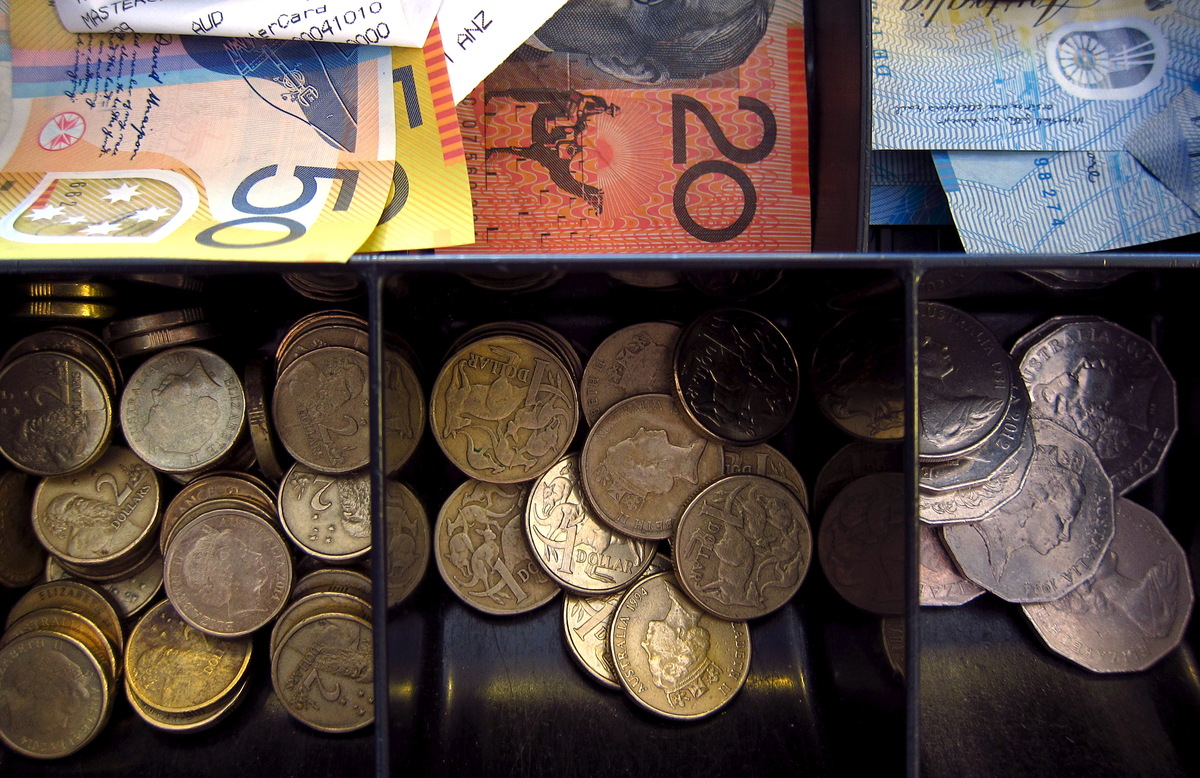
The Australian and New Zealand dollars tried to steady on Wednesday after a run of wild sessions, though markets were having fresh doubts about whether touted policy stimulus globally would really offset the drag from the coronavirus.
The Aussie was hanging on at $0.6509 <AUD=D3>, having briefly touched an 11-year trough of $0.6312 early in the week when financial markets were crashing around the globe.
A rebound in stocks had then helped it as high as $0.6686, but the gains could not be sustained as investors started second guessing the effectiveness of the policy response.
The kiwi hovered at $0.6285 <NZD=D3>, having been as low as $0.6008 and as high as $0.6448 just this week.
Much of the market attention was on Washington where White House talk of a rapid fiscal package was running into a political roadblock.
"The risk rally was built around hopes for a more proactive fiscal response, but is unlikely to be sustained, once we get more details of the plans," said Alan Ruskin, head of G10 forex strategy at Deutsche Bank.
"Historically there are good reasons why policymakers first turn to the central banks and monetary policy ahead of fiscal actions," he added. "The latter often require long lags to enact and in 2020 are bound to get caught up in electoral politics."
In Australia, the government was set to unveil its fiscal package on Thursday aimed at supporting businesses and jobs, though it was not likely to include a direct handout to consumers that could immediately support demand.
A survey of consumers on Wednesday showed sentiment had slid to its lowest in five years as the virus undermined the near-term outlook for the economy, though the longer-term outlook proved more resilient.
Reserve Bank of Australia (RBA) Deputy Governor Guy Debelle used a speech to argue that monetary policy still worked and the combination of lower rates and fiscal action would help support the economy.
"This confirms our view that another rate cut is imminent at the April Board meeting, and quantitative easing will follow," said Gareth Aird, a senior economist at CBA.
"We expect a 25 basis point cut to the cash rate in April which means that QE, in the form of yield curve targeting, might arrive as early as May."
The market currently implies a 74% chance <0#YIB:> of a cut next month, rising to 100% by May.
Australian bonds have been rallying hard in anticipation, though not as hard as those in the United States where the Federal Reserve has a lot more room to cut rates.
Indeed, U.S. 10-year yields <US10YT=RR> have fallen below those in Australia <AU10YT=RR> for the first time since early 2018. A month ago U.S. yields had been 55 basis points higher.
On Wednesday, three-year bond futures <YTTc1> were up 7 ticks at 99.585, while the 10-year contract <YTCc1> rose 8.5 ticks to 99.2975.
(Editing by Jacqueline Wong)