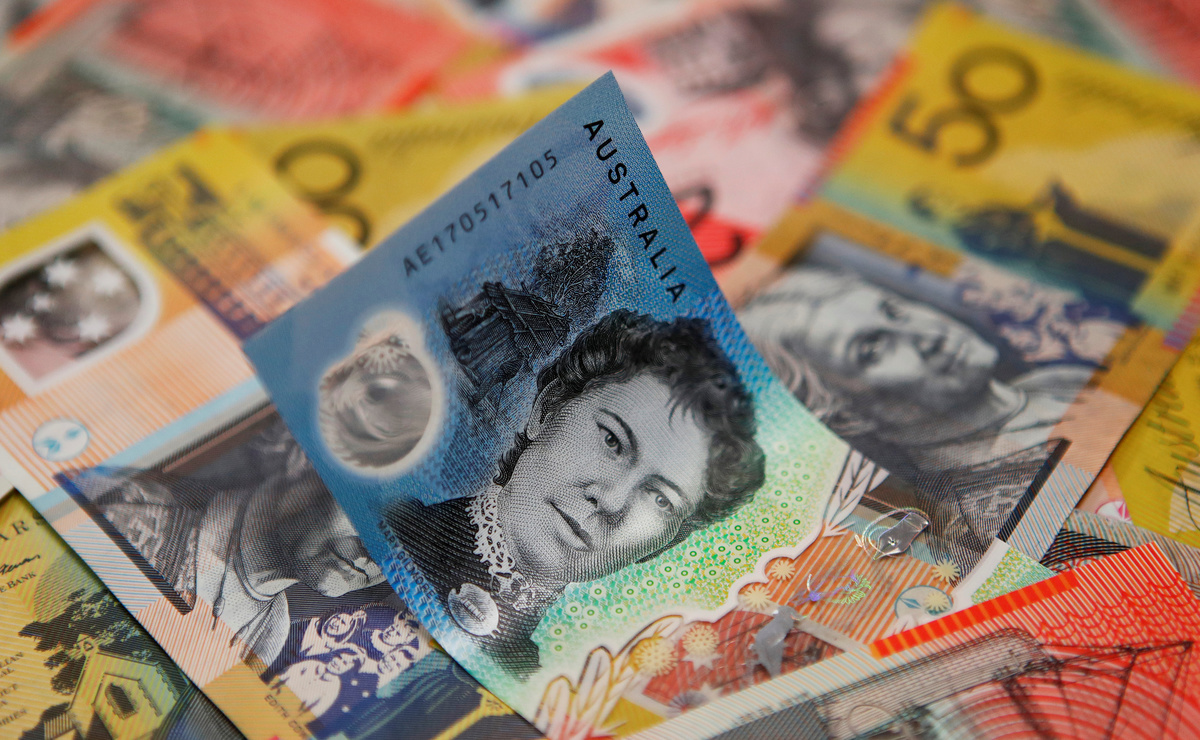
SYDNEY (Reuters) - The Australian and New Zealand dollars were stuck in a rut on Wednesday as the Sino-U.S. trade dispute dragged on with little sign of resolution, though the endless uncertainty did play well for safe-haven bonds.
The outlook for a trade truce was not helped on Wednesday when Beijing condemned a U.S. Senate measure aimed at protecting human rights in Hong Kong, vowing to take the steps necessary to safeguard its sovereignty and security.
The Aussie eased back a touch to $0.6816 <AUD=D3>, but stayed clear of the $0.6785 low touched on Tuesday when minutes of the Reserve Bank of Australia's (RBA) last policy meeting showed it had actively considered a rate cut.
The kiwi dollar <NZD=D3> steadied at $0.6428, having gained 0.5% overnight, and faced stiff chart resistance at the recent top of $0.6466.
There was more action in bond markets where yields on Australian 10-year debt <AU10YT=RR> fell to their lowest in three weeks at 1.085%.
Yields have now dropped 26 basis points in just eight sessions, a sizable rally that suggests investors are again becoming concerned about the growth outlook both at home and abroad.
It was a surprise to many that the RBA Board had seen a case for easing earlier this month, and only held off to gauge the impact of the previous three cuts.
That led markets <0#YIB:> to price in a 26% chance of a move in December, rising to almost 100% by May next year.
Simona Gambarini, a market economist at Capital Economics, argues the RBA will go even further and cut to 0.25% by mid-2020 and ultimately resort to quantitative easing.
"Our best guess is that the RBA will buy roughly A$60 billion of Australia's government debt per year, or about 10% of the outstanding amount," she wrote in a note.
"With this in mind, we think that the outlook for government bonds is more positive in Australia than in the U.S."
Indeed, Capital believes yields on local 10-year bonds could fall as far as 0.50% by end-2020, whereas the comparable U.S. yield would stay around 2.0% for the next couple of years.
On Wednesday, the three-year Australian bond future <YTTc1> was up 1 tick at 90.289, while the 10-year contract <YTCc1> rose 3.5 ticks to 98.9050 and flattened the yield curve.
(Editing by Jacqueline Wong)