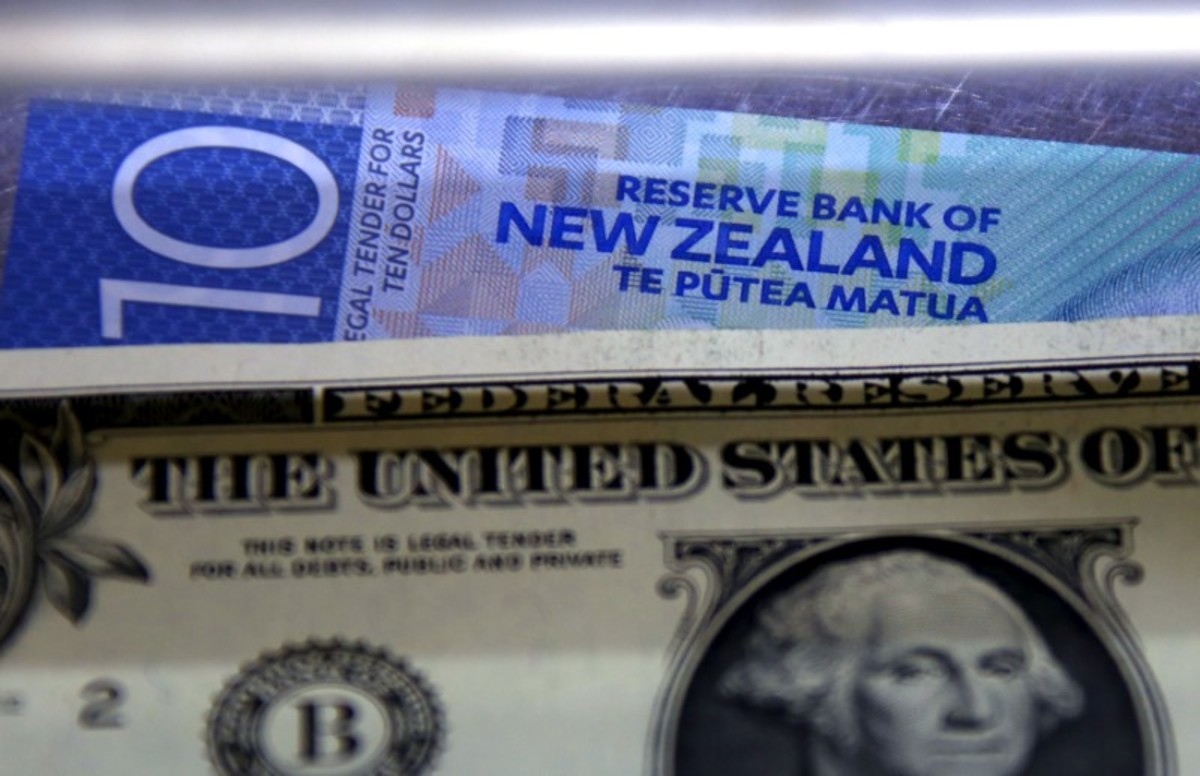
SYDNEY/WELLINGTON (Reuters) - The Australian and New Zealand dollars were consolidating gains on Monday after President Donald Trump's broadside against U.S. dollar strength knocked that currency lower across the board.
The Aussie dollar <AUD=D3> was holding at $0.7425, having bounced from support around $0.7318 on Friday. The kiwi dollar <NZD=D4> had likewise rallied to $0.6816, from lows around $0.6720.
The U.S. currency has been under pressure since Trump last week said he was concerned about the potential impact of a stronger dollar on American exports.
He also broke convention by criticizing Federal Reserve policy on raising interest rates, saying it takes away from the United States's "big competitive edge".
"Fears of a full-fledged currency war are elevated," said analysts at ANZ in a note.
"Although there may be some pressure on USD over the short term, AUD may not benefit as much given the proxy to China and relative risk profile," they added, a reference to China's position as Australia's single biggest export market.
Market positioning played a part in the moves with speculators already very long of U.S. dollars and vulnerable to a stop-loss pullback.
The latest data from the Commodity Futures Trading Commission showed investors were a net 40,000 contracts short of the Aussie against the U.S. dollar, and short 25,000 contracts on the kiwi.
The Aussie fared less well on the Japanese yen which got a boost from a Reuters report the Bank of Japan might tinker with its massive asset-buying campaign to make it more "sustainable" in the face of stubbornly low inflation.
Investors suspected the central bank could relax its grip on the bond market and allow longer term yields to rise a little, prompting an immediate sell off in bonds.
Yields on Japanese government 10-year paper <JP10YT=TWEB> jumped around 6 basis points to a six-month high at 0.09 percent, and triggered matching moves across other markets.
The sudden shift was sharp enough to prompt the BOJ to step in with a special operation, offering to buy 10-year JGBs in unlimited amounts to restrain the increase in yields.
Australian 10-year bond futures <YTCc1> slipped 4.5 ticks to 97.3350, while the three-year contract <YTTc1> eased 2 ticks to 97.870.
The Aussie also dipped to 82.40 yen <AUDJPY=> and away from last week's top around 83.90.
The main domestic event this week will be Australia's second-quarter inflation report on Wednesday. Median forecasts are for consumer price inflation to pick up to 2.2 percent, in part due to higher petrol costs.
However, analysts expect underlying inflation will remain around 1.9 percent and again short of the Reserve Bank of Australia's (RBA) target range of 2 to 3 percent.