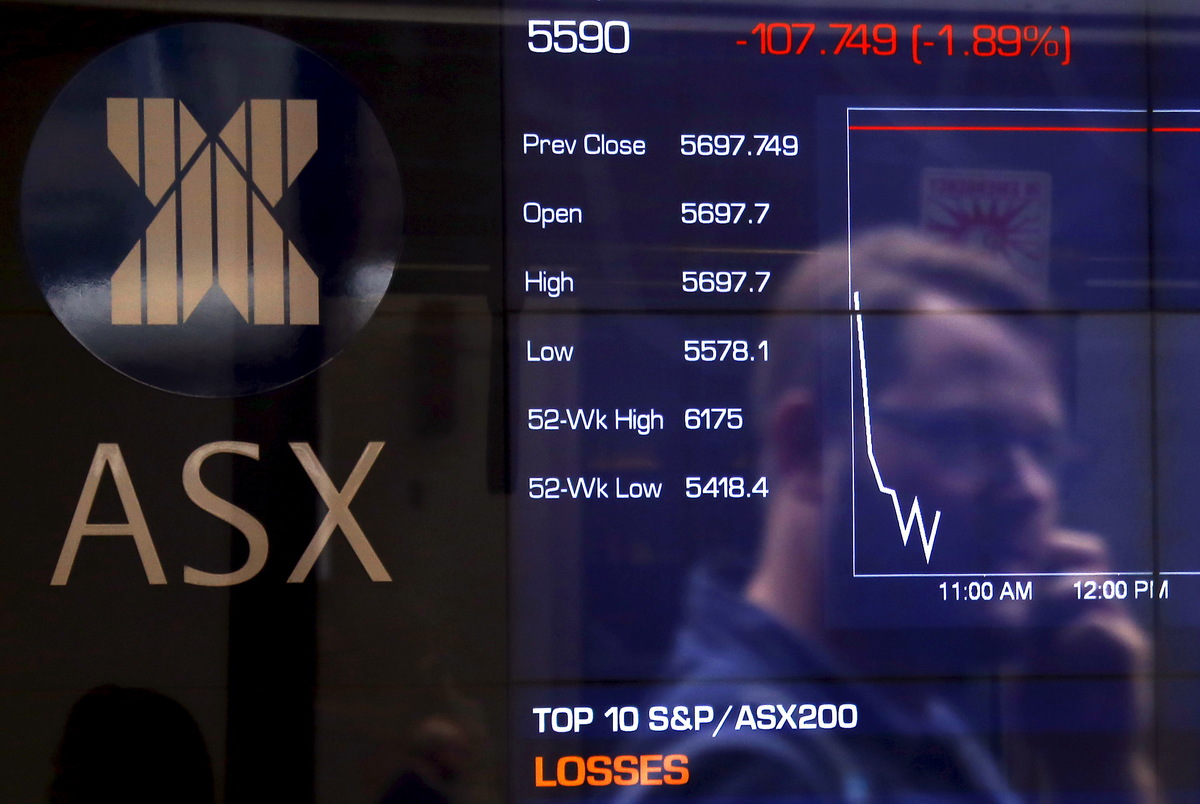
SYDNEY/WELLINGTON (Reuters) - The Australian and New Zealand dollars lost momentum on Friday as renewed fears about a global growth slowdown gripped investors with dour economic data from China further souring risk appetite.
The Australian dollar <AUD=D4>, which is often played as a liquid proxy for China-related trades, slipped to $0.7179 after three straight sessions of gains and was just off a recent three-week trough of $0.7170.
For the week, the Aussie is down 0.1 percent so far, on top of losses of 1.5 percent last week.
The New Zealand dollar <NZD=D4> skidded 0.8 percent to a two-week low of $0.6792. The currency has fallen 0.9 percent so far this week after losing 0.3 percent last week.
The antipodean currencies, which are a gauge of global risk sentiment, were already wobbly as the European Central Bank trimmed its growth projections for next year following an austere outlook by the Swiss National Bank.
Analysts generally expect global economic activity to slow next year with some even predicting a recession in the United States by 2020. Such an outcome will be a negative for both the Aussie and kiwi as the two countries' economies are heavily dependent on world trade.
Risk assets were shaken further after China reported a set of weak data, leaving investors fretting over the wider impact of a yet unresolved Sino-U.S. trade dispute.
Friday's data showed China's November retail sales grew at the weakest pace since 2003 and industrial output rose the least in nearly three years.
The kiwi dollar was also weighed by news the Reserve Bank of New Zealand was considering almost doubling the capital requirement for the country's banks to help them withstand a repeat of the global financial crisis.
Economists warned such a move could push funding costs higher and tighten financial conditions for borrowers.
"The market has viewed that comment by the RBNZ as negative," said Stuart Ive, Wellington-based dealer at OM Financial.
"Where we've seen banks up their capital requirements before it's been because there's been a strain in the system. Whilst there doesn't appear to be an immediate strain within the system, it does have a bit of a knock-on effect for sure."
New Zealand government bonds <0#NZTSY=> gained, sending yields down about 3 basis points across the curve.
Australian government bond futures rose, with the three-year bond contract <YTTc1> up 1 tick at 98.015. The 10-year contract <YTCc1> added 1.75 ticks to 97.5475.
(Editing by Shri Navaratnam)