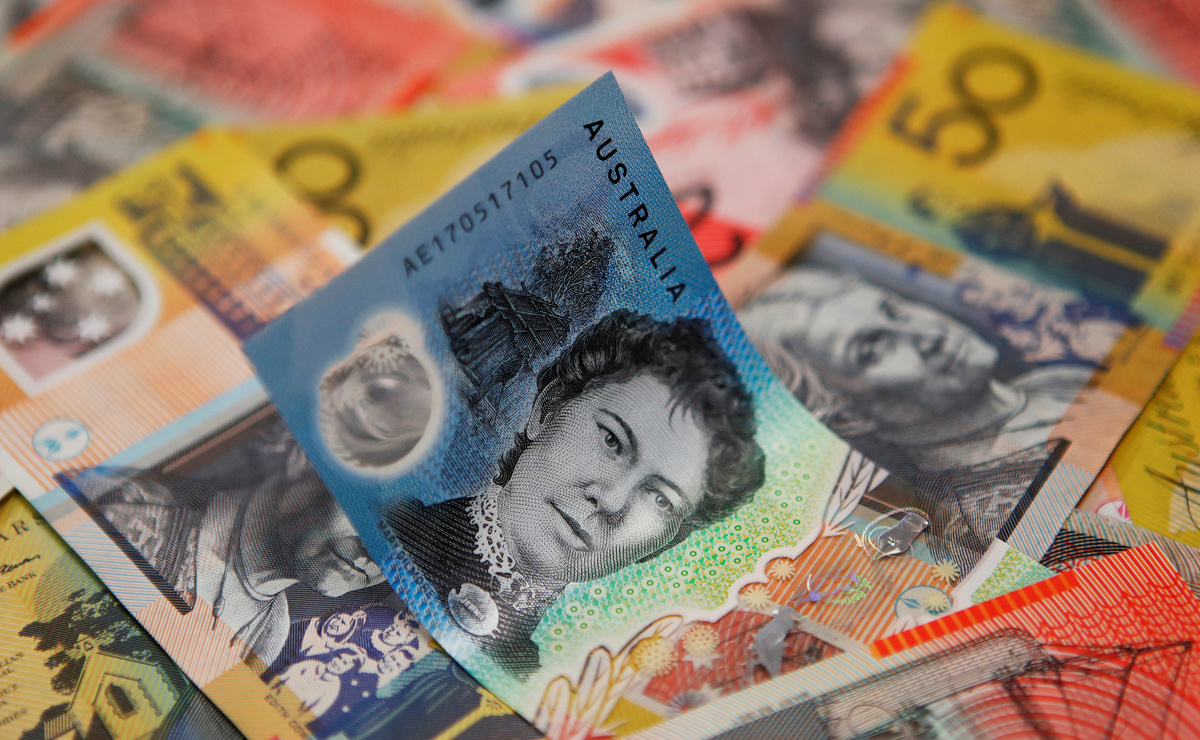
SYDNEY (Reuters) - The Australian and New Zealand dollars steadied and bond yields hit historic lows on Wednesday as investors wagered many more central banks elsewhere would soon join the global easing train.
Adding to the relief was news U.S. President Donald Trump would meet with Chinese President Xi Jinping at the G20 summit later this month and trade talks would restart.
The Aussie got a leg up to $0.6876, after striking a near six-month trough of $0.6832 overnight. The last time it spent any real time at these depths was in January 2016 when it bottomed out in the $0.6827/30 area.
The kiwi dollar bounced to $0.6528, from a low of $0.6491. It just avoided a break of the May trough of $0.6482, which would have returned it to territory last visited in October 2018.
Much will now depend on how dovish the U.S. Federal Reserve sounds after its policy meeting later in the global day, with investors betting heavily it will signal the possibility of a rate cut as early as July.
"Given recent dovish comments from Fed officials, we expect a shift to an easing bias," said ANZ senior economist Tom Kenny. "Chair (Jerome) Powell is likely to reiterate that the FOMC stands ready to support the expansion."
"We now expect it to start cutting rates later this year, and the risk to our view is that the Fed moves earlier than we anticipate."
Pressure for an early shift grew after European Central Bank President Mario Draghi reversed course and declared additional stimulus would be required in the region if inflation failed to pick up.
The dovish lurch proved a reprieve for the Aussie as it ended a run of daily gains for the euro, which fell back 0.6% to A$1.6277.
The Aussie has been hard pressed by expectations of lower rates at home as the Reserve Bank of Australia (RBA) flagged further easing after a cut early this month.
Futures imply a 50-50 chance of a cut to 1% in July, while a move in August is considered a near certainty.
Yet Draghi's comments reminded investors that the RBA was hardly alone in opening the policy spigots and that German 10-year yields were in a different world at -0.32%.
Australia's 10-year paper still offers a positive 1.35%, even if that is the lowest on record.
Investors showed they were keen to buy with a sale of A$2 billion in new 2031 government bonds on Wednesday drawing bids worth a hefty A$4.86 billion.
Bond futures likewise scored all-time peaks as the three-year contract firmed 2.5 ticks to 99.060, implying an yield of 0.94%. The 10-year contract rose 2 ticks 98.6450.
Yields on New Zealand government bonds also dropped to record lows. The two-year yield of 1.20% was well beneath the 1.5% overnight cash rate.
(Editing by Simon Cameron-Moore)