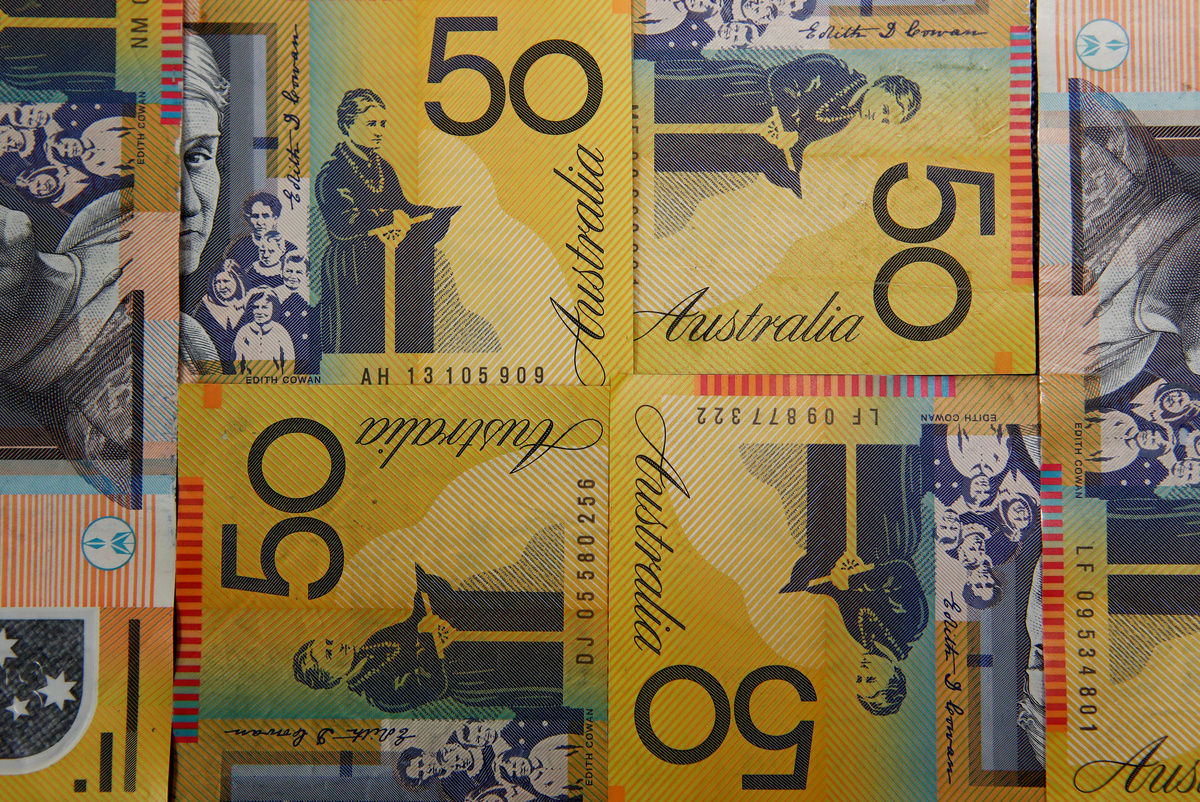
The Australian and New Zealand dollars weakened from recent highs on Thursday and bonds rallied as investors wagered domestic interest rates would stay low after the U.S. Federal Reserve pledged to stay near zero through at least 2022.
The Australian dollar <AUD=D4>, a liquid proxy for risk, was last off 0.2% at $0.6982, easing from a high of $0.7069 touched overnight.
The New Zealand dollar <NZD=D4> was down 0.2% at $0.6523 afetr going as high as $0.6585 overnight.
The falls came as bond prices jumped after the Fed repeated its promise of continued extraordinary support for the U.S. economy and maintained the size of its bond purchase programme.
Despite the drop, the Aussie is still near July 2019 highs when the cash rate was 1% versus the current 0.25%, due to a lengthy rally that began since early May. It's kiwi cousin is near four-month highs.
Both countries have proven relatively successful in containing the coronavirus with New Zealand having essentially stopped all fresh infections, allowing the entire economy to re-emerge from the lockdown. Even professional rugby games will return on the weekend with stadiums packed full of fans.
Also supporting the Aussie, commodity prices - notably oil, iron ore and gold, have been buoyant.
"In early May we were struggling to justify the full extent of the AUD/USD rally ... we are now much less troubled by the AUD's strong performance," forex strategists at National Australia Bank wrote in a note.
"Levels above $0.70 do though currently look quite rich, leading us to expect a period of consolidation near term if not outright slippage back into the mid-high 0.60s."
NAB is predicting the Aussie to jump to $0.72 by year-end and $0.75 by the finish of next year.
New Zealand government bonds <0#NZTSY=> rose, with long-term yields down about 7-8 basis points.
Australian government bond futures jumped, with the three-year bond contract <YTTc1> rising 1 tick to 99.725. The 10-year contract <YTCc1> surging 8.5 ticks to 99.08.
(Editing by Sherry Jacob-Phillips)