The Australian and New Zealand dollars bounced off lows on Tuesday on hopes the two countries would soon open their economies to each other after getting the COVID-19 pandemic under control.
The Australian dollar <AUD=D4> was last at $0.6442, drifting away from Monday's 1-1/2-week trough of $0.6373.
The currency barely moved after the country's central bank left rates at a record low 0.25% in a move that was widely expected. [nL4N2CN09X]
The Reserve Bank of Australia (RBA) said in its post-meeting statement that the country's economic output would drop 6% this year in a "baseline scenario" before rebounding by 6% in 2021.
However, Governor Philip Lowe held out the hope of a stronger economic recovery if there "is further substantial progress in containing the coronavirus in the near term and there is a faster return to normal economic activity."
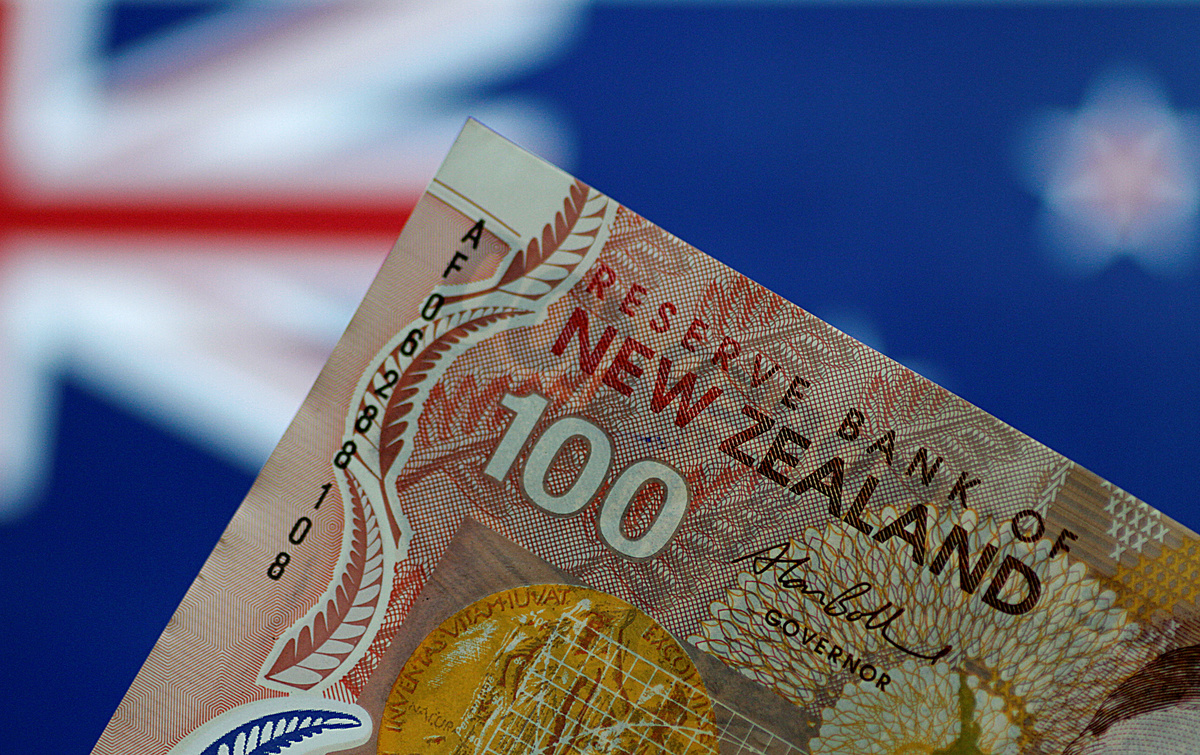
The New Zealand dollar <NZD=D4> was up 0.3% at $0.6066 after sliding to $0.6010 on Monday.
New Zealand recorded zero new COVID-19 cases for a second day in a row. [nL4N2CN07M]
Th antipodean countries are considering opening their borders to each other, having slowed their coronavirus epidemics substantially. [nL4N2CM1EH]
Australia has recorded 6,847 infections and 96 deaths, and New Zealand has had 1,137 cases and 20 fatalities.
Both countries have a coronavirus mortality rate of just 1% and have maintained low, single-digit daily increases in new cases for weeks, prompting their respective leaders to consider open their borders to each other for trade and tourism.
"A trans-Tasman COVID-safe travel zone would be mutually beneficial, assisting our trade and economic recovery, helping kick-start the tourism and transport sectors, enhancing sporting contacts, and reuniting families and friends," New Zealand Prime Minister Jacinda Ardern said in a statement on Tuesday.
Separately, consumer sentiment had lifted in Australia for a fifth consecutive week in a positive sign for retail spending, a weekly survey from ANZ Banking Group showed. [nL4N2CM3U7]
Another data painted a grim picture, showing Australia may have lost almost a million jobs between mid-March and mid-April as large chunks of the economy shut down. [nS9N2BQ027]
"This is a clear early indication of the impact the shutdowns are having on the Australian labour market," Westpac economist Justin Smirk said.
"As such, the payrolls are telling us that we need to get set for a large negative in the April Labour Force Survey," he noted.
The RBA expects unemployment to surge with the jobless rate seen above 7% at the end of next year from around 5% earlier this year.
(Editing by Sherry Jacob-Phillips)