So long, farewell
That’s enough for today. Thanks as usual for your fine company. Thanks as usual to my co-pilot Mike Bowers.
Summing up:
- Wednesday opened messily for Tony Abbott. A damaging leak from the Coalition partyroom meeting yesterday, published by Fairfax, indicated the PM had told colleagues he’d tacked on a trip to a cancer centre in Melbourne basically in order to justify claiming travel entitlement. He’d actually been in Melbourne for a party fundraiser.
- The Labor leader Bill Shorten dead batted the specific travel issue, but went straight to the meta analysis. This was terrible, colleagues leaking against the prime minister in such damaging terms. Voters hate any hint of parliamentarians maximising their perks. A bad leak this one.
- The government steadied by diving back into the national security space. An announcement was produced that there would be more customs checks at airports to ensure people on watch lists didn’t leave the country.
- Australia’s top spy David Irvine spoke at the National Press Club. His view was Asio needed more counter-terrorism powers and no more oversight because there was already too much red tape.
- The foreign minister Julie Bishop went out with a correction on foreign fighters. Despite the government clearly flagging an intention to reverse the onus of proof to better prosecute foreign fighters, the government was not in fact planning to reverse the onus of proof at all. Silly everyone for thinking that.
- Irvine made it clear that despite much talk in politics about the prosecution of foreign fighters, the government had not yet settled on the specific policy it would bring forward.
- By late afternoon, reports emerged from the US suggesting Washington was moving more decisively in the direction of airstrikes in northern Iraq. This allowed the government to square a circle it has been drawing for some days with some careful leaks and hints – that Australia would play a larger role in Iraq than the current humanitarian one. The prime minister would not rule out participating in airstrikes.
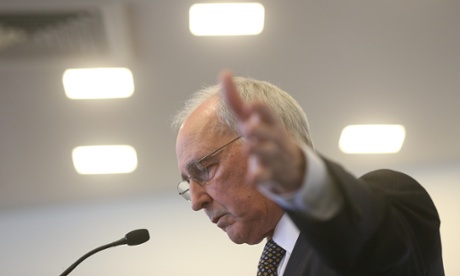
- Apart from all that, Paul Keating was grumpy. Bob Hawke made ministers meet in him the nude, and he wasn’t that attractive nude. Bob wandered off at key points in the cycle of government. Keating waxed grumpily at length at a book launch at the ANU. For some time.
- There was also a cost benefit analysis on the NBN which found exactly what it was constituted to find out: that all was well with Malcolm Turnbull’s policy.
Enough now? I reckon. Have a lovely evening.
For all the metadata nerds out there – just for the record, this was the definition provided by the attorney-general’s department in June 2013. This particular definition of what constituted metadata was provided to the joint committee on intelligence and security when Labor briefly thought about imposing a mandatory scheme. This was information to be held by telcos and ISPs.
- Internet identifier – assigned to user by provider.
- Mobiles – numbers called or texted.
- Customer’s email address, phone number, or VoIP number.
- Time and date of communication.
- General locational information – cell tower details.
- Duration of the communication.
- Name of customer.
- Address of customer.
- Postal address of customer.
- Billing address of customer.
- Contact details.
- Same information on the recipient if known to the service provider.
It will be interesting to compare and contrast when the details are finally resolved and made public. It’s also interesting to compare that list with the phone book. The Asio boss, David Irvine, today compared metadata to information in a phone book. Pretty detailed phone book. I wouldn’t mind one of those.
While still in the senate and with the Greens, I should note that in the thick of the Iraq uptick, there was also a development about metadata.
Greens senator Scott Ludlam successfully moved a motion which orders the attorney-general, George Brandis, to produce no later than noon on Wednesday 3 September 2014:
- The definition of “metadata” as defined by the Government’s proposal on mandatory data retention;
- The document distributed to the telecommunications industry within the past week which discusses this policy.
The relevance of this is the government has flagged that it will proceed with a scheme requiring telcos and ISPs to store the metadata of their consumers for two years or more – but it has provided conflicting explanations on what it actually means by metadata. Ludlam wants a definition. He’s also seeking a paper that was circulated with the telco industry earlier this week setting out some more detail on what material may be stored in such a scheme. I covered this development yesterday on Politics Live.
Thank you Mr president. What a privilege to be here.
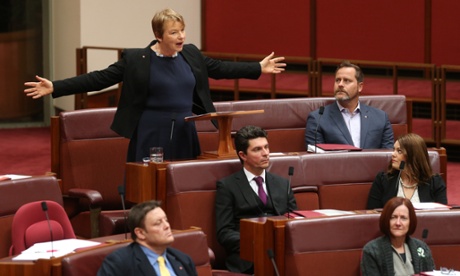
Janet Rice makes her entrance to federal politics.
Updated
Rice’s speech sets out her aspirations on forests policy and transport policy, for a treaty with Indigenous Australians.
And for marriage equality.
My children John and Leon have grown up with my Green politics, passions and commitments threaded through their lives. They are such wonderful young adults, sharing those passions – what greater inspiration could a mother have. And Penny. My wonderful partner Penny, who has been absolutely critical in my life achievements.
We’ve shared 28 years of married life; a partnership of love and support. We are proud of our status as a same sex couple who were legally married in Australia, and I am resolute that all couples should be able to share this right.
The time for marriage equality in Australia has come. I’m here for all lesbian, gay, bisexual, transgender and intersex people and their families. We deserve recognition and respect in all aspects of our lives: at school, in workplaces and in our communities.
Senator Janet Rice, in the middle of everything, is making her maiden speech to the senate. Rice is the new Green senator from Victoria.
Rice:
My agenda for my time here is clear. I want to be able to look my grandchildren in the eye and tell them that it was during my time in the Senate that Australia turned the corner and legislated to begin the shift to a zero carbon safe climate economy.
I need to track back to another element of national security policy. I’ve touched on this variously throughout the day. It concerns reversing the onus of proof – a concept the government had floated as part of its crackdown on returning fighters from Syria and Iraq.
This idea was very clearly floated by the attorney-general, George Brandis. It is now, very clearly being walked back by the foreign minister Julie Bishop.
Sky News political editor David Speers asked Bishop for clarification in the interview just a little while ago.
Q: So the individual (travelling to designated areas) doesn’t have to prove they were doing something legitimate?
If somebody is going to Mosul they should state why – family reasons, humanitarian reasons. If our authorities believe that not to be the case, the onus is on our authorities to prove otherwise.
That’s where the onus of proof lies.
The Asio boss, David Irvine, made it clear in his speech at lunchtime that there is not yet a settled policy position on foreign fighters.
He refused to engage on whether the government would reverse the onus of proof to allow successful prosecutions of foreign fighters already engaged in conflicts overseas, or whether the government should reverse the onus of proof.
The Abbott government leaves open the option of air strikes
Here now is a statement from the prime minister’s office concerning Australia’s role in Iraq. This statement says there is no consideration of combat troops. It leaves the issue of airstrikes open. It sets out the terms on which Australia would respond to any formal request from Washington.
From a spokeswoman for the prime minister:
The government has made it clear that ISIL represents a serious threat; not only in Iraq and Syria and the wider Middle East, but also to Australia’s national security – a position the director general of Asio agreed with in a speech earlier today. The government has been transparent about our intentions in Iraq.
To date our focus has been doing what we can to avert an even greater humanitarian tragedy in Iraq, including by air-dropping food and water to many thousands of desperate people on Mount Sinjar. The prime minister has made it clear that Australia is ready to continue our humanitarian involvement in Iraq.
Our response to any request from the United States, or other close allies and partners, will be based on whether there is an achievable overall humanitarian purpose and a clear and proportionate role for Australia as well as on a careful assessment of the risks. Australia is not considering putting combat forces on the ground (nor, for that matter, is the United States).
Updated
We are chasing reaction from the prime minister’s office. In the event that is forthcoming, I’ll bring it to you.
Back now to Liberal Dean Smith on 18C and the RDA
I do think that we can look beyond ourselves, have debates about these issues knowing Australians will and can and often do rise to the challenge of being a harmonious nation.
It’s disappointing the debate has gone. I accept the reasons for the debate having now passed us … It might come back in a form where it finds support because some of those rough edges if you like of the original proposal are cut off.
Smith said there should be amendments which reflect the country we want to be but which also provided protections the vulnerable. He suspected in coming months parliament and community would again have the opportunity to debate this issue in another form.
Just bear with me for a moment while I go split screen between the Senate and the foreign minister Julie Bishop, who is being interviewed on Sky News.
Given the seeming increase in tempo in Washington, I think I should bring you her remarks. Bishop says what Australia does in the conflict in northern Iraq and Syria depends on requests from the Iraqi government and the US government. The US, she says, is considering its position.
The Greens meanwhile have issued a statement in the wake of the New York Times report. Greens deputy leader Adam Bandt is not amused.
The public and parliamentarians should not be finding out about potential Australian military involvement from US newspapers.
The Greens have been raising concerns about ‘mission creep’ for some time now. This latest report is worryingly consistent with the prime minister’s confirmation that talks are underway which could see Australian troops sent off to war.
Tony Abbott must immediately bring the matter to parliament for debate so that Australia and its representatives know what’s going on.
We shouldn’t be involved in another Iraq war, but it is certainly wrong that an unpopular prime minister has the power to deploy troops while keeping the public and parliament in the dark.
Dean Smith tells the senate the best way forward, always, is to trust Australians with their freedom.
I spoke too soon, the Liberal Senator Dean Smith is making his contribution in the urgency motion debate.
Smith notes that he’d like to have seen the government maintain its commitment to have a debate about the wording of section 18C of the RDA as it currently stands. He understands why the reform has been shelved for now, but he suspects the debate will roll on.
Some people might frame the debate differently in the future.
Could Smith be talking about the attorney-general? Pure speculation on my part.
Smith:
I think its important the community continue to debate, or otherwise, the reform of 18C. When ill-considered, hurtful thoughts, are brought out in the open, Australians respond well.
The Senate has begun the debate on the urgency motion concerning the Racial Discrimination Act that I flagged with you at 12.30pm. Thus far it’s Labor voices. I’ll keep an ear on it.
Herding bits and pieces. Just conscious I haven’t given you a proper account of Paul Keating’s Castro like performance at the Evans book launch at ANU earlier. This wasn’t a sunny day by the sound of things. There was a reflection from Keating that Bob Hawke may be somewhat lacking in the anatomy department.
Then there was the nude anecdote. Hawke liked to meet his ministers in the buff.
Keating, on Hawke.
He used to often do this (meetings) in the nude of, course. It does take a certain chutzpah to meet ministers in the nude.
Then there was a reference to Hawke dropping out while they were in government.
Sad face.
We’ll chase some reaction to that NYT report over the course of the afternoon.
In the meantime, Question Time is a wrap. I’m going to take stock for a few minutes and then point us into the rest of political Wednesday.
New York Times suggests the US is mobilising allies for Iraq airstrikes
Sorry to break into Question Time, but the New York Times is reporting the US is on the move in Syria and northern Iraq. The US, the UK and Turkey are in the frame.
Here’s the relevant couple of paragraphs.
The United States has begun to mobilize a broad coalition of allies behind potential American military action in Syria and is moving toward expanded airstrikes in northern Iraq, administration officials said on Tuesday. The officials, who asked not to be named discussing sensitive internal deliberations, said they expected that Britain and Australia would be willing to join the United States in an air campaign. The officials said they also wanted help from Turkey, which has military bases that could be used to support an effort in Syria.
Updated
Labor’s deputy leader, Tanya Plibersek, to Julie Bishop.
Q: On ABC Radio today, the minister denied that Australia had been asked to supply weapons to support the Pehsmerga in their struggle against the IS in Iraq. This letter was sent on August 11 by the Kurdish representative in Australia shows that Australia was asked for “military support including equipment and ammunition.’ Why did the minister provide false information to Australians about such important matters of national security?
Bishop was asked about the letter on Radio National Breakfast this morning. She said then she was unaware of the letter. The foreign minister says she has subsequently corrected the record.
Bishop’s explanation just now is the letter had not actually reached her, because she was in Singapore. Because the letter had not come from a credited diplomat or a nation state, it went to the lawyers. Bishop says she was aware that the issue had been discussed in the national security committee of Cabinet. She was not aware, specifically, of the letter.
The education minister Christopher Pyne frolics with the new book by Paul Kelly in order to note that the Gillard camp in the previous Labor government did not trust Bill Shorten because he was untrustworthy.
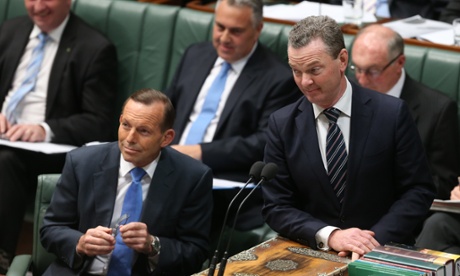
Mr Untrustworthy appears unmoved by the critique. He’d like to know if Tony Abbott is preserving Joe Hockey as a human shield for this unfair budget?
Q: Isn’t it time for the prime minister to either dump the treasurer or dump the budget?
Madam Speaker rules the question out of order.
Updated
I can see it in your eyes.
I can see it in your smile.
The communications minister Malcolm Turnbull wants Labor to FREE JASON. He says this is the meme of the moment. Turnbull means Jason Clare, the shadow minister for communications. Turnbull says Clare is a puppet of his old nemesis Stephen Conroy, the former Labor communications minister. (This is not so much meme as theme from Turnbull. He likes this gag. He’s been trialling it all day.)
Madam Speaker.
That was almost pearls before swine .. but we call the honourable member for Ballarat.
Er. The member of Ballarat Is Catherine King.
Who is the pearl, some wag quips?
That is just complete rubbish. That is just complete rubbish, unmitigated rubbish . And you should be ... the leader of the opposition should be above that.
That’s Hockey, furious, about a question from Shorten about the planned privatisation of Australian Hearing, and its potential impact on a young boy he met recently.
Hockey:
For the leader of the opposition to come in here and use that family .. that was obviously doing it incredibly tough .. as some sort of point scoring competition fodder, is just a disgrace.
It’s just a disgrace. Australian Hearing competes with a range of other private sector providers. It competes in the private market. Is the leader of the opposition suggesting that those other providers do not provide a reputable service? Is that what he is suggesting? Is he actually suggesting that Australian Hearing is the only provider of hearing services to Australians? Is that right?
Hockey notes Labor is the party that sold Qantas and the Commonwealth Bank. When it had principles. No principles now. Just opportunism.
Shadow health minister, Catherine King.
Q: I refer to the treasurer’s answer during question time yesterday that the budget papers show people with a chronic illness will not pay the GP tax. I again ask the treasurer - will Australians with chronic illness pay the GP tax?
Hockey:
The honourable member is totally misrepresenting my answer from yesterday. What a surprise.
I stand by all my words in relation to chronic illnesses, all my words in relation to chronic illnesses, including those on ‘Q&A’ which she is getting at, and why so? Because we are absolutely committed to ensure that we have universal (affordable) health care.
Shadow treasurer Chris Bowen.
Q: My question is to the treasurer. Treasurer, isn’t it the case that the parliamentary budget office has confirmed the prime minister’s signature PPL scheme will cost $62bn over the next 10 years? And, that this is equivalent to the government’s $23bn cut to the pension and $40bn cut to family payments.
Joe Hockey:
I don’t accept the premise of the question.
Hockey then sails forth on Labor’s fiscal profligacy. She’ll be right isn’t actually an economic policy.
Where is that golden goose that lays all the eggs?
[PAUSE. Many interjections follow. Fingers point in a general direction.]
Hockey:
I am ... not inviting speculation!
Human shield, or sight screen.
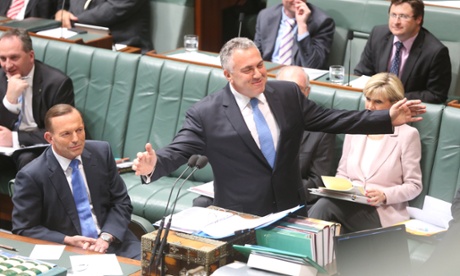
You decide.
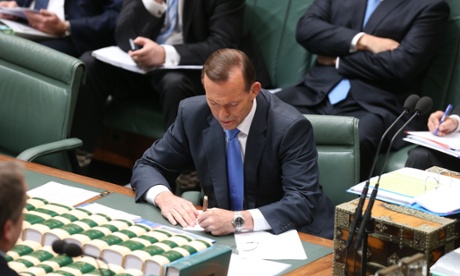
Updated
From national security to border security. The immigration minister Scott Morrison is invited to reflect on his enormous portfolio success. Morrison is happy to oblige.
Labor’s Jenny Macklin is after the estimated rate of growth in the prime minister’s paid parental leave scheme.
The treasurer, standing in front of the prime minister, notes he is a human shield. Hockey rethinks that. Perhaps he’s just a sight screen.
Hockey:
What was the question?
Updated
Elected representatives surveil their laps.
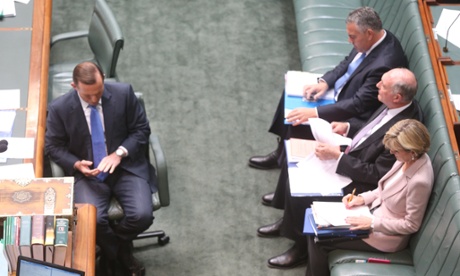
Quite evocative, this picture. Mike Bowers is in the chamber and I’ll share pictures as they come.
Q: How can this treasurer possibly claim that pensioners are better off when the parliamentary budget office is exposed a $23bn cut to the age pension payments over the next decade?
Hockey:
I am actually advised that over the next decade the pension is going to increase by 5.1% on annualised basis. It is important that we ensure that the age pension is sustainable. It is hugely important that we ensure that the age pension remains affordable.
While I was dealing with the announceable, Labor put a question on pensions to Hockey. Very surly down there today.
The foreign minister, Julie Bishop, comes back with the national security Dorothy Dixer. This sets up the finalisation of the security cooperation agreement with Indonesia.
New "counter-terrorism units" operating at airports
Abbott also lobs a security announceable into Question Time.
I do make a further announcement today that late last week the customs and border protection service began operating counter-terrorism units at Sydney and Melbourne international airports, and similar units will shortly be established at all international airports in Australia.
There will be an additional 80 border force officers stationed at international airports to monitor the movements of people on our national security watch lists. I am advised that these new units have already intercepted at least one person of interest.
(Is the prime minister suggesting here that customs were not previously monitoring people on national security watch lists? This would seem to be core business for them. Presumably he means there will be 80 more customs staff working at airports. At some point. There’s no timeline here.)
Question time
Question time, are there any questions? There are, as it happens. We are back to Hockey’s greatest hits. The Labor leader Bill Shorten opens by repeating Hockey’s words back to him.
Q: My question is to the treasurer. Treasurer, how is it strongly arguable that pensioners are going to be better off under this budget?
Hockey says, well, we scrapped the carbon price. And we are pursuing budget sustainability in part to support the pension system into the future.
The Coalition comes back with the homeland. Prime minister, what are the threats to national security?
Tony Abbott:
Madam Speaker, we know what these people can do. We have seen it on our screens and we must make sure that it never happens here in this country of ours. We need the capacity to deal with people, preferably to stop them from going overseas to join terrorist groups in the first place, but certainly to stop them, should they seek to return to this country.
The press club has folded its tent. I know there are various floating elements in our political day. I will come back to the various threads – including what Paul Keating said at the Evans book launch – when we are safely on the other side of Question Time.
Updated
The Asio boss blinks when a questioner lobs the acronym VPN.
Q: Regarding metadata policy, you have said previously metadata is only sought in very specific circumstances. If this is the case, why is it so onerous to get a warrant? And how effective can scooping up metadata be when virtually anyone can set up a VPN and not leave any footprint?
Irvine seems to think this is some kind of a technical gotcha question. He intends to give a general answer. He says Asio needs access to metadata. Asio does not need to be burdened with a regime which requires them to get warrants. He says requiring authorities to get warrants for metadata would be like asking them to get a warrant for looking up a telephone book.
(With due respect to Irvine, and I do mean that, he’s a distinguished public servant – this comparison is absurd. Really, really, absurd.)
Irvine declines to answer a question about whether Asio would like to see the onus of proof reversed. This is a question for others, he says. He’s then asked why aren’t the would be terrorists already in jail? Irvine delivers the blindingly obvious answer.
Intelligence is not evidence.
Was the prime minister’s “team Australia” formulation divisive and counterproductive? Irvine doesn’t think so. He likes teams.
Updated
Irvine gets a question on how Asio will deal with foreign fighters. He says the agency may need to use control orders.
Q: Isn’t it true that to be effective, the changes to the law will have to mean that some suspected foreign fighters returning from northern Iraq or Syria will have to be locked up for significant periods to protect the public, in the interests of public safety on very little evidence?
The issue has always been the problem of collecting evidence overseas that will meet the evidentiary standards of Australian courts. The use of control orders may be an option. It has been used in Australia in the past, as you know. It may need to be used again. But again, that will have to be fought out in the courts as well. Ultimately.
Irvine is then asked about the grooming of future suicide bombers. Is this happening here? The Asio boss says, yes, it is.
I won’t talk about the individual cases but we are aware of attempts to get young people to go over to those places and we have seen the training of young people over there to be suicide bombers, yes.
Now there’s a period of questions.
The first question concerns criminalising publication of national security leaks. This is one of the elements of the counter-terror package.
Irvine continues a formulation he has used on this question for a while. He says the laws are not intended to target journalists. (This formulation does not of course address the question of whether the law can apply to journalists. Many leading lawyers are clear: the provision as drafted will apply to media outlets.) The Asio boss says also the proposed provisions are just like existing provisions in the Crimes Act that apply to controlled operations carried out by police. Again, leading lawyers say this argument is just not right. The Gilbert + Tobin Centre of Public Law says the regimes are quite different.
A question on reversing the onus of proof.
Q: Under the proposed new laws we’re told there will be this new offence for people returning from a designated area without a legitimate reason for being there. If the onus is on the traveller, the returnee to provide that legitimate reason, isn’t that effectively reversing the onus of proof and if not can you explain why it wouldn’t be? If someone were to come back in that circumstance from a designated area and couldn’t prove that they had been there for a legitimate reason but equally the authorities couldn’t prove they had been fighting, what would happen to them? What is the intent of the law in that sort of circumstance?
Irvine is careful in his answer. He says the court would apply the relevant law. He says the government is quite correct to explore all reasonable options to deal with the threats posed by returning foreign fighters.
Having said all of that, the government, to my understanding, is only working on this issue on an in principle basis. It is continuing a conversation with the community, including the Australian Muslim communities and I think we need, before I can answer that question, I think we need to see what the government actually comes up with. As a result of those consultations that is.
(In other words, there is still no actual concrete provision drafted. Quite incredible that. All the build up, and still no settled exposure draft.)
On the imperative of balancing security and liberty, Irvine says this.
The security and safety of our citizens living within our community, your safety, is just as much a human right as are all the other civil liberties that we talk about.
The Asio boss is listing all the existing oversight mechanisms. He doesn’t mention the fact that:
- The Inspector General of Intelligence and Security has recently called for more resources to watch Asio in an environment where the surveillance footprint is being expanded; or the comments from the outgoing Independent National Security Legislation Monitor that more oversight powers would be required to ensure there weren’t abuses of power.
Irvine, perhaps addressing the point by inference:
We need to avoid a kneejerk reaction to add additional oversight and approval mechanisms every time we adjust Asio operating legislation, as if additional bureaucracy and increased cost would provide a more effective and greater level of assurance to the public than those layers already in place and proven over decades.
Asio necessarily works in the shadows. Doing so, as I have tried to point out, doesn’t make the organisation unaccountable. Asio works within the law. The organisation is accountable and responsive to those who oversee our work.
Updated
The Asio boss mounts a case that Asio must work in secret. (I suspect he is turning some of the recent concerns raised by Australia’s media industry about the government’s terror package back on the media industry.)
Why does Asio need to work in secret, Irvine asks himself rhetorically.
As any journalist will understand, we need to protect our sources.
If we’re not discreet in our activities, we can put our important community contacts and covert human sources in real personal danger.
Their reputations, their livelihoods and future prospects may be damaged if our work is not conducted discreetly, out of the public gaze.
Irvine references the substantial concerns of legal groups and civil libertairans about the government’s counter terrorism proposals. He says contention is a natural consequence of democratic debate.
There’s a but.
Irvine:
Some of the arguments may be informed by misplaced concerns or outdated or lazy stereotypes about the intelligence business.
I constantly feel the need to remind people that Asio is not the security apparatus of a non-democratic or totalitarian state.
The Asio boss says conflicts in Syria and Iraq have changed security considerations in Australia.
Irvine:
The situation in Syria and Iraq has radically complicated the threat, adding energy and allure to the extremist Islamic narrative. The draw of foreign fighters to Syria and Iraq is significant and includes more Australians than any other previous extremist conflict put together. The number of Australians of potential security concern to Asio and our law enforcement partners has increased substantially.
Not all of those Australians currently in Syria and Iraq will return. Some tens of Australians have already returned and a good number of these remain of concern to the security authorities.
I believe that the terrorist threat will be with us for some time into the future.
But having said that, Irvine says we must not panic.
And we must not blame and shame Muslims for the actions of a few.
We’re talking about a few hundred abhorrent souls in a community of half a million Muslims and it is grossly unfair to blame Australian Muslims who see themselves as a committed component of Australia’s multicultural society.
Irvine says Asio has thwarted potential terror acts on Australian soil.
We haven’t had a terrorist attack on Australian soil .. but planning for a number of mass casualty attacks on our soil has been detected and the attacks have been thwarted by Asio, working in close cooperation with its state and commonwealth law enforcement partners.
We have been long, in my time, monitoring a small number of Muslim Australians who support violent extremism and who frequently express the aspiration of conducting terrorist attacks in Australia. We have needed to be in a position to move quickly, to nip things in the bud as soon as such people move from talk and aspiration to active planning and to final preparations.
The Asio chief addresses the National Press Club
David Irvine is up at the podium at the National Press Club. He opens with three points. Terror threats are real. We need spies to deal with the threats. And, PS: Asio doesn’t need any more oversight.
I think today I want to make three essential points. The first point is that the threats that Australia faces today from espionage and terrorism are real. But they are also manageable. If we maintain our vigilance and if we continue to update our intelligence capabilities to meet the changing demands of what we in Asio call the operating environment.
The second point is after five years I am more than ever convinced that Australia actually needs a security service. A service that is governed by the rule of law and with appropriate safeguards in place to protect against threats to the nation’s security and threats to the lives of our citizens.
The third point is that following from that, the existing regime of checks and balances in respect of Asio is working and it doesn’t need substantial revamping and certainly not revamping that merely increases the cost and the bureaucracy but adds nothing to the effectiveness of the oversight we already have.
Just before we come in from the cold with David Irvine at the press club, I’ll foreshdow an interesting little tactical play in the Senate which we expect later on.
Labor is proposing an urgency motion later on calling on the Senate to affirm its support for the Racial Discrimination Act in its current form. This is obviously a statement of principle. But given there are different views within the government on this question – it is also an opportunity to highlight splits within the Liberals. Liberals, such as the South Australian Cory Bernardi, are very cranky that Tony Abbott has walked away from a pledge to water down protections against hate speech. It will be interesting to see how this debate goes.
Mike Bowers informs me the that some monks have departed the book launch over at the ANU.
MUP’s Sally Heath.
Keating still talking. He seems to be enjoying the telescope Evans' Cabinet Diary has trained on the years 84-86. @MUPublishing
— sally heath (@heath_sally) August 27, 2014
Now never let it be said that Politics Live engages in content theft. We are big on attribution around these parts.
In this spirit of fearless journalistic truth and cheerful collaboration, a little birdie or other smallish darling [*cough] animal who shall remain nameless unless he chooses to out himself informs me that the picture I posted at 9.40am is the work of @mrgrumpystephen and Mr @s_bridges
Congratulations chaps for precision moustache rendering and for services to blogues.
Even though you didn’t know you were, in fact, serving the blogues. That picture was supplied actually to me not be the creators but via a third party who shall also remain nameless unless he/she chooses to out him/herself.
All in a day’s werk on Politics Live really.
It takes a village.
Foreign fighters confusion lured me away from Keating and Gareth.
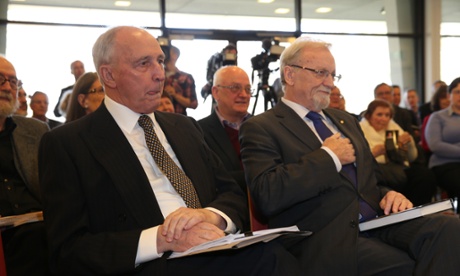
Fortunately Mike Bowers is on the spot and will be able to bring me up to speed.
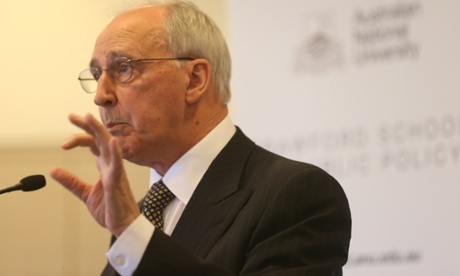
I gather there’s been a reference to Bob Hawke sunbaking starkers. That can’t be good.
What reversal of the onus of proof?
I’ll come back to Keating in a bit but first, I’m slightly confused by some remarks this morning by the foreign minister Julie Bishop in relation to the looming foreign fighters counter-terrorism package.
I’ll step this through, bit by bit. The attorney-general George Brandis has signalled previously that the government is considering legal changes, including reversing the onus of proof, for people travelling to regions where there is sectarian conflict. (The idea is that people would have to prove they were in regions for a legitimate purpose, rather than it being assumed they were in a country for entirely innocent reasons.) As a legal principle, this is somewhat controversial.
On July 4, Brandis said this:
For example, one proposal which we are considering is the capacity for the minister for foreign affairs to certify that a particular region or a particular conflict within a region is a region for the purposes of the foreign incursions legislation, so that if it is demonstrated that an Australian has returned from that region, there can be a presumption that they were there for no good purpose.
But now Bishop is saying something that sounds quite a bit different to what Brandis has been hinting. She’s saying it’s up to authorities to prove people are up to no good in Iraq and Syria, rather than the law being changed to assume they are up to no good.
In a brief doorstop this morning, Bishop said:
There is no reversal of the onus of proof.
(By way of context Bishop noted that DFAT had issued travel advisories advising people not to travel to troubled regions. She says the Australian government can only provide limited assistance to people in places like Iraq or Syria.)
Bishop:
We are warning Australians not to go. We want to introduce an offence for people to go to designated areas. If they have a reason for being there, a legitimate reason, then they can go. If they don’t, then the onus of proof is on the authorities to show they don’t have a legitimate reason for being there.
There’s no reversal of the onus of proof.
Make of that what you will. Part of my confusion stems from the fact that we have no, actual, concrete proposal of foreign fighters from the government. No exposure draft. No settled form of words.
- I’m indebted to Simon Cullen of the ABC for supplying me with audio for this post.
I like Canberra, but I don’t like it that much.
Keating references time spent by MPs in hotel rooms in the national capital. Not exactly a great global metropolis. Oh, dear.
The former Labor prime minister Paul Keating is launching Gareth Evans book at the ANU. Right now he’s on allocative efficiency. He looks rather subdued.
When I contacted the prime minister’s office early this morning to see what was being said in relation to yesterday’s travel to Melbourne – the advice was all travel was within the rules. I note that’s what the foreign minister, Julie Bishop, said, more or less, in the unfortunate walking doorstop that I referenced earlier.
My colleague Daniel Hurst has now been sent this as the statement from the prime minister’s office.
The prime minister is a passionate supporter of medical research and the government’s $20 billion Medical Research Future Fund and he makes no apologies for his visit. Whenever the prime minister travels he maximises his visits by ensuring he participates in community events, business visits and local media.
Meanwhile, over at the ANU, Gareth Evans and Paul Keating are stamping about like a couple of old warhorses, preparing for another book launch.
Inside the Hawke Keating Government. A Cabinet Diary set up. Author Gareth Evans has arrived. pic.twitter.com/1xdA770zxi
— sally heath (@heath_sally) August 27, 2014
Why do politicians do walking doorstops? This happens far too often. It makes them look like they are doing perp walks. How hard is it to just smile at the cameras and keep walking?
Anyway, the foreign minister Julie Bishop has been chased by people wanting her account of Tony Abbott’s account to the party room of his travels to Melbourne.
Bishop:
At the party room yesterday, I was in fact speaking with Secretary of State John Kerry, so I wasn’t in the party room for a good deal of it yesterday – but I’m sure that the prime minister has been acting within entitlements.
Canberra blogger Paula Matthewson prods me helpfully from the sidelines – a public service she often performs for this mildly addled live narrator. Bless her cotton socks.
@murpharoo Other element to Abbott's travel entitlement would be his use of a VIP to get there and back.
— Paula Matthewson (@Drag0nista) August 26, 2014
The Labor leader is then asked about whether PUP senator Jacqui Lambie should emulate her leader Clive Palmer and apologise to the Chinese. (Lambie has suggested recently we may be at risk of an invasion from our north.)
Shorten breaks out the lilo – a leisure device perhaps not sighted in public since a lazy summer in 1978.
Shorten:
I do not think that there are thousands of people waiting on lilos in other parts of the world waiting to invade Australia. I think people in public life need to give leadership. Australia’s future depends upon the successful rise of Asian societies.
Updated
Shorten is asked about Tony Abbott and travel. The Labor leader’s formulation is don’t look at the travel claim, look at the leak. (Travel rorts are always a bit of a glass house in this place – the convention is largely don’t throw stones.)
Q: What do you make of reports within the Liberal party room that Tony Abbott only went to the cancer centre so he could charge taxpayers for his private function?
Shorten:
Well, these matters are for Tony Abbott to explain, not for me to make points on. I’d say to the prime minister that you never need an excuse to visit a public hospital in Australia that cancer centre does remarkable work. I think what is most telling about these reports is that there are Liberal party members leaking against the prime minister. A party and a leader that cannot govern itself cannot govern Australia.
Q: Do you think that the travel rules need to be tightened?
Well, again, Mr Abbott will have to explain what he’s done. I have no further information on that. What I would say though, it’s not the prime minister’s travel budget which keeps me up at night. It’s his unfair budget to all Australians.
Q: Do you take Clive Palmer at face value and do you believe as a result the GP co-payment will not pass the parliament?
Shorten avoids referencing Palmer directly. He’s just objecting to the government turning every pharmacy in Australia into a new unfair Abbott tax collector. (Actually it was Labor who turned pharmacies into tax collectors – Labor imposed the co-payment on pharmacy medicine, not the Coalition.)
A couple of question now on security reforms. Shorten says Labor will be constructive when it comes to national security.
Clearly we want to make sure that the liberties of Australians are protected. But we also have a job to do here for the nation of Australia about protecting the security of Australians. We will work with the government in a constructive fashion to achieve these goals.
Q: An individual measure under the current legislation –we understand journalists could be jailed for up to five years if they publish information gleaned from intelligence sources. Would you support that?
Shorten:
We fundamentally believe in the liberty of the press and the freedom of the press. Labor’s very mindful of making sure we maintain the freedom of the press. We will work through the details of whatever they’re proposing with the government, but we certainly have uppermost in our mind that our journalists should be able to do their work.
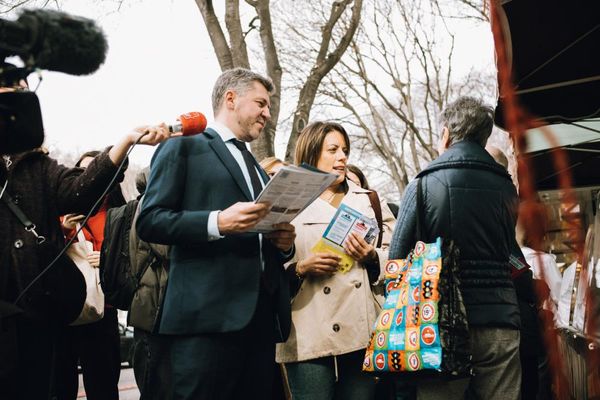
The Labor leader Bill Shorten is telling reporters in Queanbeyan that Labor is engaged in a fight against radicalism. This radicalism appears to relate to price signals in the health system – in this case, an increase in the existing PBS co-payment. Shorten is standing in front of a wall of Sudafed.
Shorten:
Labor will continue to strongly oppose this increase to pharmaceuticals and medicines in this country because it’s fundamentally unfair and it’s a broken promise. We won’t allow this double tax whammy to pass without the toughest of all fights. I am optimistic that Labor will defeat the government on this matter.
Just because we can, really.
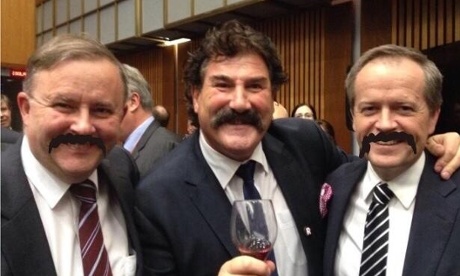
This message proudly brought to you by photoshop.
Updated
Just in case you were curious about the prime minister’s current travel entitlement, I’ve dug up the latest determination. Here are the particulars:
- The prime minister shall be provided with accommodation and sustenance up to a limit of $560 for each overnight stay in a place other than an official establishment or the prime minister’s home base.
- Accommodation and sustenance at official establishments shall be provided at government expense.
- If no receipt is produced or certification made that a receipt can be produced on request, the prime minister is entitled to $187 (approximately one-third of $560) for each overnight stay in a place other than an official establishment or his/her home base.
- In exceptional circumstances, the Commonwealth may pay the accommodation and sustenance costs incurred by the prime minister where those costs exceed $560 where:
(i) those costs are incurred in respect of overnight stays in a place other than an official establishment or the prime minister’s home base; and
(ii) the overnight stay is occasioned by official business as the prime minister.
Why do I think cleaning up will be a theme today?
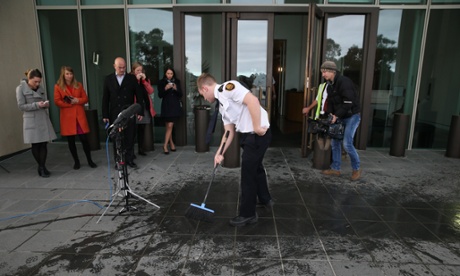
While we are still in security space, I should mention that the Asio boss David Irvine will address the National Press Club at lunchtime. His speech has been given a Le Carre sort of title: Diligence in the shadows – Asio’s responsibility.
Irvine is retiring very shortly.
What on earth was Tony Abbott thinking? Seriously. Lead us not into derptation.
Now in mentioning the foreign minister’s radio interview earlier this morning I neglected to tell you all that Julie Bishop is off to Jakarta later today to sign a new code of conduct with the Indonesians concerning the use of intelligence. This was prompted by Guardian Australia’s revelation that in 2009, Australian intelligence attempted to tap the phone of the Indonesian president, his wife, and their inner circle. So noted.
I have checked in with the prime minister’s office to establish what they might be saying about Tony Abbott’s report of his travel to the partyroom meeting yesterday.
The prime minister’s office are not denying the story. The statement is as follows:
The Coalition partyroom meeting is a private meeting. All travel is within the rules.
Updated
The trend setter responds.
Well done to @sarahinthesen8 for accepting the #ALSIceBucketChallenge today! No word from @AlboMP... @TheTodayShow https://t.co/M1k7QLLqhy
— Christopher Pyne (@cpyne) August 26, 2014
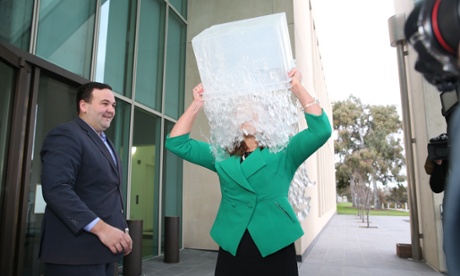
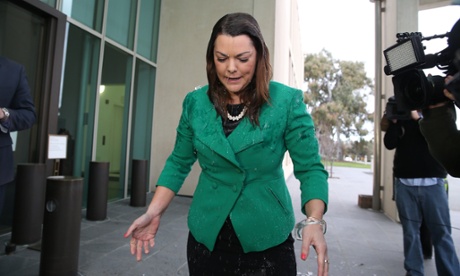
Woman takes on ice bucket. Ice bucket wins.
Updated
With the serious business underway inside, Mike Bowers has been prowling about outside. Yesterday, I linked Politics Live readers to evidence that the education minister, Christopher Pyne, had joined the ice bucket challenge.
This morning, Green senator Sarah Hanson Young has gone the ice bucket – responding to a challenge from Pyne. We’ll have some pictures of that shortly. Hanson Young has challenged Christine Milne, Clive Palmer and Scott Morrison to follow her lead. Hang on to your ice buckets folks, it’s going to get a bit crazy.
It’s the normal brisk sort of parliamentary morning. Turnbull is bolting down his NBN report with a visit to the ABC AM studios. But the communications minister was, however, asked about various stories in the news cycle, including this offering in Fairfax – which contends that Tony Abbott told yesterday’s partyroom meeting that he had to tack on a function at a cancer centre yesterday morning in order to justify billing taxpayers for a trip to Melbourne for a party fundraiser the evening before.
Turnbull was asked on AM whether this was true. The communications minister seemed slightly wrong footed by this line of inquiry.
Turnbull:
I am not sure .. what .. are you saying .. did he say that to the partyroom?
No he didn’t say that to the partyroom. The way you phrased it doesn’t sound right.
AM host Michael Brissenden says he’s simply trying to establish whether the story is true. Turnbull says the prime minister told the partyroom he’d been to Melbourne for a fundraiser and a visit to the cancer centre. Brissenden asks whether Abbott told the partyroom, in essence, that he tacked on the visit to the cancer centre to justify claiming expenses for the fundraiser?
Turnbull:
I don’t recall him saying that, no.
Down in another ABC studio, the foreign minister Julie Bishop is out on the counter-terrorism theme. She tells Radio National Breakfast host Fran Kelly that she’s hopeful that the prime minister will be coming with her to the UN leaders week in September to pursue a proposal Australia is developing with America on the problems posed by foreign fighters returning from sectarian conflicts.
On Iraq, she says Australia has not been asked to contribute to a military campaign, just the current humanitarian effort. If Australia is asked to contribute further, she says the government won’t seek parliamentary approval – it will go through the normal processes, Cabinet consultation and consultation with the opposition.
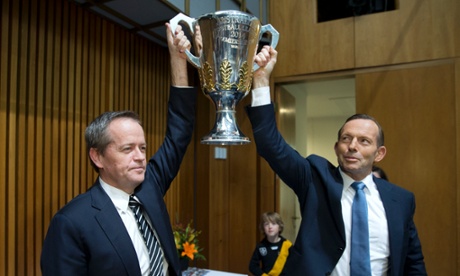
Good morning everyone and welcome to a Wednesday in Canberra where everyone’s a winner. Well, that’s the vibe from Mike Bowers opening shot for Politics Live this morning.
Mike went along last night to a friends of AFL event in parliament house – and it was well attended as you can see. Feeel the bipartisanship. As far as we are aware there has been no diplomatic fallout from Tony Abbott’s description of the game as “the ARL.” Yes prime minister, that was the entire room laughing at you – not with you. Abbott, a rusted-on rugby type, actually does a nice line in self deprecation on matters AFL, and I gather last night was no exception.
The communications minister Malcolm Turnbull is the standout winner of the political morning. The first study undertaken on the NBN project gives a big tick to Turnbull’s preferred method of rollout. As my colleague Helen Davidson reports this morning: “The best plan for a national broadband network is to extend it to households through a variety of technologies instead of fibre-to-the-premises because it is cheaper now and can be more easily upgraded later, a major cost-benefit analysis has found.”
Labor, feeling less of a winner, having no real working basis for comparison, having not conducted its own cost benefit analysis on the project, is crying foul. The argument this morning is the Turnbull panel was stacked with critics of the Labor NBN. Shadow communications minister Jason Clare says if you put a bunch of people who hated the last model in charge of endorsing the new model then you will likely get the result you want. The report is a case of
.. putting foxes in charge of the hen house.
The NBN cost benefit analysis is the main political story of the morning, but there are others, which we’ll get to shortly.
The Politics Live comments thread is open and waiting for your business, so get amongst it. Have a chat to us on Twitter if you’d prefer. You can get me there @murpharoo and the man with the camera @mpbowers One of these days I’ll check in with you on our Facebook page as well.