
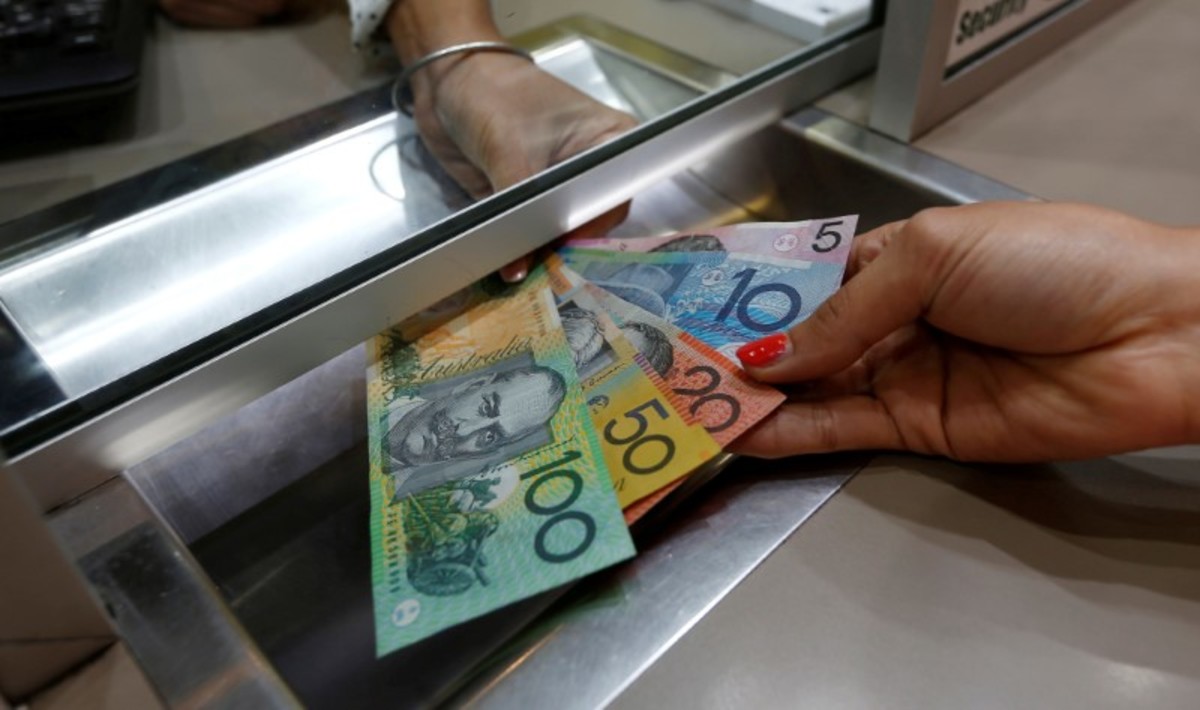
SYDNEY/WELLINGTON (Reuters) - The Australian dollar slipped on Thursday after figures on retail sales and international trade missed forecasts, while a return of risk appetite globally gave the New Zealand dollar a modest lift.
The Australian dollar <AUD=D4> eased to $0.7990 (0.6124 pounds), from an early top of $0.8019, again struggling to clear stiff chart resistance above the 80 cent barrier.
Not helping were data showing retail sales went flat in July, when analysts had looked for a rise of 0.3 percent. Australia's trade surplus also unexpectedly narrowed to A$460 million as exports disappointed.
The miss on sales in particular suggested the economy might struggle to maintain momentum after a solid second quarter.
"A modest sub-trend pace of activity seems likely to persist for some time, with the headwinds for consumers intensifying as utility prices rise and squeeze disposable income," said Su-Lin Ong, a senior economist at RBC Capital Markets.
That was one reason she doubted the Reserve Bank of Australia (RBA) would be in any hurry to ape its Canadian counterpart by raising interest rates.
The Bank of Canada surprised many on Wednesday by hiking rates to 1 percent, its second move this year.
In marked contrast, the head of the RBA this week said policy would need to stay stimulative for some time given unemployment was still too high and inflation too low.
The divergence saw the Aussie slump 1.1 percent overnight to an eight-month trough of C$0.9730 <AUDCAD=> and technicals implied a risk of a drop to C$0.9600 near-term.
The New Zealand dollar <AUDNZD=> also got a much needed lift against the Aussie, which had been up at 16-month highs in recent days.
The kiwi was a shade firmer on the U.S. dollar at $0.7210 <NZD=D4>, though off Wednesday's $0.7261 peak.
The currency has struggled in recent weeks amidst a hotly contested race to the national election on Sept. 23. The centre left Labour Party has come from behind to run neck and neck with the ruling centre right National Party, leading to some uncertainty among investors.
"The length of time it takes to form a government may cause some jitters," said Jarrod Kerr, senior interest rate strategist at CBA. "Common sense suggests the NZD, equities and market confidence will decline with the uncertainty in a change in government."
"But history shows any reaction is not lasting. The parties are centralist enough, predictable enough, and certainly not radical enough to generate too much concern," he argued.
New Zealand government bonds <0#NZTSY=> eased, sending yields 2.5 basis points higher at the long end of the curve.
Australian government bonds likewise dipped, with the three-year bond contract <YTTc1> off 5 ticks at 97.980. The 10-year contract <YTCc1> fell 4.5 ticks to 97.3600.
(Editing by Shri Navaratnam)














