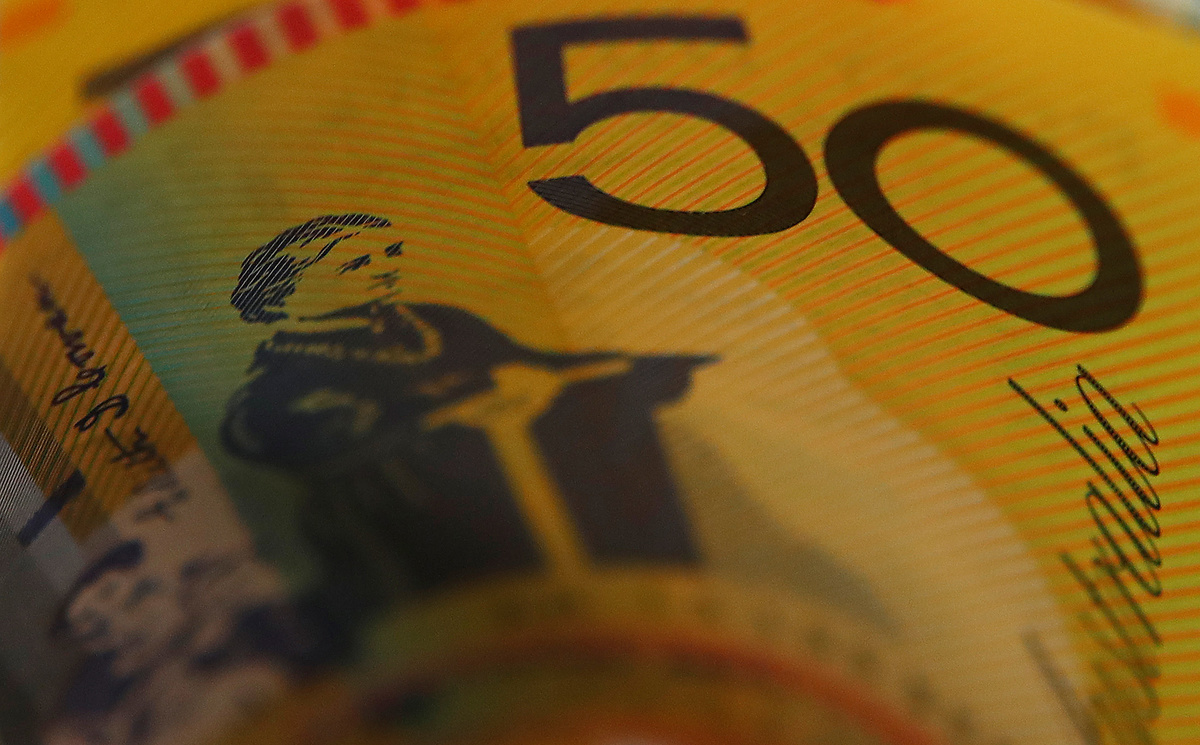
SYDNEY (Reuters) - The Australian dollar fell sharply on Wednesday after the country's central bank stepped back from its long-standing tightening bias, saying the next move in rates could just as well be down as up.
The Aussie slid 1 percent to $0.7163 in the wake of the shift as investors narrowed the odds that interest rates would have to be cut this year given mounting downside risks at home and abroad.
Futures now imply a 68 percent probability of a quarter point drop in the 1.5 percent cash rate by year end, compared to 50 percent before the comments.
Australian government bond futures jumped, with the three-year bond contract adding 8 ticks to 98.330. Yields on two-year paper dropped to 1.80 percent, lows not seen since December 2017.
Reserve Bank of Australia (RBA) Governor Philip Lowe said the bank remained optimistic on the economic outlook but acknowledged rates might fall if unemployment were to rise and inflation stayed too low.
"Over the past year, the next-move-is-up scenarios were more likely than the next-move-is-down scenarios. Today, the probabilities appear to be more evenly balanced," he said.
The RBA has left its official cash rate at a record low of 1.50 percent since August 2016 and Lowe had repeatedly emphasised the next move was more likely to be up.
"The Governor has shifted the RBA's forward guidance to a neutral stance," said CBA senior economist Gareth Aird.
"We continue to believe that Lowe is a reluctant rate cutter," he added. "But equally, the RBA looks further away from a hike than we previously thought. As a result, we have pushed our RBA hike call from November 2019 to November 2020."
Lowe did emphasise that the bank remained optimistic on the labour market and that it was "entirely plausible" the next move in rates would be upward, albeit not for some time.
"It's clear the outlook for the unemployment rate and the labour market are key for monetary policy," said Ivan Colhoun, chief markets economist at NAB.
"The Bank believes it has room to be patient, but it’s likely that the only way rates could move this year would be down, if they move at all."
The shift in stance echoes the U.S. Federal Reserve's move last week to all but drop its plans for more rate hikes. The European Central Bank has also sounded less certain that it will start tightening later this year.
The Aussie duly lost ground to its New Zealand cousin, falling 0.8 percent to NZ$1.0411. That in turn helped the kiwi hold at $0.6882 against the U.S. dollar.
New Zealand markets were closed for a holiday on Wednesday.
The Aussie drew some support from steep gains in prices for iron ore, a huge export earner for Australia, after miner Vale SA declared force majeure on some contracts.
Vale has had to cut production since a dam disaster in Brazil, sending iron ore prices to a two-year peak.
(Editing by Shri Navaratnam)