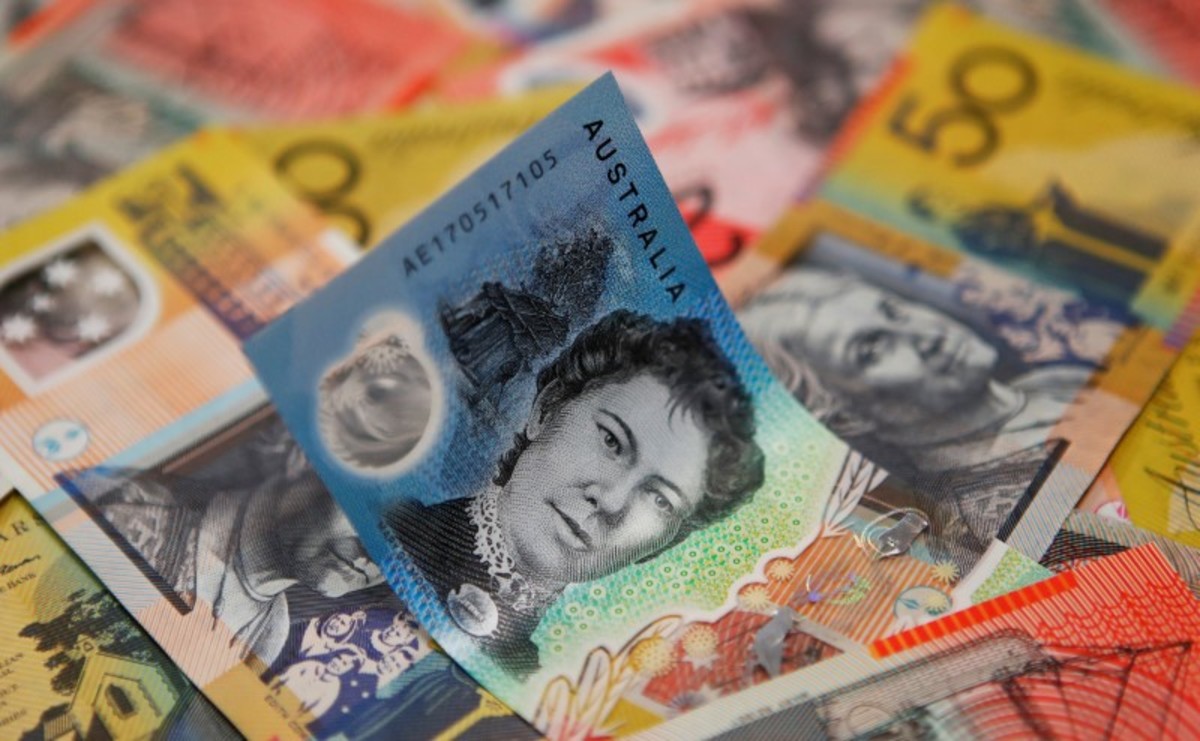
SYDNEY/WELLINGTON (Reuters) - The Australian dollar sank to one-year lows on Tuesday as intensifying trade tensions between the United States and China darkened the outlook for global growth, hitting commodities and driving demand for safe-haven bonds.
The Aussie dollar <AUD=D4> was pinned at $0.7408 having been as deep as $0.7394, the lowest since June last year. The next major support was a $0.7372 trough from early June in 2017, followed by a $0.7329/7333 double bottom from May that year.
The New Zealand dollar <NZD=D4> fared somewhat better at $0.6937, with speculators focusing on shorting the more liquid Aussie as a hedge against potential weakness in Chinese and emerging markets.
The Aussie has shed over two U.S. cents since last week's announcement by U.S. President Donald Trump of a 25 percent tariff on $50 billion worth of Chinese products.
Beijing responded with tariffs of its own, leading Trump on Monday to threaten a 10 percent tariff on $200 billion of Chinese goods.
China is Australia's single biggest export market and easily the largest buyer of its commodities, so any development that risks a slowdown in China is seen as negative for the Aussie.
The currency is also used by investors as a liquid proxy for wagering on global growth and resource prices in general.
Adding to the pressure has been a rise in U.S. interest rates to above those in Australia, a gap that seems set to only widen.
Minutes of the Reserve Bank of Australia's (RBA) June policy meeting released on Tuesday showed policy makers were more optimistic on growth and wages, yet still in no rush to lift rates from all-time lows.
Westpac analyst, Elliot Clarke, predicts U.S. rates will be 112 basis points above those in Australia by mid-2019, by far the biggest premium in modern history.
"Out along the curve, risks to inflation and fiscal uncertainty in the U.S. are set to keep U.S. government yields well ahead of those in Australia, further aiding the U.S. dollar," argued Elliot.
"We believe the Aussie will inevitably lose altitude to $0.7200 by March 2019, and test $0.70 in the second half of the year."
Australian 10-year bond yields <AU10YT=RR> dipped to 2.63 percent on Tuesday amid the shift to safety, putting them 26 basis points under their U.S. counterparts.
Government bond futures firmed, with the three-year bond contract <YTTc1> up 2 ticks at 97.885. The 10-year contract <YTCc1> rose 4.5 ticks to 97.3600.
New Zealand government bonds <0#NZTSY=> likewise rallied, with yields down as much as 4.5 basis points.
An auction for dairy, New Zealand's biggest goods export, was due to take place overnight with futures markets suggesting a decline in prices for the second time in a row due to higher global supply.
Economists were also forecasting figures due on Thursday to show GDP growth had slowed in the first quarter in the face of headwinds from softer migration and housing.
(Editing by Jacqueline Wong)