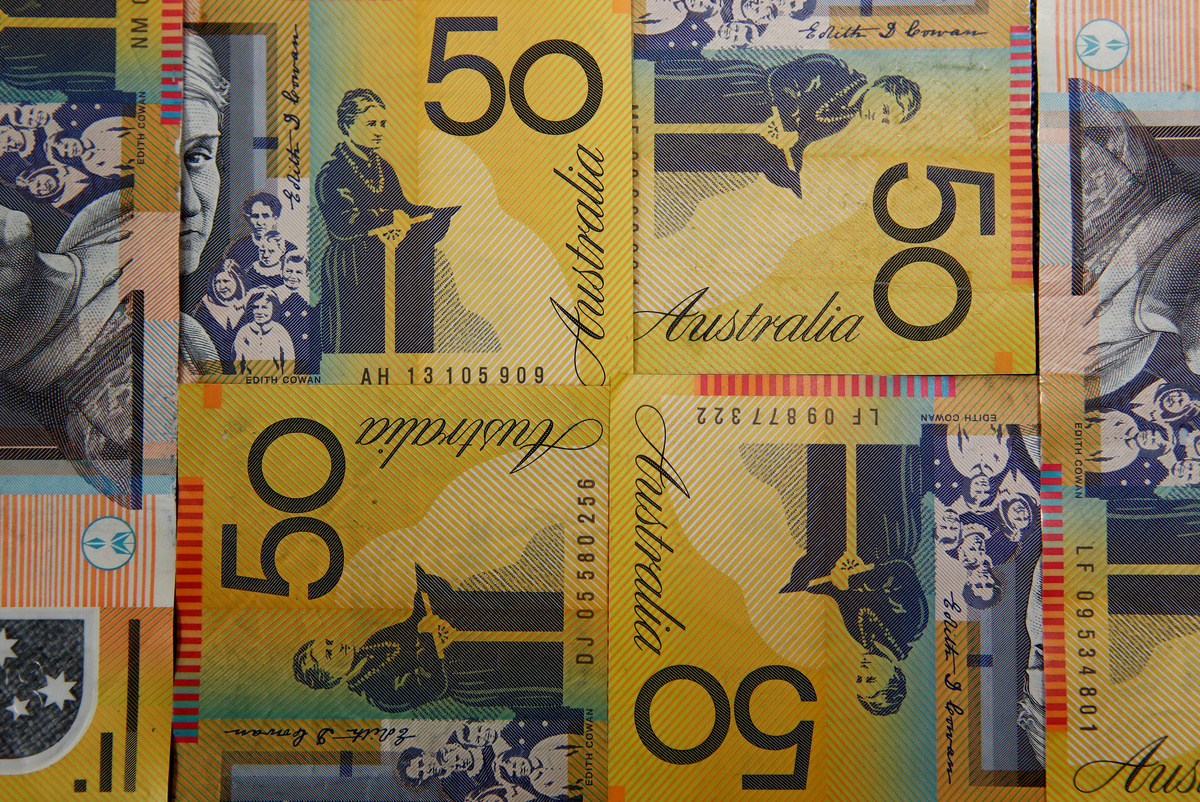
The Australian dollar climbed to a seven-week high on Wednesday, with its New Zealand cousin not too far behind, as optimism about progress on opening economies globally whetted risk appetite.
A surprisingly high reading for Australian inflation added an extra fillip, though a dive into deflation is likely this quarter as the impact of the coronavirus lockdown is fully felt.
The Aussie rose 0.5% to $0.6527 <AUD=D3> for its sixth straight session of gains. That took the currency back to the level of early March, before market panic over the pandemic sent it crashing more than 10 cents to a 17-year low of $0.5510.
The kiwi dollar added 0.6% to $0.6094 <NZD=D3> and was nearing a top of $0.6131 touched earlier this month. A break there would open the way for a return to the $0.6300 area held in early March.
"The AUD continues to push ahead, in part because of declining volatility in other asset markets," said Ray Attrill, head of FX strategy at NAB.
"Though the run up this month has extended far beyond what the improvements in risk metrics most pertinent to the AUD would justify."
He said the Aussie had surged 6.3% on the U.S. dollar so far in April, outpacing all its major peers.
"This is quite extraordinary and does leave us a little cautious about the near-term outlook, especially as the calendar clicks over into May," he added.
The rally has prompted NAB to revise up its longer-term forecasts for the currency, which it now sees reaching $0.6750 by year-end and $0.7200 by the end of 2021.
Australia's success in containing the virus has helped the Aussie's rise, though the economic damage done by the lockdown is yet to fully show in the data.
Figures out Wednesday showed inflation had picked up to a 5-1/2-year high of 2.2% in the first quarter, finally taking it back into the Reserve Bank of Australia's (RBA) target band of 2% to 3%.
However, that progress is likely to be entirely wiped out this quarter as large parts of the economy shut down and oil prices collapsed.
"The demand shock from the virus crisis is about to plunge Australia into the deflationary world, a world experienced by Japan and Europe in recent years," said Ryan Felsman, a senior economist at CommSec.
"The huge impact of the economic shutdown will see deflation persist for a few quarters."
This unwelcome outlook is a major reason the RBA has committed to keep cash rates at a record low of 0.25% for the next three years.
That in turn limited the reaction in the bond market, with the three-year future <YTTc1> steady at 99.740 despite the higher inflation number. The 10-year contract <YTCc1> added half a tick to 99.0850.
(Editing by Clarence Fernandez)