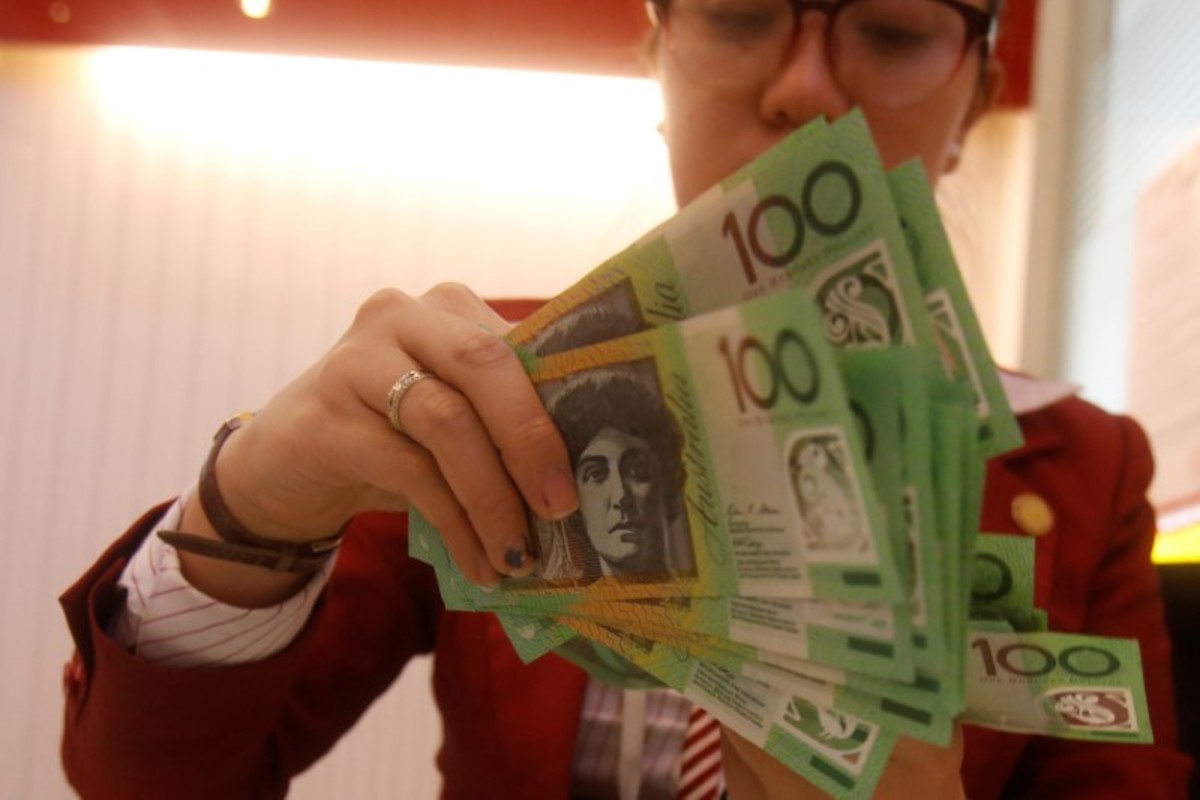
SYDNEY/WELLINGTON (Reuters) - The Australian dollar took a knock on Wednesday as the country's economic growth just missed forecasts for last quarter, while weakness in consumer spending underlined the case against a rise in interest rates for months to come.
The Aussie <AUD=D4> slipped a quarter of a U.S. cent to $0.7584 and left behind Tuesday's all-too brief top at $0.7654, which will now act as chart resistance.
The pullback came as data showed Australia's economy grew 0.6 percent in the third quarter, from the previous quarter, just under forecasts of 0.7 percent.
More troubling was the parlous state of consumer demand as meagre wage growth and high debt sapped spending power.
"Household consumption almost flatlined and the savings rate has fallen off a cliff," said Michael Workman, a senior economist at CBA.
"There was no sign of inflation either, meaning the Reserve Bank is on hold for a long time to come."
Just Tuesday, the Reserve Bank of Australia (RBA) held rate sat 1.5 percent for a 15th straight policy meeting and cautioned household spending remained a "source of uncertainty".
Interest rates futures <0#YIB:> are not fully priced for a quarter-point hike until March 2019.
Neither is there any prospect of a rise in New Zealand interest rates anytime soon with the head of the country's central bank this week saying policy might have to be eased next year if inflation did not pick up as expected.
The kiwi dollar <NZD=D4> was stuck at $0.6881 on Wednesday, after faltering at $0.6908.
"The NZD met some resistance just over the 0.69 mark and has slipped in overnight trading," said BNZ currency strategist Jason Wong.
The latest global auction of dairy, New Zealand's largest good export, did show a rise in prices, though that followed four straight falls.
New Zealand government bonds <0#NZTSY=> gained, sending yields 5.5 basis points lower at the long end of the curve.
Australian government bond futures bounced in the wake of the growth data, with the three-year bond contract <YTTc1> up 4.5 ticks at 98.020. The 10-year contract <YTCc1> rose 7 ticks to 97.4550, leaving cash yields a slim 18 basis points above comparable U.S. debt.
(Editing by Simon Cameron-Moore)