The so-called Pool of Death has yet to turn unbearably hellish but for Australia the water temperature has just got hotter. There were no scented candles or soothing oils here, just the nagging realisation that a potentially crucial bonus point failed to materialise. In terms of stress-busting opening games this was not what the flying doctor ordered.
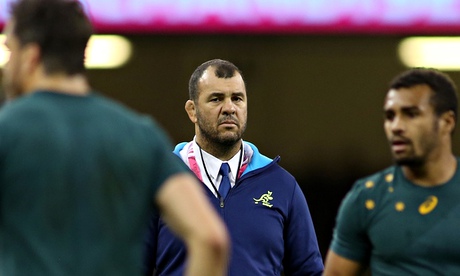
It was even more puzzling to hear the Wallabies’ coach, Michael Cheika, suggest after the game that “we haven’t even thought about bonus points”.
Really? Cheika He might just regret that throwaway line in a couple of weeks’ time. While his side have no serious injuries and a first victory safely in the swag bag they really should have taken more from the game.
Australia, ultimately, were not unlike England on the opening night – good in parts, unconvincing in others. When they scored their third try after 43 minutes to take a 25-3 lead it seemed a formality that the fourth would follow. Unlike England their bench arrivals proved rather less productive against a Fijian team which again gave a decent account of itself.
What kind of message this will send to England and Wales is debatable. The Wallabies were not good enough to make their rivals panic nor were they bad enough to make them complacent. Instead David Pocock and friends came across as England’s worst nightmare: talented but unpredictable opponents with plenty still to come.
In Pocock, who scored two tries in five first-half minutes playing at No8, Australia also have a man making up for lost time. The back-row forward has won a half-century of Test caps for his country but has not played against England since 2010; on this evidence his first brush with Stuart Lancaster on Saturday week at Twickenham is set to be every bit as unrelaxing as this weekend’s appointment with Wales.
There are clearly bigger No8s out there but none with Pocock’s range of skills: turnovers, support running, stamina, tackling, leadership. In tandem with the equally energetic Michael Hooper at flanker it gives opponents no respite. Pocock has a fine rugby brain, too, which tends to ensure he is in the right place at the right time. His brace of neatly taken tries further underlined that point. The man of the match award was one of the tournament’s simpler adjudications.
Aside from Pocock, two other individuals stood out: Fiji’s Nikola Matawalu – who recently signed for Bath from Glasgow – will light up the English Premiership if he stays fit while Matt Giteau’s calm authority at 12 for Australia showed the value of a second playmaker who can ease the pressure on his fly-half. What will stick in the minds of England’s coaches, however, is the way Fiji made life uncomfortable for their opponents despite being given little leeway by the referee, Glen Jackson.
At two Wallaby scrums in the first half the ball just sat there, unmoving as a slumbering wombat, with Stephen Moore unable to strike and Fiji going nowhere. There was also scant evidence that Bernard Foley is a fly-half about to tear the rest of the world apart. If Cheika is trying to lull Lancaster into a false sense of security regarding the current form of his half-backs he is in danger of succeeding.
It might have been even tougher for Australia had Fiji not had a five-day turnaround between their match against England and this one. As with Japan at Kingsholm, it will never be known what might have happened had the scheduling been slightly more equitable.
Australia will play on Sunday but their opponents will be Uruguay, against whom they can field a totally different starting XV. The battered Fijians have had no such luxury, though Wales cannot yet rest easy.
The occasion itself was nevertheless an excellent one; 67,253 spectators for a midweek game in Cardiff in term-time not involving Wales is no mean figure. For Australia, though, this is no time to dwell on peripheral details. In the World Cup’s most shark-infested pool, a lost bonus point could come back to bite them.