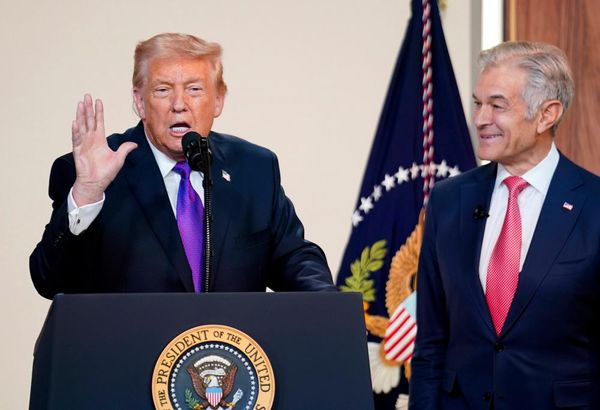
A quick recap of the three premiers on Q&A
Alright, so what did we learn from that?
Well, not much.
Daniel Andrews would not say when students were likely to return to schools in Victoria except that it would be by the end of term two, which he has said previously.
Andrews and Gladys Berejiklian said they will consider economic reforms like cutting payroll tax and stamp duty in order to support businesses through the recession caused by the coronavirus, but did not make any solid commitments. They said there was an opportunity for structural economic reform and what form that reform might take was under active consideration.
Berejiklian said that “thirteen out of 14 [cruise ship] disembarkments were successful in New South Wales,” it’s just that the 14th was the Ruby Princess. She said that a “mistake-free pandemic is impossible, it would be miraculous”.
Annastacia Palaszczuk would not give an indication of when Queensland might lift its hard state border, but said Queenslanders may be able to travel within Queensland in June or July. She would not say when regional areas in Queensland might enjoy more freedom, because there are still people in those areas in quarantine.
All three premiers said Australia’s situation could have been much worse and while we were now facing difficult economic times, they were grateful to be grappling with how to reopen the economy rather than coping with tens of thousands of deaths per state.
We did not, however, learn to what extend these larger states were able to strong-arm national cabinet and the federal government into following their lead on introducing the shutdown in the first place, and closing schools. That inside story, when told, will be well worth reading.
On that note, I’ll say goodnight. You can continue to follow our rolling global coverage here. Stay safe, work on your list of five to 10 visitors (depending on jurisdiction) and we will see you in the morning.
Also, if you thought the person asking the first question tonight looked familiar you’d be right.
That was Kirsten Armstrong, who is the director of knowledge and innovation at the Fred Hollows Foundation. She is also one of the AFR’s 100 women of influence.
The final question was from a man named Corey from New Zealand, asking when he might visit family in Australia.
Berejiklian jokes that she may be able to visit Auckland before she can visit Cairns, and says Australia needs to resolve its internal borders before it looks at creating a trans-Tasman bubble.
Craig Rowley from Seahome, Victoria asks what Australia’s economic drivers will be if immigration tapers off post-pandemic.
Berejiklian says there will be some changes to the economy. She if focusing on manufacturing.
What about cutting payroll tax and/or stamp duty to help businesses?
She says she is “absolutely” willing to look at reform in those areas, and also to cut red tape, which is something she was already inclined to do.
The treasurer and our team are focused on the opportunities this brings to us to become more efficient. You find you let go of processes which are cumbersome during a pandemic. You forego red tape which is normally part of our lives.
Andrews is also asked the payroll tax question, and dodges it.
He says there “will have to be change”.
If we assume things go back to the way they were that would be very foolish. ...there’s also a big obligation for us to do things differently. We need to have hopefully for the first time in a long time a mature debate where we argue things on their merits and we don’t get led down these ideological paths, which are usually about cheap politics.
He says that national cabinet could be a circuit breaker for the kind of IR reform that Australia has, of late, decided on ideological lines.
Rather than the usual old favourites of jack up the GST or let’s cut wages by IR reform, let’s look at IR sensibly. The people of people that don’t have secure working hours and conditions has been exposed through this pandemic. People who don’t know if they have a shift tomorrow until they get the text message at 11pm tonight, they’re some of the most vulnerable.
It’s wonderful to see he still has such hope.
Next question is about football. Why is the NRL given the green light, when so many people are out of work and unable to work due to coronavirus restrictions?
Palaszczuk says the NRL is a workplace.
They’ve got to abide by the conditions they’ve put forward and it’s up to the NRL or the respective codes to endorse their plan and make sure it’s adhered to.
Andrews says he’ll leave it to the AFL to make its own decisions, but that if it can be done safely there is a net community benefit to the reutnr to sport
It’s a big part of the way our country operates and the feedback I get is almost universal, people want to see footy back. I’m pretty confident it will be done safely.
Hamish asks Berejiklian about the disruption in her own cabinet. She first answers Nick from Mandurah’s question.
I’m we got that question today and — I’m glad we got that question today and not why thousands had died in New South Wales. That’s where we were heading.We knew by looking at places overseas if we did not take action when we did, we literally would have had thousands of people who would have perished by now already.
I’m grateful we’re in this position. Given the other questions raised subsequently, I do feel now the pendulum has to shift. New South Wales is in a position where we do want to get our economy going and we’re looking for the pathway, the safest way to do that.
Yes, but what about the issues in cabinet?
If it’s not life and death, I don’t worry about it.
A man named Merwyn in Queensland (apologies, I missed his last name) asks about former treasurer Jackie Trad resigning over a corruption investigation, and whether management of the pandemic will be set aside as the government manages factional disputes.
Palaszczuk says no. She had replacements in cabinet in 48 hours
Next question is from Nick Valentine in Mandurah, WA. He says that by this time next year we will have a virus for Covid-19 (that’s a strong maybe), and the road toll will be 10 times higher than the number of lives lost from Covid-19 in Australia.
Do the premiers believe it was worth ruining our economy over COVID-19?
Andrews is up first. He says it was a tough decision, and no one entered into the decisions lightly, but that if the virus got away from them it would have been “deadly”.
It does also very significant economic damage if it runs wild. There are very big health and economic challenges throughout Europe, the US, the UK. This is a health challenge first and foremost and the best economics is to fix the health problem and then move to repair the inevitable damage, damage that saves lives but it does cost jobs.
He says the choice was between repairing economic damage and having tens of thousands of people die.
Palaszczuk says that peoples lives have been turned upside down, but “the initial modelling we had was if we didn’t flatten the curb, in Queensland there could have been 37,000 people who lost their lives”.
You only have to look at what’s happening in the US. Thank God we live in Australia and all worked together at the National Cabinet level. If that hadn’t happened, I don’t know where we would be. We have worked collectively together and put people first.
She says the focus is now on getting people back to work.
Berejiklian says she would prefer to keep a one size fits all approach to restrictions in NSW to “avoid confusion”.
The feedback wore getting from our regional communities is that whilst they do rely on tourism for economic uplift, they’re very cautious about welcoming people into their communities because they’re conscious there might be COVID-19-free but that might not always be the case.
She says that Victoria and NSW decided not to close their borders because people living in those border communities, like Albury-Wodonga, do not see the distinction between the states so imposing a hard border wouldn’t work.
Neither NSW or Victoria are allowing regional travel at this stage. They said they will monitor and allow that travel when they are comfortable.
Callan Oar from Ayr in northern Queensland has a question for Palaszczuk.
How is it fair that other than a small cluster in Cairns there have a been no known locally acquired infections north of the Fraser Coast, yet we North Queenslanders are subject to the same draconian-type restrictions as the south-east? ...When can we get back to business?
Palaszczuk says the lack of any known cases does not mean that there’s no risk in northern Queensland.
We have 2,000 people still in quarantine throughout Queensland. Which means they have the potential to have the virus and spread it. We need to be very vigilant and make sure we are getting to clamp down on it as much as possible.
She says opening up those regions will depend on the number of people still in quarantine in those areas.
Queenslanders will be able to holiday in Queensland from June or July, premier says
Annastacia Palaszczuk is asked when the Queensland border will be reopened. She says that depends on rates of community transmission in NSW and Victoria.
But I’ve said very clearly we’re going to review our borders at the end of each month and we’ll take it from there and see how it goes. Hopefully by June and July we’ll be able to have people travelling around Queensland.
But it might be a little bit longer before we see our southerners comeback to Queensland. We love you dearly. We want you to come to Queensland but not at the moment.
The next questions is from Catherine Kopec in Burwood, Victoria, about the outbreak at Cedar Meats.
What will you do to ensure employees, including teachers, are safe to go to work? What will you do to guarantee that employers follow strict guidelines?
Andrews says “we’re going to see further outbreaks” and the key to managing them was a lot of testing and rapid contact tracing.
Asked why the government took so long to publicly identify Cedar Meats as the site of an outbreak, Andrews says deciding to identify a place of work as the site of an outbreak is a matter for the public health team.
He said there would be “learnings all the way along” in terms of how to appropriately manage localised outbreaks. He praises both the public health team and the abattoir workers.
The next question is about Newmarch House aged care home. By allowing sick residents to remain out of hospital and in the residential aged care home, the questioner says, it has increased the risk for healthy residents at the home.
How does a sick person’s desire to stay out of hospital override the rights of those who are well and at risk of contracting the virus and even dying?
Berejiklian says it’s a “vexed moral and ethical questions”.
It would be wrong for politicians to make those decisions. The best health advice we have is it is up to the individual residents and their families on what their preference is for their treatment and about their future.
She says that the aged care regulator stepped in to monitor the situation, and repeats that it would be inappropriate for politicians or the national cabinet to step in or override health advice.
The health advice says assess the person’s condition and also assess their choice on what their preference is given their condition. It’s not a hard and fast rule for every single person.... We’ve had a number of instances in New South Wales where there have been examples where things have been handled extremely well and others where things have not been handled well.
She said the expectation is that everyone who manages an aged care home assumes they are going to have a Covid-19 outbreak and has a plan in place.
Berejiklian on the Ruby Princess: 'A mistake-free pandemic is impossible'
To the Ruby Princess. Olympia Kwitowsi from Salisbury in Queensland asks Berejiklian why people should be listening to her, given her government let that cruise ship in.
Berejiklian makes a quip that Olympia should ask her own premier, is reminded by McDonald that 10% of Australia’s coronavirus cases come from the Ruby Princess.
She acknowledges that, and says she does not want to cut across the commission of inquiry or the police investigation.
This reply is a bit of a mess. Berejiklian keeps repeating that “thirteen out of 14 disembarkments were successful in New South Wales”.
A pity the 14th was the Ruby Princess.
I’m not going to promise there won’t be further mistakes. There might be in my state and maybe elsewhere, but we have to pick ourselves up and move forward. A mistake-free pandemic is impossible, it would be miraculous. We take learnings and move forward but I can’t promise there won’t be other mistakes into the future. We need to make sure we have the social distancing and contact tracing in place to protect our citizens as much as possible.
Berejiklian is asked why she was confident that students could safely return to school in NSW from this week.
She said the advice was the biggest risk was transmission between teachers, and NSW had spent weeks getting PPE and sanitary equipment in schools
And just to demonstrate our capacity of preparedness, we extended all of our cleaning contracts. Every school has extra cleaning during the day. Extra provisions in place to mitigate the risk to anybody.
Next question is from Tori Hill in Malvern, Victoria. Why can’t kids in Victoria return to school?
Andrews is not really able to say why the rules are different on returning to school in Victoria than in NSW or other states, but he says by the end of the term “I think most states will finish up in about the same place.”
He says that “every state’s in a different position”.
We took the position and the view that it simply wasn’t a good thing to have a million students going to and from school hundreds of thousands of teachers and parents going to and from school every day.
McDonald asks Andrews to tell parents when they might expect to have their kids back in schools in Victoria, so they can plan. Andrews says he won’t announce that on Q&A.
We’ll have an announcement soon. As important as this program is, we’ll make announcements for all Victorians at the appropriate time. We’re very close. There’s details that have to be settled about the nature of that staggered return. We can confirm tonight that we will have our kids back to face to face learning before the end of term two.
The next question is about the protests that were in Melbourne yesterday, at which 10 people (from a crowd of about 250) were arrested.
Andrews says it was an “ugly scene” and while he supports peaceful protest, this wasn’t that.
If it’s not peaceful, it’s not a proper legitimate protest. We saw police injured. That’s something that we can never accept.
This pandemic is very real. If you don’t think theAustralian experience is something that you should trust, if you need to look further afield, turn your TV on and have a look at what’s happening in Europe and America.This is very serious. If it gets away from you, thousands of people will die.
Berejiklian:
I think the bottomline is to Dan’s point, if you’re out protesting you have to exercise social distancing. I have no issue of what people do when they leave the home as long as they’re within the rules. No matter what you’re up to, even if you’re have a picnic with your best friend, keep the 1.5m.
Andrews responds by talking about Victoria’s testing quota, which Hamish says was not the question.
Andrews says he was unhappy to see images of a number of people in Victoria at shopping centres potentially buying things they don’t need (how do you know, Dan?).
He says we have just one chance to get this right and if he had to, he would tighten the restrictions again.
Andrews:
If I got advice from our chief health officer... that we no longer had control, things had got to a point where we were going to see a significant spike in cases and our hospital system fundamentally overrun, then of course we’d have to reintroduce some of these sanctions. That’s in our own hands in many ways. If people change their behaviour but keep pace with the rule changes that we are making, continue to follow the rules and continue to get tested, we will have many more options in June and we can gradually open up.
The first question is from Kirsten Armstrong in Maroubra, NSW. It’s basically a dixer.
We’ve seen images over the weekend of people at shopping centres seemingly unaware social distancing is still important. With significant outbreaks in New South Wales andVictoria, with most states experiencing a re-emergence of new cases this week, it seems almost inevitable we’ll be having some sort of re-emergence of the disease in the next few months. What’s your trigger, what’s your threshold for reintroducing restrictions that you’re lifting this week?
Gladys Berejiklian responds first, because it’s her state.
I’ll summarise her response, because it’s long and none of it’s new. She says you expect case numbers to rise as you lift some restrictions, cases have fallen significantly since March, it’s all about finding a “healthy balance”, the situation will be monitored to figure out what is manageable over the next few weeks.
Are you prepared to go back into lockdown if numbers increase, Hamish asks?
Obviously if there are significant outbreaks but we’re hoping that’s not the case.
So, we’ve got NSW premier Gladys Berejiklian in the room with host Hamish McDonald and Victorian premier Daniel Andrews and Queensland premier Annastacia Palaszczuk on a fancy ABC version of Zoom.
I have moved the cat off my lap and am ready to go.
Alright, here we go. I have a cup of tea, you might want to go ahead and indulge in something stronger. The bad show will begin shortly.
The day so far
We will be providing live coverage of state premiers Daniel Andrews, Gladys Berejiklian and Annastacia Palaszczuk on the ABC’s Q&A program at 9.30pm. But before we get there, here’s what’s happened today:
- Victoria announced it would relax its restrictions from midnight tomorrow, allowing people to have up to five visitors in their home and outdoor gatherings of up to 10. Regional daytrips are allowed but not staying overnight.
- AFL training is resuming from Wednesday.
- Hugs are still not recommended.
- Another resident of Newmarch House has died, bringing the death toll at that facility to 17. This resident had tested positive to Covid-19, then tested negative twice before they died.
- The CovidSafe app now has 5.5 million registered users and is “operational and working”.
- Scott Morrison has indicated jobkeeper might be “adjusted” to provide more targeted (read: less broad) support. Labor says it may back it if the savings are redirected at workers who missed out.
- Morrison still doesn’t want to talk about sports rorts.
- And he says he would be “extremely disappointed” if China’s proposed barley tariffs were in response to Australia’s push for an independent investigation into the origins of Covid-19.
- Labor leader Anthony Albanese has laid out his vision for a post-Covid world, saying he doesn’t want things to just snap back.
- Carnival Cruises’s port operations manager has told the Ruby Princess inquiry that they didn’t implement a 1.5 metre distancing policy between disembarking guests because he “does not remember it being a requirement at the time”.
- Across the ditch, New Zealand has moved to stage two restrictions, meaning schools have reopened, workers are back in offices, and restaurants and shops are reopening.
You can follow our rolling global coverage here and read a more detailed summary of the day’s news in Australia here. I’ll see you in an hour or so.
Updated
Chief medical officer Brendan Murphy is currently on ABC’s 7.30 program.
It’s a repetition of the lines he said yesterday, and his deputies were saying today.
Asked what keeps him awake at night, Murphy says:
A large second wave. That is the most worrying thing of all. We saw people behaving really badly and congregating ... If people aren’t careful and we have lots of pockets of outbreaks and widespread community transmission, you know, thousands more cases — that is what worries me most of all.
I don’t think it will happen because I think we are as well prepared as we could be, but it will only work if every citizen does the right thing.
Updated
The eased restrictions in NSW do not actually come into effect until Friday, but you have been allowed to surf — where beaches are open — for some time. “Exercise” is not narrowly defined in the public health orders.
But it certainly feels less locked down this week, which may or not be a good thing.

The problem throughout the lockdown period has not been individuals going to the beach, but crowds, or apparent crowds, at beaches. So you can go to the beach for exercise purposes provided no one else has the same idea.

Paul Karp and Luke Henriques-Gomes have been looking into reports the Morrison government is considering “adjusting” the $1,500 jobkeeper payment, just days after the money actually started flowing.
And there are reports that some employers are exploiting the scheme. They write:
Victorian Trades Hall Council’s JobScammer website has received more than 400 complaints from workers about potential rorting of the scheme, the union peak body said.
Luke Hilakari, the VTHC secretary, said the complaints included serious claims such as bosses breaching the scheme’s rules by refusing to pay the subsidy in full or demanding workers increase their usual hours to the value of $1,500 a fortnight.
Other businesses had been accused of “picking and choosing” which employees to include in what is supposed to be a “one-in, all-in” scheme, Hilakari said.
The complaints relayed to trades hall included a childcare company that told workers they would have to increase their hours to earn the $1,500 a fortnight worth of work, and a juice company franchise accused of refusing to backpay staff back to 30 March.
Other examples included a major streetwear retailer who was said to have told their casual employees they were ineligible for the subsidy if they had taken any time off.
Updated
In sad news:
I’m sad to say that my father, Jerry Stiller, passed away from natural causes. He was a great dad and grandfather, and the most dedicated husband to Anne for about 62 years. He will be greatly missed. Love you Dad. pic.twitter.com/KyoNsJIBz5
— Ben Stiller (@RedHourBen) May 11, 2020
Forget golf – Melbourne’s true favourite pastime, purchasing real estate, will be able to resume from Wednesday.
And the Real Estate Institute of Victoria is excited.
Auctions and open-for-inspections will be restricted to 10 people (significantly reducing rubbernecking) and the REIV is “encouraging” real estate agents and anyone attending an auction or open house to download the Covidsafe app. The app isn’t compulsory, and real estate agents will also be taking people’s contact details for contact tracing purposes.
REIV president Leah Calnan said:
Online auctions have worked well over the last few weeks and we encourage members to use this as an additional channel for wider engagement.
Having public auctions will inspire increased confidence in our economy. Auctioneers across the state are looking forward to getting back to what they do best.
Updated
Labor’s foreign affairs spokeswoman, Penny Wong, says Australia’s relationship with China is “not in a great place”.
Speaking to ABC TV this afternoon, Wong said the relationship would benefit from “consistency and discipline and leadership” from the prime minister and foreign minister rather than backbencher-led commentary.
Some Coalition backbenchers, including George Christensen and Concetta Fierravanti-Wells, have been pushing for Australia to take a hard line in its relations with China. Wong also called on the government to provide detailed briefings to parliamentarians on how Australia is handling the China relationship:
I’ve said previously we need to think about the China relationship in 30-year terms, not in three-year terms. Unfortunately, there’s been a little too much from the Morrison government of a reflex to short-term domestic politics on this relationship and more broadly. And we would urge them to take a long-term position and a responsible position, and as much as possible a bipartisan position, when it comes to that relationship that’s in the national interests.
The call comes in the wake of a diplomatic dispute between the two countries over Australia’s call for an international investigation into the origin and handling of Covid-19, which China took to be directed against it.
Tensions intensified when China’s ambassador to Australia gave an interview to a newspaper late last month saying Chinese tourists and students may rethink their plans to visit Australia in the future “if the mood is going from bad to worse”, while consumers may also decide against buying Australian wine and beef.
The government is currently trying to persuade China not to proceed with plans to impose tariffs on Australian barley imports, with Scott Morrison saying the proposal stems from an 18-month-long process and he doesn’t believe it is connected to the recent inquiry proposal.
Updated
Cafes and restaurants in South Australia were open to sit-down customers today, for the first time in seven weeks. I say sit down, not sit-in, because customers have to dine alfresco. It’s limited to a maximum of 10 customers.
People will not be able to eat indoors at restaurants until June.
The SA premier, Steven Marshall, says the change that came into effect today will mainly benefit restaurants that have already switched to take-away service.
It won’t be worth it for many organisations. Some states have told us 10 indoor dining and the industry told us 10 wouldn’t be viable. Even 20 will make it very difficult, so we are trying to work through, with the industry, how we can get them back to being viable as quickly as possible. But we’ve got to do it in a safe way.
Updated
Jobkeeper should be extended, ACCI says
The Australian Chamber of Commerce and Industry chief executive, James Pearson, has commented on proposals to modify the $130bn jobkeeper program.
He told Guardian Australia:
Given the continued global uncertainty, as well as concerns about a second wave of the virus, we believe it is too early to be thinking about restricting the scope of the jobkeeper payment. Rather, we believe its eligibility should be extended, as the amount budgeted for it will unlikely be spent by September.
Businesses such as those relying on international visitors, tourism, hospitality, business events and large entertainment venues will continue to be stymied by both health concerns and the three-stage plan to restart the economy. Providing these businesses with continued and targeted support will be necessary to give them the greatest chance of surviving, and ready to restart with as many as possible of the same employees on their books as before the pandemic began.
Updated
A final very important question for those of us watching the snowfalls at the start of this month: will we be able to go skiing in Victoria?
Sutton says yes – to the extent that you can socially distance while skiing, so daytrips and groups of less than 10. But no staying overnight, no dorms, possibly only cross-country skiing at this point. The full details are likely to be worked out later. The ski season doesn’t open until the Queen’s birthday weekend in June.
Updated
Sutton says that by the end of the month, Australia should have a “decent antibodies test”.
He says a testing program using that test should be up and running in the next couple of months. That will give an indication of how many people in Australia have had Covid-19 and have antibodies.
But he warns it’s likely to be quite low. Even in New York, only about 20% of the population has had and recovered from Covid-19.
Updated
Is it possible we could have a second wave bigger than the first? Epstein asks.
Yes, Sutton says, mainly because our first wave was so small.
We could have tens or hundreds or thousands of cases in Australia. And that’s not scaremongering, that’s just a fact.
He says the limiting factor is how well people can maintain social distancing, even if the restrictions lift.
I guess my nervousness in some respects is a second wave, if people are completely fed up in how they are restrained in their lives and just can’t handle it any more.
Updated
Epstein asks Sutton about the protest outside parliament in Melbourne yesterday.
Sutton says it’s “not ideal for people to be in close contact, and if there are significant gathering size, then the potential for transmission increases”.
I hope people understand that they can make protestations in whatever way they desire, but they should also follow the social distancing rules that are in place for a reason.
Suttons says it’s not a matter of people just risking their own health. If the disease spreads, the chance of vulnerable people getting it grows exponentially.
With infectious diseases, you don’t get to make decisions about other people’s health.
Updated
Sutton says his advice to the Victorian government on if and when schools can reopen is cabinet-in-confidence.
He says he would not oppose a staggered approach to returning to school, which is what Queensland and Tasmania are doing, but won’t be drawn on what he has actually told cabinet.
Updated
Sutton is echoing a lot of the comments made by the national chief medial officer, Professor Brendan Murphy, about personal responsibility and making judgement calls about what is safe to do under these loosened restrictions.
Just as hugs are a matter of personal judgement, when and what to shop for will be matter for a personal judgement, Sutton says.
But we don’t want all and sundry to go there every other day to get something that they think it would be nice to go and shop for. That applies to all of the retail sector ...
If you go in and you can see that people aren’t able to physically distance because of the people that are there, that is not a time to go. I am sure there will be a time that it’s quieter and it will be safer for you to go.
On gatherings, which are now allowed (groups of 10 outdoors and five indoors), he says “don’t gather more than you have to”.
Updated
Victoria’s chief health officer, Professor Brett Sutton, has been on ABC radio in Melbourne talking about the restrictions that will be lifted from 11.59pm tomorrow. He says lifting those restrictions is an “experiment” so the changes will be incremental.
Sutton says there is no number that will trigger the Victorian government to go back to stage three restrictions (which is what we have been in for several weeks). The key concern is community transmission, and Sutton says he would like the daily increase in cases with no known source of infection stay in single figures.
Raf Epstein asks if hugs will be allowed, if he and his kids visit his parents this weekend.
Sutton:
It is about you, I am not about to step into your private life and tell you what you can and can’t do, but that 1.5m distance is there for a reason.
Sutton says he has not made a call on whether he should see his parents yet – it will be based on his health and that of his family, and also the health of his mother and her partner. “I’ll be seeing my brother first,” he says.
If anyone is unwell, he says, they should not join the group – even if they are very mildly unwell.
Updated
Good evening, it’s Calla Wahlquist here taking over from the wonderful Naaman Zhou. I’ll be taking you right through to Q&A (9.35pm on ABC), which tonight will host the east coast premiers, Daniel Andrews, Gladys Berejiklian and Annastacia Palaszczuk.
They run the biggest states and have been the strongest voices in the national cabinet, so it has the potential to be really quite interesting.
Updated
Adelaide Crows players have escaped bans or fines for their part in breaching social distancing rules during a club training session but assistant coach Ben Hart has been stood down from coaching duties for six weeks.
The AFL found the breach was “inadvertent and not done to create a competitive advantage”, and the 16 players each received a suspended one match sanction, in place for the remainder of the 2020 premiership season. Barring any further breaches, they will be available to play once the season resumes.
But Hart, who took the session involving 16 players last Thursday when the club was supposed to be self isolating in the Barossa Valley after returning from interstate travel, was not so lucky.
The Crows maintained they were not deliberately trying to break any rules, but after concluding its investigation on Monday, the AFL found the club to have been in breach of protocols.
South Australia police opted to caution, not fine the club last week, leaving the AFL to mete out punishment, with Hart now largely shouldering responsibility for the aberration. He will not be able to access the club facilities or have contact with players until 22 June.
An AFL statement read:
The investigation found the players had been compliant with the protocols for the majority of a two-hour training session where they had worked in pairs before separating into two larger groups of eight – one group to complete an eight-minute kicking drill, one group to complete an eight-minute running drill in pairs, before swapping. The kicking drill was supervised by assistant coach Ben Hart which is where the breach occurred.
The investigation found the club had provided written and verbal instructions to players and the assistant coach to comply with the protocols in place, however the assistant coach present had accepted that his instruction was not in line with either the rules or the club’s instructions.”
NSW school attendance up 21 percentage points
NSW’s public schools have seen in-person attendance up 21 percentage points since last Friday.
Today, on the first school day since the federal government unveiled its three step plan to easing restrictions, 37% of students attended school in person, and 63% learned remotely.
On Friday, there were only 16% of students on school grounds and 84% at home.
61% of primary students and 74% of secondary students were not on site today, the NSW education department said.
Updated
Fast food chain Hungry Jacks is urging its customers to download the Covidsafe app (via push notification).
Um. Hungry Jack’s just encouraged everyone to download COVIDSafe pic.twitter.com/1uE62TY3uJ
— Ben Grubb 🐛 (@bengrubb) May 11, 2020
This follows earlier reports that McDonalds was doing the same last week.
When even fast food chains are spreading app propaganda. pic.twitter.com/Ydb6NIo15c
— Andrew Harvey 🏠 Home (@mootpointer) May 8, 2020
You know the government is desperate when they’re getting #McDonalds to send you a #covidapp notification wtf? #auspoI pic.twitter.com/C13Fkgrzq7
— ★Erin★ (@ez1985) May 8, 2020
And the assistant treasurer, Michael Sukkar, has confirmed that processing of applications has resumed today.
He says more than 1.2 million people have applied for early access for a total value of over $10bn.
“As the ATO advised superannuation funds last week, it paused the processing of applications for one day to further enhance its systems in response to new techniques criminals are using to try to steal Australians’ identities,” Sukkar said.
“The ATO has identified a small number of third parties who could be susceptible to criminal activity. The ATO is working with these third parties to help them make security enhancements.”
The Australian Tax Office has provided an update on the freeze over the weekend of early access to superannuation after an alleged fraud of $120,000 from 150 workers’ retirement savings.
An ATO spokesperson told Guardian Australia:
The ATO has implemented enhancements to further increase the end-to-end security and integrity of the early release of super program.
The files that were paused on Friday, will be delivered to funds today.
The ATO will now run additional risk filters over all files before they are delivered to funds, and provide additional information to funds to assist them in their own fraud prevention processes. The files will still be delivered to funds within publicised service standards.
Importantly, applications for the early release of super program remain open, and individuals should continue to receive their payments well within service standards.
The ATO is using this as an opportunity to remind Australians to be vigilant with how you store, and who you provide your personal information to. Ensure that you only provide information to trusted advisors and never provide information if you are not certain who you are speaking with. You should never share your myGov login with anyone, including your tax agent. You should be particularly wary of clicking links and emails or text messages that seek your personal information. The ATO will never send you a link to log on to our online services.”
Updated
The deputy chief medical officer Prof Michael Kidd is now on the ABC being interviewed by Patricia Karvelas.
Kidd says that the government is not aiming for “elimination”, where new cases of Covid-19 are zero, but is aiming for “suppression”. He says the stages of reopening the country could see infection rates increase.
“We’re looking at cautious steps and each of those steps needs to be given time to see what the response will be, if we do see significant increases in the number of new infections,” he says.
“At the moment we have less than 20 infections being diagnosed right across the country each day, so Australia is in a very good position at the moment and we want to keep to it that way.
“But we’re not moving towards being able to eliminate the virus in Australia. We’re suppressing the virus and recognising we may get a small number of infections each day.”
Updated
In non-coronavirus news, police have opposed the bail request of the Melbourne Porsche driver accused of speeding and verbally abusing a dying police officer.
Richard Pusey was earlier today charged with three additional charges, and police told the court that Pusey was a serial speedster with “violent tendencies”, AAP reports.
A month before the incident, Pusey allegedly boasted to a friend about going 300 km/h along the same freeway.
“Apparently it [the car] will do 350 [km/h] and it’s coming,” he said, the court was told.
The driver was previously accused of threatening to set himself on fire at a debt collection agency and drive down Bourke Street, in an apparent reference to James Gargasoulas’ rampage.
He also allegedly sent threatening emails to a Westpac employee.
Police informant Aaron Price said Pusey took “disturbing pleasure” in causing discomfort to others.
He displayed “violent tendencies” towards the public and police, and “has absolutely no regard for the safety of other road users”.
Pusey’s lawyer, Vincent Peters, said his client had a pre-existing mental health condition and suggested he went into shock.
The lawyer added his client could not receive the mental health treatment he needed in jail.
The magistrate will decide on Pusey’s bail application on Thursday.
Updated
There are 49 people in hospital from Covid-19, 16 of whom are in intensive care, and 14 people on ventilators.
6,179 people have recovered from Covid-19, Kidd says. And Australia has conducted over 855,000 tests in total.
Kidd is asked whether the start of cold weather in Australia could increase transmission rates.
He says the limits on indoor gatherings are crucial during winter.
“We don’t understand exactly what the impact of the weather has on transmission rates for Covid-19,” he says. “Clearly, as the weather gets colder, people tend to crowd more, we may get more crowding on public transport, or inside, in venues.
“The mechanisms put in place to maintain physical distancing, to reduce the number of people to 4 sq metres in each venue, are incredibly important.”
Updated
5.5m app users as it becomes fully operational
There are now 5.5 million registered people on the Covidsafe app, Kidd says. He adds that it is now fully “operational and working”.
However, the contact-tracing departments of the states and territories have only just completed their training with it, and they won’t be able to use that data for a few days.
“It is operational and working so if you have it on your phone, it will be recording the details of people you have been in close contact with, encrypting those details and storing them on your phone,” he says.
“The national cabinet on Friday agreed to national protocols for the use of the information being stored on the app, and training by disease detectives in each of the states and territories, has been completed today.
“And we hope it will therefore start to be used by disease detectives over the next day or two across the country.”
Updated
"Very serious risks" from overcrowding, says deputy CMO
The deputy chief medical officer Michael Kidd has issued a strong warning as states ease restrictions and people gradually start congregating more.
“We have very serious risks if overcrowding starts to occur,” he says. “Covid-19 is still out there in our country.
“This is not a time to become complacent,” he says. “Each of us needs to continue our strong commitment to maintaining physical distancing of 1.5m from other people whenever we are outside of our homes, and that means avoiding crowds whenever possible.
“If you see a crowd, please go in the other direction.”
He adds: “Going into to a crowded workplace at this time would not be sensible”
Updated
The deputy chief medical officer, Michael Kidd, is now providing the daily coronavirus update.
There have been no new cases in the ACT, the Northern Territory, South Australia, Western Australia, or Tasmania.
And you may have seen earlier today – and last week – my dispatches from the NSW special inquiry into the Ruby Princess cruise ship.
The inquiry wrapped up its sixth day of public hearings today. There will be more hearings and witnesses at some point in the future, but commissioner Bret Walker SC did not specify when. The next hearing dates will be put up on the website when they are ready, he said.
Over the past six hearings, spread over multiple weeks, we’ve heard evidence from the ship’s senior doctor on board, a NSW Health senior epidemiologist, the duty harbourmaster, the acting CEO of the NSW Port Authority, two paramedics, the Ruby Princess’s port agent, and a senior manager of Carnival Australia, who are the operators of the virus-hit ship.
The inquiry must complete its final report by 14 August.
Hi everyone, it’s Naaman Zhou here. Thanks to Amy Remeikis for her incredible work, as always.
Queensland’s new cabinet has just been sworn in, after the sudden resignation of deputy premier and treasurer Jackie Trad.
The ministers assembled at government house today with an appropriate 1.5 metre gap for the official photo, AAP reports.
Health minister Steven Miles is the new deputy premier while Cameron Dick has become treasurer, in addition to his other portfolios.
Tourism minister Kate Jones will also be responsible for state development, while fire and emergency services minister Craig Crawford will pick up Trad’s Aboriginal and Torres Strait Islander department.
Member for Mackay Glenn Butcher has been promoted to cabinet as the minister for regional development and manufacturing.
The reshuffle came less than 24 hours after the Crime and Corruption Commission confirmed it was investigating Ms Trad for the second time in 12 months.
It’s alleged she interfered with the selection process for the principal of a new high school located in her South Brisbane seat.
Trad denied the claim and said she “never expressed a view to anyone on who should fill that role”.
Updated
One of the betting agencies is so desperate for punts, it is now taking bets on how often the prime minister will say “Australians” in his press conference.
Moving on.
That’s me done for the day – thank you so much for joining me. I’ll be back tomorrow morning with Covid and parliament in the one blog, so make sure you have your coffee ready for that.
I’ll leave you with the wonderful Naaman Zhou for the next part of the day. Thanks again – and take care of you.
Updated
The deputy chief medical officer, Prof Michael Kidd, will give today’s national update.
It won’t include the death of the Newmarch House resident because that person (we don’t know gender or age) had tested negative for Covid before they died, which would have put them in the “recovered” cases.
Updated
Exhibit A:
Celebrity chef Pete Evans has launched another bizarre rant on social media, claiming “mainstream media” manipulated his personal image and posting tributes to Donald Trump. #7NEWS https://t.co/ulyUaKGPoL
— 7NEWS Australia (@7NewsAustralia) May 11, 2020
(And no, it is not lost on me that the network that made Evans a household name in a lot of households is now all whhhhaaaaaaaaaaaaa....????)
That a health authority has to not only make this post, but have all the (zoom) meetings, sending up the chain requests, consult with departments and bother a scientist who is probably pretty busy doing things that actually matter, says everything about what has gone quite stupidly wrong in this country:
COVID-19 does not spread via mobile networks or wireless technology. COVID-19 is spread through contaminated droplets by coughing or sneezing, or by contact with contaminated hands, surfaces or objects.
— NSW Health (@NSWHealth) May 11, 2020
Find the facts: https://t.co/HbdohSPJs3 pic.twitter.com/WolbwTu46m
Updated
Paul Karp has the latest on the sports rorts saga – new evidence has emerged about five representations from the PMO.
Updated

Jacinda Ardern continued:
The upshot is we will have opened most businesses in New Zealand in 10 days, and sooner than many other countries around the world, that fits with our plan and our plan was go hard, go early, so we can get our economy moving again soon.
So we can get the economic benefit of getting our health response right.
So far, we have.
There does have to be a new normal.
And that normal means that we will be breaking out our bubbles, we will be around more people, but we can do that and get my activity going, if we balance that with keeping our distant and keeping our social gatherings small for now.
Updated
New Zealand to move to stage two restrictions
Jacinda Ardern says the NZ cabinet has met and agreed to relax restrictions even further:
On Thursday this week, retail, malls, cafes, restaurants, cinemas and other public spaces including playgrounds and gyms can reopen.
All will be required to have physical distancing and strict hygiene measures in place.
You can begin to move around New Zealand but space yourself out, especially if you’re using public transport.
And of course health services will restart.
On Monday 18 May, children and young people will be able to return to school and early learning. The staging is to give education facilities and teachers time to plan.
On Thursday 21 May, bars will be able to open, with requirements set out last week including seating must be provided, there must be space between tables and there must not be multiple waiters and waitresses serving a single table.
We have left bars to last because they do prove the most risk, as we have seen from South Korea, who opened the bars to close them again after one person created an outbreak of 40 people causing 1500 tests.
Updated
Jacinda Ardern says that as of today, New Zealand has just 90 active cases of Covid-19, with two people in hospital, and believes it is on track to eradicate the virus from its shores.
But she still wants to step up testing.
Updated
Wyd? (Via AAP):
Locked down in his New York home, world famous artist Spencer Tunick battled depression while contemplating all the goals he set for an isolation period amid a global pandemic.
The possibility of creating one of his large-scale, iconic nude shoots at a landmark like the Sydney Opera House was out of the question.
But during a time when everyone is communicating via video chats, he decided to invite people around the world to help create a naked mosaic titled Stay Apart Together, to highlight “human connection in the virtual world”.
Up to 100 volunteers will be directed to pose online as the artist composes an image where different nude bodies in their own personal space will create an image “similar to a window in a church”.
Australians are among the first to be offered a spot in the artist’s creation and anybody selected for the communal artwork will also feature in an Australian-only canvas.
Tunick told AAP:
I’ve been getting so much love from Australia that I felt like connecting. Anyone above the age of 18, all body shapes, all races. Covid-19 impacts all of us and I want my artwork to be representative of this unique moment in time.
Living in one of the worst-hit regions in the US, Tunick has experienced the struggle of coronavirus firsthand, tending to a family member who lives nearby as they recovered from coronavirus.
The artistic endeavour has helped Tunick get through lockdown and he believes it can help those amateur models willing to participate.
Updated
*Ian Malcolm Jurassic Park voice* Life will find a way.
Updated
The Greens leader, Adam Bandt, has responded to reports of revamping jobkeeper.
He said:
The economic fallout from the coronavirus economic crisis is going to stick with us for a long time, and so too should the government’s response. The idea that we’re going to snap back to normal is a fanciful daydream concocted for Scott Morrison by his mates in big corporations who want restrictions lifted.
Scott Morrison can’t yank away a life preserver from people and small businesses struggling to keep their heads above water. Repealing the jobseeker and jobkeeper packages in the midst of a crisis would be the height of bastardry for a government that’s already known for putting people last.
If the government rewrote the rules of jobkeeper to make it more expansive, deliver more money to more people, and help short-term casuals and their employers, we’d be open to looking at it. However, we’d oppose anything that would strip away money from people who are already fighting the fallout of a global pandemic.
Updated
The federal government has released its Covidsafe tool for businesses.
Updated
Well, the cruise industry apparently thinks it is all steam ahead.
Oceania Cruises has launched its “ultimate sale” – “featuring major price reductions with fares starting as low as $2,220 per guest for inside staterooms and $2,930 per guest for veranda staterooms”.
Discerning travellers can select from more than 400 voyages departing in 2020, 2021 or 2022 sailing throughout Australia-New Zealand, the South Pacific, Alaska, Europe, Asia, New England-Canada, Bermuda, the Caribbean and Panama Canal, South America, Africa and Arabia, and even Grand Voyages that traverse the continents.
(This is not a parody.)
Updated
The ABC is reporting a version of Super Rugby will recommence as an Australian-only competition comprising five teams, including the Western Force.
The Perth-based Force were considered surplus to requirements in 2017 when they were axed from the competition. They have since been playing in Global Rapid Rugby and the National Rugby Championship.
The Force will join the Queensland Reds, ACT Brumbies, NSW Waratahs and Melbourne Rebels in a new-look competition that will reportedly be back up and running by July at the earliest.
Global travel restrictions have put paid to the inclusion of the South African cohort of teams, along with Argentina’s Jaguares and Japan’s Sunwolves. New Zealand has already announced its plans for a local-only competition, “Super Rugby Aotearoa”.
The 2020 Super Rugby season was suspended due to the Covid-19 outbreak in mid-March, after just seven rounds of play had been completed.
The ACT has recorded no new cases, meaning it stays (active) Covid-case free.
Updated
Anglicare confirms 17th Newmarch House death
The aged care provider has released this statement:
Sadly, another resident of Newmarch House passed away overnight. While the resident had previously tested positive for Covid-19, they had returned two negative tests before passing.
The family and all relevant authorities have been contacted.
We are devastated at the passing of this loved resident and extend our sympathies to the family as they grieve their loss.
That is the 17th person to die in the facility, having been diagnosed with Covid-19, and the second to have passed after recovering from the virus to the point they tested negative in the days before their death.
Updated
Labor’s industrial relations spokesman, Tony Burke, has left the door open to reforming the $130bn jobkeeper wage subsidy – if the proceeds were redirected to workers who missed out.
At issue is the fact that some employees who normally earn less than $1,500 a fortnight actually earn more than their usual wages through the subsidy, while others such as shorter-term casuals with less than 12 months service miss out.
Burke told Guardian Australia:
We called for the government to subsidise wages, not multiply them. From day one we’ve said the scheme should be better targeted, so that the people who really need it can get it but we don’t waste taxpayers’ money. It’s not fair that a single woman working to support three children misses out because she’s only been in her casual job for 11 months, but a uni student who lives at home and works a few hours a week for pocket money gets a massive pay rise.
Labor will consider any proposals to better target the scheme so that it reaches more people who need it.
I don’t imagine Labor would support cutting short the six-month term, but there does appear to be some flexibility on ensuring it is better targeted.
Updated
Recap
It was a busy few hours there, so what have we learned?
Dan Andrews has laid out the first stage of easing Victoria’s restrictions: outside gatherings of up to 10 will be allowed, and Victorians can have up to five visitors to their homes. Travel to beaches and walking paths are allowed, but no overnight camping, or Airbnb-ing/hotels. Training for professional sports will be allowed, as will golf.
The jobkeeper wage subsidy could be changed, but its too early to say how, or even when, at this stage
Scott Morrison really doesn’t want to talk about sports rorts.
Labor has laid out the bones of its post-Covid restriction priority list – more manufacturing, science industries and better social security are the headlines there.
It’s a “free country” for dickheads who want to protest dickhead things (but climate protesters deserve cracking down on for “denying the liberties of Australians”).
Updated
Listening back to Scott Morrison’s press conference, I realised I missed a question asking Morrison what he thought of the anti-lockdown (and 5G and Bill Gates and, I don’t know, email chain letters) protests over the weekend.
And his response to people who have walked around with 3G and 4G but are now convinced 5G is the G that will kill us all, as well as actually breaking physical distance restrictions while protesting enough nonsense to get “dickhead” and “moron” trending on social media (a big ask in this country) was a lot different to his response to climate protesters:
I understand people’s frustration. I’m pleased to see the Victorian premier made decisions today, or further today, and in terms of the road map back. I welcome that as I do.
The announcement was made in Western Australia and New South Wales and other places. The states as we said last Friday are setting out their time-table. An important part of what we decided is that people needed to see that road ahead.
We understand the frustrations of not knowing what happens next and after that, get ourselves to a position last Friday, a week ahead of where we thought we would, where we were in a position to do just that. So it is our hope that that will provide it.
Well smash me down and call me avocado. I am SHOCKED dickheads protesting vaccinations and a telecommunication upgrade get more introspection and respect than people worried about the obviously bullshit issues like climate change and the future of the planet. SHOCKED.
Updated
The shadow treasurer, Jim Chalmers, has responded to reports the government could cut short the six-month jobkeeper payment
He told Guardian Australia:
Wage subsidies are a very good idea being very badly implemented by a government which leaves workers out and leaves people behind. Millions of Australians will find these reports really concerning. The prime minister is considering ending jobkeeper early without having a plan for jobs or the economy once that support’s withdrawn.
No word from Labor yet about whether they could support reform the payment so that people who ordinarily earn less than $1,500 a fortnight no longer get the full payment, and money could be redirected to those currently ineligible, such as shorter-term casuals.
Updated
Richard Marles, his deputy, tells the caucus room that he believes the speech was wonderful, full of hope and one of the best things he has heard during the crisis.
As you were.
Updated
Anthony Albanese finishes with:
The pandemic has left many feeling alone.
But the recovery will bring us together to pursue the common good like never before.
The present situation is unprecedented. But as we look ahead it is our instincts – shaped by our past experience and underpinned by our enduring values – that will give us our best chance of getting the future right.
I firmly believe that Labor is best placed to learn the lessons of the recent past, and to build a better and fairer future – a future where the benefits of inclusive economic growth are shared, where opportunity is created, where we continue the spirit of looking after each other as we have during the bushfires and the pandemic.
We are, after all, as Ben Lee sang, “all in this together”.
Updated
[cont from previous post]
This crisis has exposed a complacency about the underlying health of our economy and society that has deepened over the last seven years of Liberal government.
With 1 million unemployed it’s no time for complacency.
It’s no time for a “snapback” to the Liberal agenda of cutting services, suppressing wages and undermining job security.
This pandemic has shown that Labor’s values of fairness and security and our belief in the power of government to shape change to the advantage of working people are the right ones.
A constrained fiscal position does mean difficult choices. But a reform agenda that doesn’t work for all Australians isn’t one we should pursue.
We need investment in people, in technology, in infrastructure and in the capacity of government to do good, if we are to be better prepared not just for the next crisis but for the challenges of the next decade.
We need an economy that works for people, not the other way around.
Updated
Anthony Albanese:
Right now Australia is one of the worst countries in the OECD at commercialising scientific research. We must turn this around if we are to climb the technological ladder.
We should promote the study of science and celebrate our achievements, like the Square Kilometre Array Telescope in Murchison, to inspire those looking at future career options.
But instead the government has slashed funding to the CSIRO, the very organisation now testing vaccines for the coronavirus.
They have slashed funding for the ABC, invaluable during the pandemic and absolutely pivotal to keeping people safe during the bushfires.
At a time we need muscle, the government has left us only bone.
Updated
Albanese continues:
We must invest in nation-building infrastructure, including iconic projects like High Speed Rail, and we should be building trains here. Government procurement policy in rail manufacturing has produced superior outcomes to imports and created regional jobs in Queensland, Victoria and Western Australia.
The commonwealth can deliver coordinated procurement across states and territories and the private sector to smooth out production, lower costs and build skills and capability.
An appropriate decentralisation strategy which boosts regional economic development and takes pressure off our capital cities should be at the heart of national economic development.
We could start by restoring public sector jobs in areas such as Centrelink, Medicare and Veterans Affairs that deliver services to regional communities.
The contracting out of essential public services is not in the national interest and must stop.
It’s time to put human beings and human dignity back into human services.
The basics of life, such as early childhood education, should be nurtured and made affordable.
Updated
Anthony Albanese lays out Labor vision for post-restrictions Australia

Anthony Albanese lays out some of Labor’s proposals for a post-Covid restriction Australia:
We should relish the prospect of looking back with pride at how we saw off this crisis and then emerged stronger.
That strength must be built on delivering more security for those who have work, and jobs and skills for those who don’t.
We must build more permanent jobs, an industrial relations system that promotes co-operation, productivity improvements and shared benefits.
The experience of working from home in recent months has given a practical insight into how many businesses could improve their cost structures and productivity by moving to regional cities and towns.
For many, the location and nature of their work will have changed forever, with the potential to increase productivity and decrease urban congestion.
We must revitalise high value Australian manufacturing using our clean energy resources.
With our abundant renewable resources, mining industry and industrial capability, we should be at the forefront of the global competition for jobs and industry.
Lower energy costs will deliver investment in energy intensive manufacturing like steel and aluminium and boost regional jobs and economic activity.
Updated
OK, now to Anthony Albanese’s speech.
The Labor leader says the pandemic response has shown the best of politics, but the economic response risks a split:
By and large we have avoided the worst of the health consequences, as we have watched mass graves being dug in New York, or the convoys of coffins driven through Italian villages.
Yet the damage to the economy has been severe, and the threat of a prolonged impact is very real.
The pandemic has shown that Labor’s values of fairness, security and the power of government to change lives were the right values in a crisis.
They are also the right values for the recovery.
The prime minister’s talk of “snapback” to what came before foreshadows a return to the Liberals’ traditional agenda.
Marketing slogans won’t ease the ongoing burden of this pandemic, or hasten recovery.
Updated
Carnival Australia’s port operations manager has told an inquiry that it did not implement 1.5m physical distancing between 2,700 disembarking passengers from the Ruby Princess because he “does not remember it being a requirement at the time”.
Paul Mifsud from Carnival Australia, which is the operator of the Ruby Princess, also said he did not know who was in charge of workplace health and safety for Australian-based cruises.
Under questioning from Kylie Nomchong SC, counsel for the International Transport Workers’ Federation, Mifsud said that passengers were not kept 1.5m apart on 19 March.
“I do not remember it being a requirement at the time,” he told the inquiry.
Nomchong said this was put in place in Australia on 15 March.
Mifsud said he did not recall any information being sent to Carnival Australia about this.
Earlier, Mifsud was also asked who was in charge of workplace health and safety on Australian cruises, and said he did not know because it “would be somebody in the US office” from the department of fleet operations.
Updated
What can you take from that?
Well, the signs are all there that the jobkeeper program could be tweaked with, if the economy opens up faster than anticipated. Nothing is concrete, because no one knows what the next six weeks holds, let alone the next few months.
But the hints are there that if certain sectors bounce back, the wage subsidy could be redirected from them to others which will be slower to reopen, like tourism.
Watch that space.
And the other thing? Scott Morrison really, really, really doesn’t want to talk about sports rorts. At least some things have remained constant in this weird world.
Updated
And then the press conference ends with this – if the unemployment rates drops sooner than anticipated, the Covid supplements could be wound back.
Scott Morrison:
What people know is that there’s six months of an economic lifeline to the value of $130bn.
And that says to Australians that we will be there for you. And we will be there for you to get Australians back into work. The thing that matters is getting Australians back into work.
The thing that matters is getting Australian businesses back open. Because when that happens, there will be no need for those levels of income support.
Success for our economy is when we’re able to get ourselves out of the situation which requires such enormous taxpayer support.
And it’s not just today’s taxpayers. It’s tomorrow’s taxpayers as well. And our government will always be extremely prudent into not putting burdens on to future generations – let alone the current generation – in dealing with the challenges that we have today.
So that income support was forthcoming. It was forthcoming quickly and delivered with record speed when it comes to programs of this scale and this size.
It was carefully considered. It wasn’t rushed into. It was worked through. It was well designed and it’s been doing the job.
And it will keep doing that job for as long as it’s needed, and the test, ultimately, is ensuring that we get people back into jobs.
If people are in jobs, they don’t need income support. And that’s my task. That’s the state’s task. That’s all of our task – to support business.
Updated
PM brushes off sports rorts questions
We then get this question from Paul Karp:
The Audit Office revealed on 26 March 2019 your office asked Bridget McKenzie to seek your authority on projects to receive sports grants and she wrote seeking that on 10 April.
So did you mislead the House of Representatives when you said that no authorisation was provided by you and why did your office do that if you had no role in authorising them?
That is in relation to this story, from information very handily lodged late on a Friday afternoon:
But Scott Morrison again says he has no questions to answer:
Good to see the Canberra press gallery is back to politics as usual with parliament coming back. I answered your question. I said no.
Updated
Question: Prime minister, would you consider scaling back jobkeeper or ending it before the end of September?
Scott Morrison:
All of this is very premature. We are six weeks in to a six-month program.
The impact of the virus, how it will impact on Australia in the months ahead, with a reopening economy, is very much a work in progress.
That’s why we put this six-month lifeline in place. What we need to ensure that we do is that whatever supports we have they they are targeted.
I said in early March we have to have programs that are targeted. We have to have programs that use existing distribution mechanisms, within the government. We have been doing all of these things. All of our programs will continue to be delivered in accordance with those principles. But let there be no doubt: Australians know our government has been there to back them through one of the toughest times in their lives, not just on Covid-19 – bushfires, on drought, on floods – we’ve been there to support them and we will continue to be there to support them.
Updated
Scott Morrison continued:
I think Australians have to remain on their guard. I think the chief medical officer was stressing this point yesterday. The reason we’re opening things up again is not because the virus is beaten.
The virus is still out there – it hasn’t gone anywhere, it is still out there.
There may be 700 or so active cases in Australia now, but Australia is still very much at risk.
The reason we’re reopening is we put protections in place and it will take us some time to reopen our economy and get it back to a point where it can start supporting Australians again and so I wouldn’t share your assessment of the scene several months ago.
We have put in place and bought six months’ worth of time.
We’re only six weeks into that six months. We have put the commitment in to support Australians over that period of time.
As we need to adjust, based on advice and the strength of the economy and how many people we are getting back to jobs – these are the things we will watch carefully.
I don’t think Australians can be in any doubt that when they needed us most, we were there and we’re there for them right here, right now and we will be there in the future
Updated
Question: Prime minister, two months ago you insisted to us, if you shut down, it had to be for six months. That was the only way you could squash the virus. How did you get that wrong and can you confirm the tertiary review into jobkeeper will assess whether to truncate or alter the program before September, given restrictions are being lifted?
Scott Morrison:
I don’t share your certainty about the future that you seem to profess about how the coronavirus operates. We still have a long way to go on this. I think it is dangerous, I think, to assert this is all over, as your question suggests.
So I wouldn’t agree with your assessment. We still have a long way to go. We are just now starting to reopen our economy.
We are not fully certain about what the implications of all of that will be and that’s why we have to remain on our guard and that’s why the states are moving at their own pace to implement the road map I set out last week.
Updated
China decision on barley tariffs not retribution, Scott Morrison says
Question: The draft decision by the Chinese to impose the tariffs on barley, do you see that as retribution for us pushing for the review into the outbreak of the virus?
Scott Morrison:
No, I don’t. This is a program that’s been going on for 18 months. This review has been a subject raised at various meetings with the Chinese leadership, including premier Xi Jinping last year.
It’s been an ongoing issue between our two countries. We saw the level of trade of barley to China fall from 1.7bn to 600m.
So I think it’s, it would be, I think we have to be careful not to draw lines. We would expect and hope that this issue will be determined on its merits.
It’s an anti-dumping issue from their perspective. They certainly haven’t raised it as connected to other issues. I would be extremely disappointed if it was.
There’s no reason for me to think, based on the way that they’re approaching it, that I could draw that conclusion.
It’s important we just deal with this on its merits, as we have been for some time now. We believe that trade is incredibly important and beneficial for both countries. Anti-dumping regimes, we respect.
We have anti-dumping regimes here. We have had anti-dumping inquiries in relation to Chinese products to Australia.
Not all those decisions were well received.
They’ve been made on the merits and I would hope and expect China to do the same thing.
Updated
Scott Morrison is also holding his media conference – of course the issue of China’s tariffs came up:
On China considering tariffs on barley imports from Australia, Morrison urges Beijing to consider issue on its merits. PM says China certainly hasn't raised it as being connected to any other issues (like Oz call for COVID-19 origin inquiry) & he'd be extremely disappointed if so
— Daniel Hurst (@danielhurstbne) May 11, 2020
The Victorian chief medical officer, Prof Brett Sutton, says handshakes and hugs are still not recommended:
It is up to the individual. I wouldn’t be doing it. It’s clearly a very close contact. My recommendation to everyone would be not to do it.
There must be circumstances, though, where it’s really important for an individual.
I won’t step into their private life but I would say from a public health perspective: no handshakes, no hugs and kisses is the safest thing to do and does make a difference and has made a difference to this point in time.
Updated
NSW police handed out three tickets for ignoring restrictions yesterday. Here is how they explained it:
- Officers from Sydney City police area command were patrolling Sydney’s CBD when they stopped a vehicle on George Street about 1am yesterday (Sunday 10 May 2020). Police spoke with the 19-year-old female driver and three passengers. The Greenacre woman told police the group had just wanted to get out of the house but could not provide a reason for being in the city. When checks revealed she had previously been warned for being out in a group and without a reasonable excuse, she was issued a $1000 PIN. Her passengers each received warnings.
- About 6.30pm, officers from Blacktown police area command were patrolling Seven Hills when they observed two men sitting and drinking on Boomerang Place. Police spoke with the men about breaching ministerial directions, with neither able to provide a reason for being there and stating to just give them a fine because they weren’t going to pay it. Checks revealed both men – aged 39 and 43 – had previously been warned for doing the same thing. They were each issued $1000 PINs.
Updated
So again, that is up to five visitors in a household (or half a Sam Newman) and 10 people for outside activities (a whole Sam Newman) in Victoria from midnight tomorrow.
Dust off those old MySpace lists, Victoria.
And “10 is 10”:
At this stage, it’s for three weeks. There might be a different arrangement.
This is mainly about training and social activity. It’s not about a return to a full Auskick program, not amateur footy coming back at pace. It is cautious, the appropriate step.
People want to go for a hike, want to go fishing, want to go in a tinny, you can’t have 10 people in a boat that doesn’t allow you to be 1.5m apart.
You might be able to play golf, but there won’t be rakes in the bunkers, people won’t be milling around the clubhouse and it will be shut. The list goes on.
This is all driven by common sense. Logic is the best guide. If you are doubting whether you ought to be doing it, don’t. That’s the simple message.
This is not an invitation to be out every hour of every day or to be having friends over every lunch and every dinner. That’s not what this is about.
If we all did that, then we will have less options in June because our testing program – the biggest in the country – will find more positives because nothing will happen but it will spread the virus.
We’re in this together. If we all do the right thing, we will all benefit from more options, more easing, further steps in June and beyond June.

Updated
Again, if you can work from home, Dan Andrews says you should:
I would say to you there are many, many Victorians that are employers and workers who have, because of the work they do, they have been able to work from home.
I don’t want to see that change in the next three weeks.
The fact that we’re going to have literally hundreds of thousands of people visiting family and friends, that’s a big step a lot of movement that wasn’t happening.
We have to be careful not to do too much too soon.
The problem then is how quickly it can get away from you.
We saw how infectious this is, how rapidly it spreads – not just in our state and nation. I’m sure people have seen reports about a single individual attending a number of bars in South Korea – there’s now 1,300 people in home quarantine and I think something like 2,100 bars closed.
This thing is highly infectious, rapid, dynamic. It gets away from you quickly. That’s why we’re taking the significant steps, but cautious, safe and appropriate to the circumstances we face.
They’re different to what is happening in the Northern Territory, for instance, because they’re in a different position.
If you can work from home, you must for the rest of May. Beyond that, I hope to be able to have a different message and move to a different set of circumstances for June.
Updated
Beyond the next three weeks?
I’m sure others would like us to go further. I’d take you through the obvious example, if you think about cafes and restaurants: my thinking here is that if we wait these three weeks, when we move to open, go beyond just takeaway, for cafes, we might not have to stick with the number of 10.
We might be able to go higher. I won’t speculate on what that number is.
I think the feedback from many businesses is that at just 10 patrons, it’s hard to be viable.
If we wait three weeks, if we do the testing, have that further assurance, that the significant steps we took today isn’t causing us trouble, that we can’t manage, then I think we can take a bigger step potentially in June for cafes and restaurants and ... get them to a point where they are viable.
Their business model has changed. I think takeaway will be a feature for a long time.
If we can supplement and complement that with table service at more than 10, there’s every chance for a more viable model. That’s our thinking.
Assume the rules don’t change any time in the next three weeks and we will have more to say in full detail once we get to the point where we make decisions for June.
Updated
Dan Andrews is serious about the no overnight rule:
I don’t think you will find, Airbnb will not take bookings. There won’t be bookings at hotels.
We don’t think that is appropriate. If you need to visit family and friends, then you are able to do that.
We ask people to use commonsense and good judgment.
Things like camping won’t be allowed. We think that is appropriate, just for the three weeks.
That may change in June. A number of different experiences that are not feasible now, we may find a way to be able to socially distance.
There will be a gradual opening up of the economy, gradual relaxation of these rules, but each step – and particularly the first step – has to be cautious, safe and appropriate to the circumstances and they are different to other states.
Updated
And if you can still work from home, you are encouraged to do so.
Updated
Camping not allowed, but no limits to travel distance in Victoria
But camping is still out – there will be no overnight stays allowed in the national or state parks.
There are no limits to how far you can travel though, Dan Andrews says – you can drive to the beach, or your favourite hiking track, if you wish (and can still abide by physical distance rules).
Updated
Weddings in Victoria allowed 10 guests; golf back on the agenda
[continued from previous post]
We’re also able to make some changes to rules for some of the most significant gatherings in any of our lives: weddings will now be able to have 10 guests and up to 20 people will be able to attend funerals held indoors and up to 30 if they’re outdoors.
More of the outdoor recreational activities that so many Victorians have been missing will also be allowed: walking groups, fishing, hiking – and yes, even a game of golf. These activities will be subject to physical distancing to help keep people safe.
These new restrictions and a renewed State of Emergency will be in place until 11:59pm on Sunday 31 May.
As we go through this month, we’ll keep reviewing the situation and our case numbers – and hopefully, we’ll be able to make further announcements then.
But with more freedom comes more responsibility. I’m asking Victorians to use common sense – you should only spend time together if it’s safe. And you should only be undertaking these activities if you really need to.
If it’s integral to your health and wellbeing.
Use your judgment. And think about the health of your fellow Victorians.
Updated
Gatherings in Victoria restricted to 10 people outdoors and five visitors in your home
From Dan Andrews’s statement:
From 11:59pm this Tuesday night, there’s now a fifth reason to leave home: visiting friends and family – with a maximum gathering of up to 10 outdoors and having up to five visitors in your home.
I know this will come as a welcome relief, but I need to be clear. Although these are our first steps back towards normalcy – they are not an invitation to host a dinner party every night of the week.
It’s not about having a rotating roster of acquaintances and associates – or your third best friend from primary school – over for a visit.
This is about seeing those you need to – if you need to.
We’re asking Victorians to limit their circle to just family and friends. That means that when we do have outbreaks and positive cases – and we will – we can test and trace and effectively contain the spread.
I want to be clear: just because you can, doesn’t mean you should.
For our family, that means I won’t see my Mum for a little while. She’s in her 70s – and she has a number of conditions that would put her at risk.
Updated
So from Wednesday (basically) you can have five visitors in your home, if you live in Victoria.
You can go outside for outdoor activities in groups of up to 10.
Schools will start looking at a return to on-site learning.
Professional sports may restart training.
Counselling services and community groups can restart, but only with physical restriction rules and no more than 10 in a group.
Updated
Dan Andrews:
These are small steps, significant steps, though. You only get one chance to get this right.
The last thing we want to do is follow the example that so many countries have given us – if you relax too many rules too quickly, then we will find ourselves back here and, indeed, worse. We will find ourselves in a lockdown even harder than the ones we’re coming out of.
Our numbers, performance is the envy of the world. We need to make sure we jealously guard that, we are cautious, we are safe, we are appropriate in any easing.
Of course, June, following more testing, following the experience of these 3.5 weeks that will guide us and we will have more to say about cafes at that time, restaurants and a whole range of other issues.
We’ve been guided by the data.
I’m impressed to think so many Victorians did the right thing. So many Victorians got tested.
We are in this together.
We can all be proud of the results we have been able to produce and we all need to have that shared commitment to keep following the rules so we don’t give back all the great progress that we have made.
Updated
Dan Andrews:
Overall, you only get one chance to take this first step and to do it properly. This is safe, this is cautious, this is appropriate. We’re not other states. We face our own unique challenges and we need to be appropriate to those. We need to be cautious.
AFL training to resume from Wednesday
Dan Andrews says schools will start to return to on-site learning, in a staggered approach, and professional sports will be allowed to restart training, paving the way for the return of the season:
There have been a lot of work between the AFL and the public health team and we will be able to, we have agreed to a set of arrangements to allow training for AFL, for rugby league, other professional sports, to resume from just before midnight tomorrow night.
The other (slight) changes include:
Groups of 10 will be allowed to go outside to engage in activities such as hiking, jogging, kicking the footy, or if you are Sam Newman, golf with all of your ego.
Funerals, church gatherings, weddings, auctions and the like will also be able to have more people than previously allowed (we’ll outline those when we see the release).
There are changes also to the way a number of community facilities work. For instance, some counselling services which we believe are really very important, some council facilities, community centres, that run Alcoholics Anonymous meetings, counselling and other integral and important community meetings, they will be allowed but again, no more than 10 and there will be physical distancing and all of the other usual arrangements. Nothing changes there.
Updated
Victoria (slightly) relaxes restrictions to allow five guests in your home
Dan Andrews has announced that Victoria will slightly ease its restrictions – but it is not going as far as the rest of the states, just yet.
From midnight tomorrow, you can have five guests in your home, if you live in Victoria:
They should be family and friends, after all, [those] are the people that mean the most to us and that’s where it’s hurt, people not being able to connect with the people that are most important to them.
So, from just before midnight tomorrow night ... You can have five, family and friends coming to your home.
Updated
Dan Andrews press conference
The Victorian premier says there have been seven cases of Covid-19 diagnosed in the last 24 hours.
I will start by saying how grateful and how impressed I am that 161,000 Victorians have come forward to get tested.
It is a mighty effort and I’m so grateful that we asked people to do that and they have absolutely come forward in record numbers. This is by far and away the biggest testing program that our state has ever seen and it’s one that gives us options, options we will act on today and I will come to that in a moment.
Those 161,000 Victorians – thank you so much to the lab technicians, the public health team, taking the tests, processing them – we now have 141,000 of the 161,000 tests processed and we can say that there are 30 cases that we simply didn’t know about before those tests were conducted.
They’re not connected to an outbreak, not connected to overseas travel. What that tells us is the virus is still with us – it is in the Victorian community.
Updated
Pendles is every AFL fan right now
Haven’t been this keen to watch a press conference since Mick Malthouse sprayed people in press row 😂💯
— Scott Pendlebury (@SP_10) May 10, 2020
Given the tsunami of press conferences, we are going to concentrate on Dan Andrews’s announcement first, as that should have the new information.
So at 11am we have:
- Dan Andrews announcing Victoria’s restriction easing “roadmap”.
- Anthony Albanese announcing Labor’s outline for economic recovery post the Great Lockdown.
- Scott Morrison talking bushfire recovery and the latest in the national response.
I am going to go make another coffee. I suggest you do the same thing.
Updated
Scott Morrison will also hold a press conference at 11am, where the bushfire funding announcement will officially be made
Anthony Albanese will deliver his latest “vision statement” (what Labor is calling its policy overviews, given that policy needs the input of its national bodies) at 11am.
Updated
Social workers call for double the number of mental health sessions under Medicare
The Australian Association of Social Workers want the government to increase the number of mental health sessions allowable under Medicare, given the increased pressure people are living under – and will have to live under for some time to come.
At the moment, you can get up to 10. The AASW wants that doubled (at least). From national president Christine Craik:
Accredited Mental Health Social Workers (AMHSWs) have reported instances of their clients rationing their sessions despite significant concerns about their mental health and a worsening of symptoms as this pandemic continues. Social workers have reported observing an increase in service users presenting with suicidal thoughts and concerning behaviours. This is not surprising given the current circumstances, however supporting someone through this is difficult with the limited number of sessions available at the present time.
People are experiencing heightened anxiety with this pandemic, due to many stressors including loss of income, financial pressure, isolation, uncertainty about the future, and for some, dealing with this alongside existing mental health issues. We are seeing an increase in incidents of family violence and worsening drug and alcohol abuse. It is clear that if we are to work to support the mental health of Australians through this pandemic and into recovery, there needs to be adequate service provision.
Updated
It’s been a slow start to the sixth day of hearings in the Ruby Princess special inquiry. But commissioner Bret Walker SC has passed some interesting comment on the responsibility of the NSW Port Authority.
The inquiry is deciding whether or not to ask more questions of Cameron Butchart, who was the duty harbourmaster on 18 and 19 March. The legal team for Carnival Australia, who are the operators of the Ruby Princess, want to question Butchart on some of his evidence.
But Walker said he does not consider Butchart to be a “decision-maker” and his actions were not a “pivotal event” in the saga.
“Neither the docking nor the decision to permit disembarkation as it occurred was affected by what Mr Butchart told anybody,” Walker said.
He adds that there is “no Flying Dutchman” scenario – by which he means a scenario where the ship would never have docked at all. He says he’s more interested in why passengers were allowed off the ship before test results came back, which is not the responsibility of the NSW Port Authority.
“I am not interested in exploring some supposedly superior outcome where the ship was not permitted to dock [at all] in Sydney on the 19th,” he says.

Updated
David Littleproud has been doing the rounds this morning, spruiking the $650m bushfire recovery fund just announced by the government.
He was also very, very careful to point out that the states are in charge of the recovery. Here he is on the Seven Network this morning:
What we’ve tried to do is make sure we get the relief right first, and this is about the long-term recovery.
We’ve put out $1.3bn through the state governments who run the programs.
We’re working with them and helping them to get the money out the door quicker, getting people back into their homes, get the clean-up done quicker.
We’re not passing blame, in fact, we’re putting on an additional 24 staff in the bushfire agency to help them get these programs out there quicker, to sit at people’s kitchen tables and help them fill out the paperwork.
But this is about the long-term recovery of them determining what it looks like.
We didn’t want it to be a Canberra-led recovery, we wanted a local-led community, and to build back better. And the best people to make that determination are the community themselves.
With politics resuming its normal Auspol-ness, and the Eden-Monaro byelection campaigns whirring up, expect to hear those lines a lot more.
Updated
The MPs are starting to arrive ahead of tomorrow’s sitting.
The new fleet of Commcars rolls out. 🏎
— Jamie Travers (@JamieTravers) May 10, 2020
Am told they DON’T have heated seats - definitely needed it this morning. ❄️ pic.twitter.com/eaRWj2P5G1
We are about an hour away from Victoria’s premier, Daniel Andrews, making his announcement on how that state will ease lockdowns.
Victoria’s state of emergency expires tonight.
The Eden-Monaro byelection has put the bushfire recovery back on the agenda – and truly, it is beyond time.
There are still many, many families with no accommodation. Insurance issues. Landlines down. Mobile towers down. Closed roads and collapsed bridges.
Cobargo was one of the communities hardest hit.
Andrew Haydon, president of the Cobargo Tourist and Business Association says there is a feeling in the town that people are in “a worse situation now, than they were immediately after the bushfires” and with the pandemic, phone calls to authorities are no longer being returned:
They all seem to think we’ve all got computers, that we’re all living OK again.
There are people still living out of tents.
There are people who don’t have electricity. They don’t understand. They always say, “get on to this website or link or whatever” but it is not happening.
We still have a lot of infrastructure that hasn’t been reconstructed. It’s just – people, it’s making people depressed.
It’s making people angry.
There are people who are quite strong, that as time goes on, they’re having mental health issues, and now with the coronavirus, all of our support, local mental health support, has basically gone.
The locals don’t want to talk to somebody in a glass castle in Sydney. It doesn’t work. Doesn’t work.
Updated
US Marines will be returning to the Top End. In case you missed it, Linda Reynolds gave the all-clear (with physical distance caveats) for the annual rotation of US defence troops to commence (it was meant to be in March but was delayed because of Covid).
Updated
Just remember, when restrictions are eased, all the health authorities are expecting infection numbers to go up.
The lockdown hasn’t meant Australia has eradicated the virus, just suppressed the infection rate to a point where the health system can cope.
Queensland reports no new cases of Covid-19
No new cases in Queensland
Monday, 11 May – coronavirus cases in Queensland:
— Annastacia Palaszczuk (@AnnastaciaMP) May 10, 2020
• 0 new confirmed cases
• 18 active cases
• 1,045 total confirmed cases
• 137,009 tests conducted
Sadly, six Queenslanders have died from coronavirus. 1,021 patients have recovered.#COVID19Aus pic.twitter.com/k1xgL9u0lx
Updated
Not sure what the intention was then, or what John Barilaro thought would happen, but here is Murph’s much more elegant take on the whole sorry saga:
NSW Nationals leader John Barilaro has the “full support” of Gladys Berejiklian and the NSW government, despite helping to turn the Coalition’s preselection for Eden-Monaro into an absolute circus, while the rest of the nation was focused on an international pandemic. Helpfully, the Nationals continue to make it all about them, while their communities suffer with poverty, natural disaster, ongoing drought, climate change and shrinking economic and social bases.
Barilaro has already announced he’ll be leaving NSW state politics in 2023, so he seems safe until then, although he has plenty of state colleagues from his own party pretty pissed at him for embarrassing the party (every branch needs its own Barnaby Joyce apparently. Must be in the secret Coalition agreement.)
His federal colleague, David Littleproud, who has the job of bushfire recovery, as well as trying to inject some calm into the Nationals crazy, was not on the “full support’ train when asked about Barilaro on ABC radio this morning:
I think I’ll leave that to the general public, but I don’t think self-indulgence in the middle of pandemics and bushfires is what the public were looking for.
It got away from all of us, we have to accept that, we have to accept the responsibility, understand it, have a good hard look at ourselves and make sure it never happens again.
... Let’s be honest, that is not the behaviour we expect, during these periods or at any time. We are all better than that, they are anomalies, they are outliers, and I know that probably on reflection, it wasn’t what John wanted to see happen and I’ve heard him say that, on other broadcasts, so it is important we learn from this, put it behind us and get on with the job.”
Over the weekend Guardian Australia’s Anne Davies wrote about the men in Gladys Berejiklian’s team who “are indulging in a kind of sabotage that should have been left behind when they graduated from the Young Liberals or Young Nationals”.
Updated
Josh Frydenberg and Mathias Cormann will give an economic statement to the parliament tomorrow, laying out what they know so far.
We saw some of that last week in Frydenberg’s press club address.
The Australian Council of Social Services, Dr Cassandra Goldie says people on social security payments cannot be made the scapegoat:
People cannot afford these huge cuts to income support, proposed by the government, which would take us back to the old, brutal rate of Newstart at just $40 a day.
Let’s not forget that on the old Newstart rate, people living on such little money were showering once a week to cut their energy bill, and 90% regularly skipped meals, as shown by our survey last year. The government says it has our backs but going ahead with these severe cuts to income support would be the opposite.
You can read more here about the experts who are calling for the federal government to put aside ideology and establish a permanent equitable safety net for Australians:
Updated
And just excuse me a minute as I attempt to wrap my head around this quote. It’s been about 10 minutes and I am still trying to make sense of it, but I have always been a bit slow:
[Bob] Katter said he would spend next week banging on the doors of as many ministers as possible, as well as gaining national publicity for the cause.
“The people that make decisions for Australia out of Canberra live in a bubble and really without slashing into that bubble we will remain under the boot heel of Brisbane,” he said.
Bob Katter says he is being “forced” to travel to Canberra because north Queensland has not been quarantined from the rest of Queensland. From his release:
For two months these North Queenslanders pleaded for a ban on people coming from a high contagion area into a no-contagion area.
We are getting nowhere abusing the women who dictate to Queensland and their public health Tsar, Janette Young* who presides over the Queensland Health Department that sent coronavirus into the Cairns Base Hospital – Northern Australia’s great fortress of protection.
Quite independently of my own efforts nearly 150 doctors, that’s almost every single doctor in North Queensland not employed by the health department, have signed the document urging the quarantining off of regional areas such as North Queensland.
So Janette Young and the two Tsars who run Queensland know more than the accumulated wisdom of over 100 doctors?”
*for the record, it is Dr Jeannette Young

Updated
You’ll also find more information on Anthony Albanese’s coming announcement, here (thanks to Daniel Hurst).
Updated
A reminder for those looking for international Covid-19 news, you’ll find all you could want, and more, over at our other daily blog:
Updated
First stage of restrictions ease in South Australia today
South Australians will also get some sit-down dining establishment time – as long as it is outside.
From today, that state will allow outdoor dining, as well as open community services such as libraries and pools and churches, and reopen university and Tafe facilities for tutorials – but physical distancing restrictions remain in place.
The first stage of restrictions are being eased in SA today.
— Steven Marshall, MP (@marshall_steven) May 10, 2020
They include:
⚽️ Outdoor sports training
🍲 Outdoor dining for cafes and restaurants
📚 Local government libraries
⛺️ Regional travel, campgrounds & caravan parks
🏠 Auctions and open inspections pic.twitter.com/NvoEDzB2dY
Updated
Northern Territory to open pubs, cafes and restaurants on Friday – with restrictions
Michael Gunner just had a chat to ABC News Breakfast.
The Northern Territory will ease restrictions even further from Friday, with residents able to go to a pub, cafe or other dining establishment, and actually sit down for a drink and meal with other patrons (as long as physical distance restrictions are still met and no one stays longer than two hours).
But it will be some time before the borders are opened:
It will be the last thing that we do. I have to say, based on how rest of the country is going, Australia is a success story here compared to the world. They may come down sooner than we think. It is based on how rest of Australia travels and how we can get on top of coronavirus in the rest of the country.
Updated
Speaking of jobkeeper, Samantha Maiden of news.com.au just published this story:
Jobkeeper exclusive: https://t.co/gDNpzYfWoI has also confirmed $130 billion scheme is running at a $20 billion UNDERSPEND as fewer workers sign up. Now Treasury officials are preparing options for PM to slash cost even further by reducing $1500 payment & tightening eligibility
— 𝕤𝕒𝕞𝕒𝕟𝕥𝕙𝕒 𝕞𝕒𝕚𝕕𝕖𝕟 (@samanthamaiden) May 10, 2020
Updated
Gladys Berejiklian:
Our results have allowed us to move forward and ease some restrictions on Friday.
We will be starting to roll out more community information to make sure everybody is aware of what they can and can’t do from Friday.
We look forward to people respecting the restrictions and the easing of restrictions as we move forward.
Pleasingly, today our schools go back to face-to-face teaching. I know this is a huge relief for families.
It is a huge relief for the state government. We know how important it is for students to receive that face-to- face teaching.
Whilst we have said, on average, students will go back for one day a week this week and next week, I am pleased to say, as far as year 12 is concerned, on average in our public schools, year 12 will be going back between three and four days this week.
Significantly for year 12, it is a higher proportion and some schools are going back full-time in the public system for year 12. On average, it is around three and a half days face-to-face for year 12.
We look forward to that number increasing next week and the week after that.
Updated
NSW reports one new case of Covid-19
It is Gladys o’clock (all time is told through daily press conference and device battery levels now).
The NSW premier says there has been one new case of Covid diagnosed in the past 24 hours, from 5,200 tests.
Updated
Now that the federal government has moved into “back to work time” you will be hearing A LOT about the future of both the jobkeeper wage subsidy program and the jobseeker Covid allowance, which effectively doubled the unemployment benefit.
Both are set to expire in September. But the economy both are designed to keep afloat will not be in any shape to support the millions of Australians who will still be out of work. The unemployment rate is predicted to double by Christmas.
Still, there have been whispers both programs could be wound up BEFORE September. That seems ridiculous but every month seems like a year at the moment, so who knows. The calls to extend the programs are even louder but, so far, Scott Morrison and Josh Frydenberg have stuck to the September expiry line.
Dave Sharma, one of the few Coalition backbenchers trusted to speak on behalf of the government (you may have noticed Craig Kelly, Eric Abetz and other notable absences from your screens during this crisis) told Sky News this morning he saw the situation as a “wait and see” scenario, depending on what was happening in September.
Labor’s finance team of Jim Chalmers and Katy Gallagher said the latest Deloitte budget monitor pointed to a nation that couldn’t afford to wait to learn what support would or would not be available in the last quarters of the year:
The report warns against the rapid withdrawal of support programs including jobseeker and jobkeeper:
- “Jobkeeper should be phased out rather than cut out. And ditto the increase in the unemployment benefit seen in Jobseeker”;
- “It will be critical to ensure the economy is at the right point in managing the public health crisis and the easing of restrictions so as to not create too large a shift from Jobkeeper to Jobseeker because businesses can’t sustain reopening or afford to keep their employees”; and
- “There is an obvious case to keep Jobseeker at a higher rate than NewStart”
Updated
The AFL Commission will meet later today to see work out when a return is possible.
11 June is the date it has circled but, as with everything at the moment, it really depends on the individual states.
Updated
The Greens also plan on announcing an economic plan for the arts today. From Sarah Hanson-Young’s release:
The plan comprises three main elements including ‘Creating Australia’s Future’ which would see artists in residence in every school and library across the country, the ‘Billion Stories Fund’ to kick start our local screen industry prioritising Australian stories and children’s content, and ‘Australia Live’ which would inject funding into Australia’s festival, music and live performance sector.
Thousands of Australia’s arts workers have been ineligible for the government’s jobkeeper scheme because of the contract nature of their work. With subscriptions to arts organisations falling, the sector is in real crisis, with not a lot of ways out.
Updated
The federal government has released its “spectrum objectives” for 850/900MHz bands.
You’ll find what they are looking for, here.
Watch this space. The 5G battle is only just heating up.
Updated
In Victoria, increased testing remains one of the linchpins to its plan to ease lockdown restrictions. Some 154,000 Victorians have been tested for Covid in the last two weeks alone. Today the government will announce new “rapid response” teams which will be deployed in the event of a new outbreak of the virus, or at the first signs of a community cluster.
Anyone with a sniffle is encouraged to get tested in Victoria, with the state hoping to have 50,000 more tests done over the next week. The new “outbreak unit” within the health department will head to areas suspected to be at risk. As the health minister, Jenny Mikakos, said:
The unit will include new rapid response outbreak squads, staffed by public health specialists and clinicians to ensure appropriate testing, contact tracing and deep cleaning is carried out as soon as a cluster is identified.
The squads will also make proactive visits to high-risk facilities, businesses and industries, and work with local services on infection control and prevention, while also stepping in to quickly manage any high-risk cases should they occur.
Mobile testing units will also be sent out to areas suspected at being at risk of a cluster.
Updated
National income next financial year could fall nearly $200bn short of predictions in the previous budget update, according to a new report by Deloitte Access Economics.
The budget monitor, released today, also estimates the underlying cash deficit could be $143bn this financial year and $132bn in the next.
But the report argues that any push for rapid budget repair would be “misguided” and there is a need to accept a further period of higher deficits, in part to fund more infrastructure spending.
It also says the key problem Australia will face on the other side of the crisis is unemployment, so the budget’s fight against the virus will have to morph into a fight against joblessness. That task may require scaled-down wage subsidies to continue in the hardest-hit small businesses even after the scheduled end of the jobkeeper scheme in September, while there is also an “obvious case” to ensure the jobseeker allowance remains higher than its previously low levels.
The treasurer, Josh Frydenberg, is due to provide an economic update this week but the full budget has been pushed back until October.
Deloitte Access Economics has attempted to crunch the numbers based on the current state of play, although it heavily cautions that forecasts are subject to wide bands of uncertainty.
Here are some of the highlights from the report:
- National income may fall $35bn below the previous Myefo projection in 2019-20, followed by “a jaw-dropping shortfall” of just under $200bn in 2020-21.
- Most of this gap is due to a shortfall in economic output, or production levels, while a small portion is due to ongoing weakness in wage and price gains.
- Unemployment is not expected to return to 5% until late 2024.
- Because of fewer workers and lower incomes, the government’s takings from personal taxes are down $14bn compared with the previous forecast for 2019-20 and $37bn the following year.
Updated
Good morning
Welcome to another week of Covid-19 coverage – this week, with added parliament.
It may be some time before Australia returns to anything even approaching what we knew as normal, but Australian politics is doing its best to return to a pre-Covid state. The Coalition continues to make a mess of its Eden-Monaro pre-selection, and sports rorts and issues involving Angus Taylor are slowly making their way back to headlines.
Meanwhile, Labor is starting to firm up its policy standpoints, as the dust settles and the state of the economy becomes even clearer. At this stage, the one thing everyone can agree on is that, in terms of the economy, what is coming towards Australia is not great. Not great at all.
Amid all that, helped along by the coming Eden-Monaro byelection, the government will also announce $650m in recovery funding for the communities hardest hit by the summer bushfires.
The special commission established to investigate the Ruby Princess debacle will hold another hearing today, with questions to be asked about what the cruise company told the NSW Port Authority.
And Daniel Andrews is expected to set out Victoria’s mud map towards loosening restrictions, with that state expected to take a more conservative approach to stage one than has been laid out in the rest of the states and territories.
We will have all of that as it happens, as more, as we navigate the latest day of announcements and politics. You have Amy Remeikis with you for the majority of the day.
Ready?
Updated