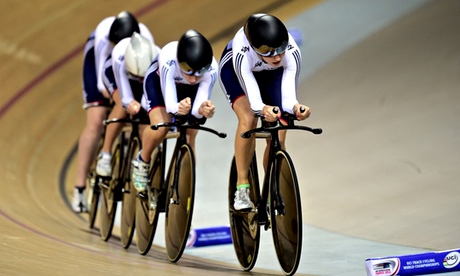
The Great Britain women’s 4,000m team pursuiters have turned themselves into the squad’s gold medal bankers in recent years but their long spell of dominance was finally ended just outside Paris as Australia took the discipline to a new dimension, smashing the British world record – set at altitude – by three seconds. It was a measure of what Elinor Barker, Laura Trott, Jo Rowsell and Katie Archibald have achieved that it took such an immense ride to break their stranglehold but that will be scant consolation.
Australia had thrown down the gauntlet in qualification and in the final Annette Edmondson, Ashlee Ankudinoff, Melissa Hoskins and Amy Cure took an early lead, moving ahead after three of the 16 laps and building on that. The British rallied briefly around half distance in defence of the title that they had held since 2011, pegging the Australians back to a lead of just over one second after 2,500m, but the effort proved too much for Rowsell, who pulled out of the string early, leaving her team-mates exposed.
It was an Ashes battle to match any of those that have pitted their male counterparts against one another over the years but the Australians built their lead inexorably as the British wilted in the final kilometre, with Archibald visibly struggling to hold the pace in the final lap. Trott and company were going faster at sea level than they have ever managed and were not far from the time they set at altitude in December 2013 when they crossed the line, but it was Australia’s day.
The defeat marked the end of a remarkable series of successes, beginning at the European Championships in 2010, since when the British had landed four European, four world and one Olympic gold medal, to go with world titles in 2009 and 2008 with only a world championship silver medal in 2010 breaking the perfect run.
Having qualified second fastest by 0.072sec to Australia, the British quartet were drawn against Canada in the second round and, with Barker piling on the pressure in the final two laps, they got within half a second of their world record of 4min 16.552sec – set at altitude in Mexico, so in faster conditions – en route to victory, while the Canadians were well within 4:18, a time that would have beaten almost any other team on the track.
That reflected the fact that Great Britain’s sprinters have been well off the pace here and they will have to gain inspiration from the men’s team pursuiters, who have put themselves completely back on track in the 12 months since the 2014 debacle in Cali.
“A bit gutted I guess,” was Laura Trott’s reaction after tasting defeat for the first time in a world championships. “We rode quicker than we’ve ever been before at sea level, and for us that is a massive step. It also shows we have work to do. You have to have four girls going good on the same day. And they did. The lap speed they must have had to do a 4:13 is something we haven’t touched in training yet.
“I never thought they would be three seconds ahead of us. After yesterday I was sort of doubting us a little, I guess, I thought they would go quicker. They rode flat out in qualifying and we were close to them. But then in the second ride today they were so controlled. I think you sort of got the feeling they were going to pull a good ride out.”
Their male counterparts, meanwhile, continued where they had left off in the qualifiers, winning comfortably against Germany in the second round, but with a spectacularly fast time of 3min 55.087sec. That in turn was a riposte to their perennial rivals Australia, unlucky victims of a mechanical incident in qualifying, who looked to be making a point in their second round ride, where they posted 3min 55.292sec to win through to the bronze medal ride-off.
Australia were clearly worthy of a place in the final, but the Great Britain versus New Zealand encounter still marked the climax of perhaps the fastest men’s team pursuit series seen to date, with all eight teams on the track breaking the magic 4min barrier for the four kilometres in the second round. This is turning out to be a rapid track, thanks to its long curves and gentle transitions, but it also reflects a welcome new appetite for team pursuiting among nations such as Holland, Germany and Switzerland.
There had been hopes that Jason Kenny might make up for the Great Britain sprinters’ poor start with a successful ride in the keirin but, while the home favourite François Pervis romped to a perfectly calculated gold medal, the 2013 world champion never looked in the hunt. The “nightmare”, as Kenny termed it, began in a first round in which he was positioned last wheel in the string from the off and never managed to get to grips with the race.
“I should’ve moved up early, to get at the thick end of it,” the Lancastrian reflected. “Sitting back in fifth, sixth wheel, you’re six bike lengths off the front and it’s a long way. I need to get up near the business end earlier and get involved.” He rode more aggressively in the repechage but was unable to match the Russian Nikita Shurshin in the final lap.
In the women’s 500m time trial, Katy Marchant made her world championship debut in 13th place.