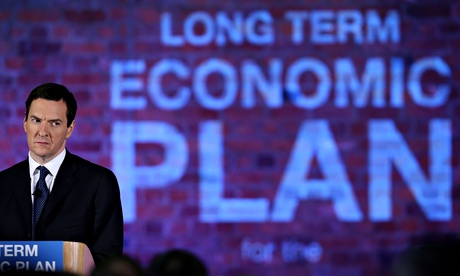
The latest figures indicate that UK economic growth has halved in the three months to the end of March, continuing a slowdown that began six months ago (Report, theguardian.com, 28 April). This is further evidence of how unsustainable the recovery – which is heavily reliant on consumer spending and levels of household debt relative to income – actually is.
The general election campaign has, however, been dominated by the major UK political parties looking at how they can impose further austerity, cutting the deficit and the debt through public spending cuts, rather than doing so by investing in the economy to stimulate economic growth.
When it comes to total private- and public-sector investment, the UK’s record is appalling, coming in 32nd position out of the 35 most advanced economies in the world, a significant concern when it comes to the future prospects of the economy.
There needs to be a radical change in mindset and a focus on increasing both public- and private-sector investment, through modest public spending increases and additional borrowing. This will see the deficit and the debt being cut, but on the back of sustainable economic growth.
Without such an approach the fragile foundations on which the economic recovery is currently based will quickly crumble.
Alex Orr
Edinburgh
• James Meek’s analysis (Why privatisation is the key to this election, G2, 28 April) is well argued. It seemed obvious from the start of this government that the top priority was not to save the economy but to use the recession as a front for budget cuts to destroy a large part of our public services and replace them with “cheaper” privatised companies and so lower taxes. This cheapness is achieved by re-employing public sector workers to do longer hours for worse pay and conditions – hence the poison felt by so many. And with much more to come.
SJ Closs
Edinburgh
• As a fellow economist I fully endorse Larry Elliott’s demolition of Tory party assertions that all is well for the UK’s growing economy, and that Britain is paying its way (The Tories’ ticking economic timebomb, 20 April). There is a key word that has been virtually absent from current debates on the economy: productivity. If people’s rising spending power is not matched by rising production per head, we will suck in more imports without an offsetting rise in exports to pay for them. This is what is happening; the UK’s productivity record in recent years has been dismal by historical and international standards; we have a rising balance of payments deficit with the rest of the world of £100bn a year; we are certainly not paying our way.
This cannot be sustained for long. Otherwise we will have to pay for the shortfall by selling off income-earning capital assets to foreigners, thereby further reducing our overseas earnings. This in turn will weaken sterling, leading to depreciation and/or devaluation. The effect of this in real terms is to hand over chunks of our national income to other countries.
Lawrence Lockhart
Bath
• Is George Osborne really clever? Well, no and yes. After the banks had precipitated the 2008 financial crisis, by 2010 there was the beginning of a recovery – only to hit the brick wall of Osborne austerity. This was not an evidence-based policy. It was an experiment which, he promised, would reduce the deficit to zero by 2015. It has failed, to the extent that in the last five years the national debt has doubled.
Meanwhile the bankers, cabinet ministers and other millionaires have been able to sit in comfort while watching the rest of the nation suffer – especially the disabled, the poor and the vulnerable. There has been desperation. A few have killed themselves; about 1 million have had to resort to food banks; 1.4 million have taken zero-hours contracts; around 4.5 million have become self-employed, many of them just trying to scratch a living. That is the background to the much-vaunted fall in unemployment.
Osborne points to a date in the future when the deficit will be eliminated. Another promise! The additional cuts would pile yet more suffering on to those who least deserve it. Osborne is the Daffy Duck of British politics – enormous confidence and self-satisfaction, leading to calamity; and then he pops up again, unabashed, ready for his next adventure. And yet he has convinced many people that he is competent. Now that is clever!
Frank Hibberd
Coventry
• Rafael Behr argues for the continued survival of the Lib Dems (Opinion, 22 April). Here in North Norfolk the very ambitious Norman Lamb speaks proudly in support of the coalition’s economic policies but expresses no views on the causes of the economic crisis. He seeks to distance himself from the consequences of austerity – the cuts in social services and welfare provision.
Sadly, the only conclusion is that it doesn’t matter to him what direction the bus is heading so long as he has a seat on the top deck. Not surprisingly, participation in a future coalition has immense appeal.
Professor Martyn Sloman
Kingston Business School
• And so – as Larry Elliott records –there were three deficits: a budget deficit, a balance-of-payments deficit and a productivity deficit, but the greatest of the three was the productivity deficit. If we don’t raise industrial productivity (through higher levels of investment and skills training, even a state bank and an industrial policy), we will never close the balance-of-payments deficit (and will thus remain a credit-fed, import-led economy), or raise living standards through higher real earnings (regardless of Ed Miliband’s plans). And without higher earnings there will be no higher levels of revenue with which to pay off the budget deficit. A depressing catechism? Or a plan of action, perhaps?
Peter Lyth
Hockerton, Nottinghamshire
• Markit chief economist Chris Williamson’s pronouncement that the Bank of England is forecasting UK economic growth “fuelled by consumer spending rising on the back of higher real employee earnings”, albeit with the worry “that weak pay growth means the economy is reliant on ultra-low inflation to boost consumer spending power”, leaves much unsaid. He mentions “consumer spending rising” but not that it would be debt-fuelled; the average UK household owing close to £10,000 in non-mortgage debt by the end of 2016, a new high in cash terms, according to a PwC report. Given their election boasts, the fact that coalition cuts have almost doubled public sector debt, saddling future generations with debt repayments, is bad enough, but the coalition’s and the Bank of England’s total failure over five years to deal with private-sector debt is worse. As John Hawksworth, PwC’s chief economist, said in 2010: “The UK’s addiction to debt has reached alarming levels during the past decade”, adding that “deleveraging will be a painful process for the UK”. Given such a prospect, the headline on Heather Stewart’s piece (Low pay rises persuaded Bank of England to hold interest rates, 23 April) looks less convincing than that the Bank is holding interest rates down because of the coming election.
David Murray
Wallington, Surrey