Australia's share market has retreated from the previous week's record high as investors weigh the latest twist in the Trump tariff saga.
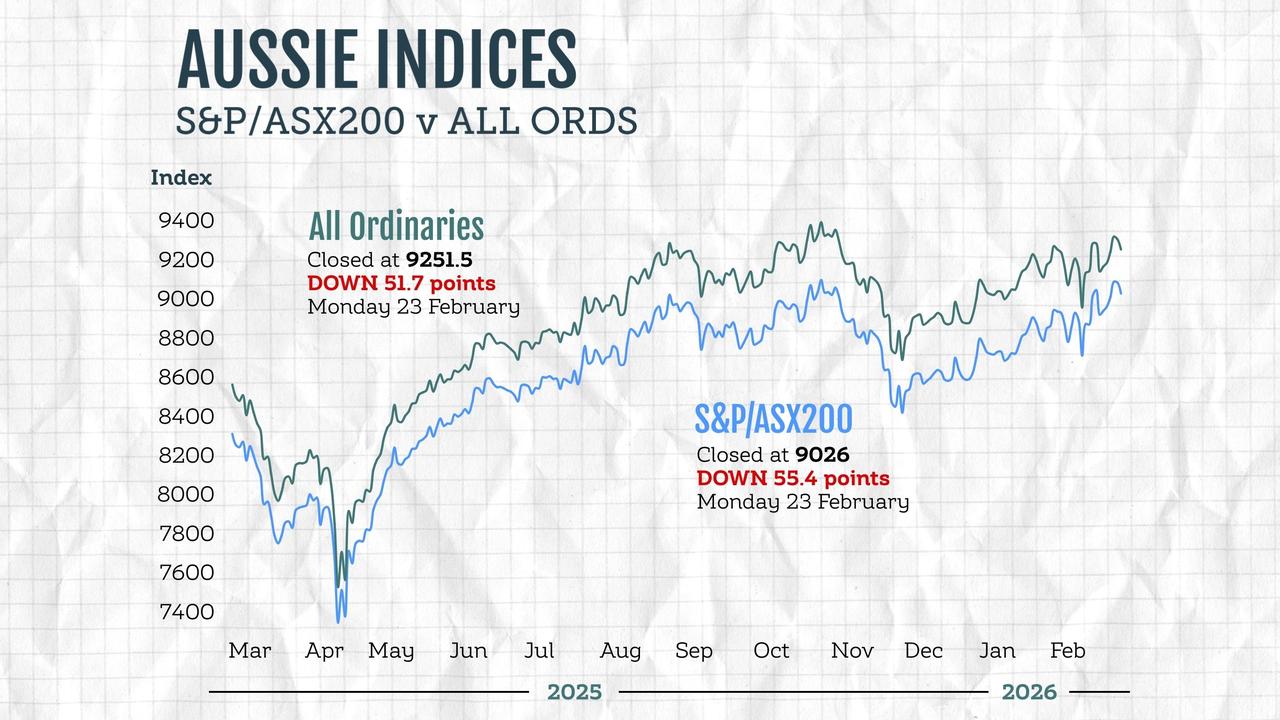
The S&P/ASX200 fell 55.4 points on Monday, down 0.61 per cent to 9,026, as the broader All Ordinaries gave up 51.7 points, or 0.56 per cent, to 9,251.5.
Gold miners were a lonely success story, helping lift the basic materials sector 1.2 per cent as investors sought safe havens following US President Donald Trump's threat to lift global tariffs to 15 per cent after a US court ruled against his previous tariffs.
While local markets got off to a shaky start, the impacts on Australia's economy should be minor, IG Market analyst Tony Sycamore said.
"It doesn't really impact our GDP (gross domestic product) given we don't have a huge export sector to the US," he told AAP.
"This isn't a toxic outcome for the Australian stock market or for Australian exporters net-net, and it may actually turn out to be a boon because China, where most of our exports go, has gotten out of it with a lower effective tariff rate."
Only three of 11 local sectors ended the session higher, led by a 1.5 per cent boost to basic materials as investors ploughed back into gold stocks.
Spot gold is buying $US5,156 ($A7,294) an ounce, supporting names such as Evolution Mining and Northern Star, which each rallied 3.5 per cent.
Iron ore giants were mixed, with BHP lifting to its best-ever closing price of $54.02, while Rio Tinto and Fortescue fell behind.
Lynas Rare Earths ticked higher ahead of its earnings update later in the week and lithium producers Liontown and PLS each gained more than three per cent.
Financials were heavy, down 1.2 per cent as all four banks sold off, led by a 2.3 per cent slump in ANZ shares.
Commonwealth Bank lost 0.6 per cent to $178.53, but has held onto most of its recent earnings season gains.
Energy stocks tumbled 1.7 per cent despite oil prices hovering near recent highs as tensions between Iran and the US persist.
Coal producers were also in the red while uranium stocks ran into profit-taking after strong performances the previous week.
Ampol shares faded more than two per cent as its first-half statutory net profit after tax fell by roughly a third on the equivalent half to $82.4 million.
IT stocks were the worst-performing segment, down 4.6 per cent despite a positive lead from Wall Street on Friday, as concerns about artificial intelligence disruption to software companies loomed.
Health care was also under pressure, the sector losing 2.4 per cent as CSL tanked to its lowest price in more than six years.
The slip came despite strong earnings and guidance from Fisher and Paykel Healthcare (up 4.0 per cent) and Regis Healthcare (up 7.6 per cent).
Consumer cyclical stocks gave up almost 1.8 per cent in a broad-based slump that overshadowed positive earnings reports from Kogan (up 5.5 per cent) and Adairs (up 10.5 per cent).
Looking ahead, earnings season continues with Woolworths and Nine Entertainment among companies reporting on Tuesday and Fortescue, Yancoal, Domino's and Qantas to follow later in the week.
The Australian dollar is buying 70.74 US cents, up from 70.43 US cents on Friday afternoon.
January inflation figures come out on Wednesday, and any upward surprise in price growth could significantly increase the odds of a Reserve Bank interest rate cut in March.
ON THE ASX:
* The S&P/ASX200 fell 55.4 points, or 0.61 per cent, to 9,026
* The broader All Ordinaries lost 51.7 points, or 0.56 per cent, to 9,251.5
CURRENCY SNAPSHOT:
One Australian dollar trades for:
* 70.74 US cents, from 70.43 US cents at 5pm AEDT on Friday
* 109.25 Japanese yen, from 109.37 Japanese yen
* 59.84 euro cents, from 59.92 euro cents
* 52.32 British pence, from 52.38 British pence
* 118.19 NZ cents, from 118.3 NZ cents