A valuable audio recording of a witness of World War II describing the Battle of Okinawa will be made available to the public in mid-August, around the time of the 75th anniversary of the end of the war.
As people with firsthand accounts of the war are aging or have died, the release of audio materials is seen as a way to pass down memories of war to future generations.
The National Diet Library is releasing the audio recording of a 1967 Yomiuri Shimbun interview with Imperial Japanese Army Col. Hiromichi Yahara (1902-1981), the architect of Japan's defensive strategy in the 2-1/2-month battle that claimed 200,000 lives, mainly of civilians and soldiers from Japan, and of U.S. soldiers.
The Yomiuri Shimbun donated materials, including the Yahara interview tapes, to the National Diet Library in 2018. The library digitized three reels of tape, covering over four hours of the interview, to CDs that will be available to visitors to listen to on the premises.
"When an enemy comes, we are carrying out the long, drawn out battle plan that we have prepared, just as planned," Yahara said on the recording. "But [headquarters] told us fiercely and strongly, 'Get out there and fight! Go out and attack!'"
In March 1967, a Yomiuri Shimbun staff writer, part of a team involved in a 1967-75 serial, visited Yahara, who was living in his home prefecture of Tottori. Yahara hadn't spoken about the battle to his family, but he wanted to say what he knew about the Battle of Okinawa, expressing his feelings and revealing information based on a memoir that he had been continuing to write after the war.
Yahara graduated from the Army War College in Tokyo and stayed in the United States from 1933 to 1935. As a senior staff officer responsible for planning the 32nd Army's operation to defend the island of Okinawa, he took a pragmatic approach that differed from staff officers of the Imperial headquarters, making use of Okinawa's terrain and Japan's military strengths.
Yahara drew up plans to gather the main forces in caves to create fortified zones on the main island to conduct a war of attrition. After the U.S. military landed on the island in April 1945, fierce battles were fought over the strong defensive positions built by Japan in the middle of the island.
Several times, however, the Imperial headquarters requested the army to launch an all-out counterattack to recapture airfields in the middle of the island against the Allied forces. In the audio recording, Yahara can be heard criticizing the Imperial headquarters' approach.
By the end of May, the 32nd Army withdrew to the southern part of the island. As a mix of Japanese soldiers and civilians sheltered in caves, there were many victims in the battle.
"On the other Pacific islands, the [Imperial Japanese Army] fight flashy, just like fireworks or sparklers, for three or four days. They always end with banzai charges," Yahara said on the recording. "If we do that, we might not damage the enemy sufficiently at that time. Holding the enemy off for two or three more days didn't lead anywhere.
"Well, at the end, I fought a war of attrition for three months, so through that, I can't say I fulfilled all the 32nd Army's mission, but I thought I carried it out," he continued. "It's because I had that spirit."
By the end of June, the commander and chief of staff of the 32nd Army had committed ritual suicide and organized fighting in the battle was over. Hoping to report on the progress of the battle, Yahara escaped among refugees, but he was captured by U.S. soldiers.
--Son hears father's intentions
Shortly after the war, Yahara was criticized for being "the only survivor among high-ranking military officers of the 32nd Army."
At that time, his son was deeply troubled after reading such criticism. When the son heard remarks about his father like "Why didn't he die?" or "He should die," the son had asked himself, "Was my father in a position to do so?"
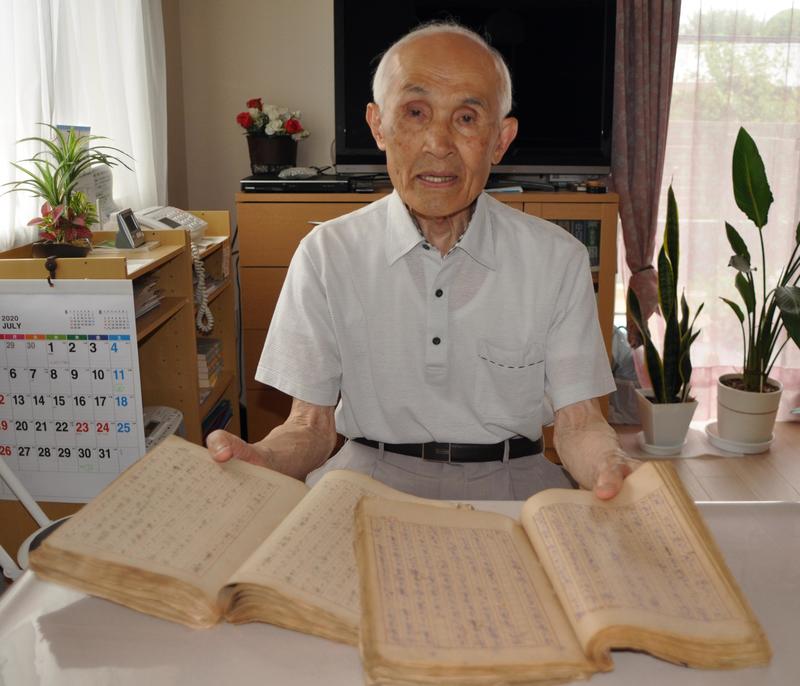
Seventy-five years after the war, Yahara's son Kazuhiko, 87, listened to his father's recorded voice at his apartment in Tokyo in July.
"This is my father's voice. My father actually wrote down what he wanted to say in his memoir," he said. "But I can understand the nuances better with the audio materials. His written words can't express it as well."
Earlier this year, "Crucible of Hell," British military historian Saul David's book on the Battle of Okinawa, was published. Compared to other big World War II campaigns like the invasion of Normandy, David saw distinct differences in the Battle of Okinawa.
"The fighting in Normandy through the bocage was particularly tough for the Allied troops," he said in an email. "But they did not have to contend with fortified coral rock, tropical weather and an opponent who refused to surrender."
As for Yahara, David said: "From my perspective, Colonel Yahara was a brilliant operations officer whose clever plan to turn the center of the island into a fortress of interlocking defensive positions in caves probably extended the battle by at least two months. Yet the outcome was never in doubt -- the Americans were bound to prevail sooner or later -- and so Yahara's plan to fight a battle of attrition was also responsible for the high number of deaths."
In 1995, the 50th anniversary of the end of the war, Kazuhiko Yahara attended a memorial service in Okinawa Prefecture to which people connected to the 32nd Army were invited.
"I was worried about how people in Okinawa would respond if I introduce myself as 'Yahara,'" he said.
He came to deeply understand what people in Okinawa thought and felt during the war by talking with other attendees. Some of the attendees who had known his father were surprised, mistaking the son for the father.
Recently, Kazuhiko Yahara found his father's memoir in his apartment and read it again. His father strongly criticized the mentality of the military's upper echelons. But his father's demeanor in the Yomiuri interview was gentle, even calm.
"These audio materials expressed his real intention," Kazuhiko Yahara said. "People can think about how my father planned and carried out the Battle of Okinawa not only through reading his book, but also by listening to the recording."
Read more from The Japan News at https://japannews.yomiuri.co.jp/