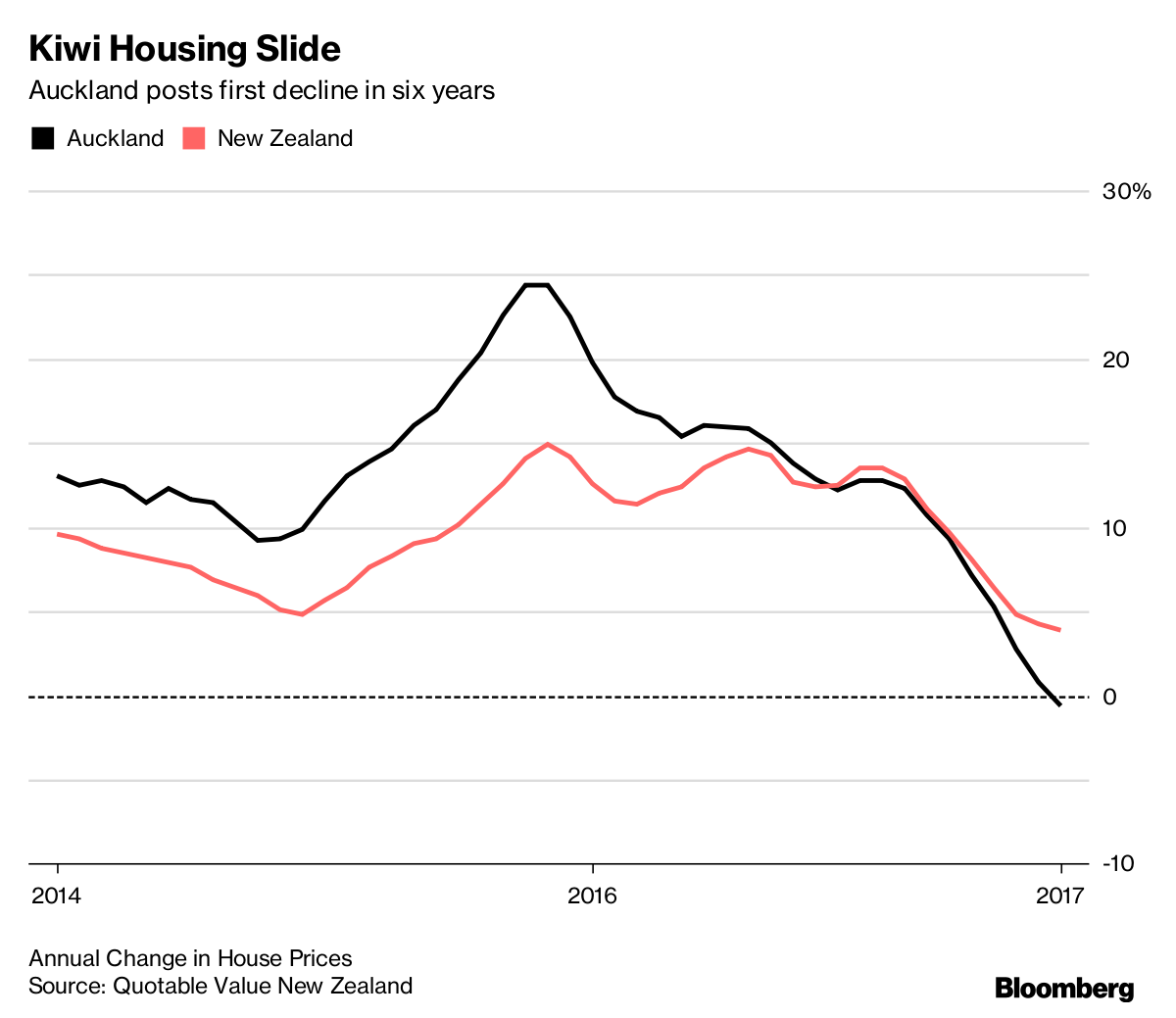
House prices in New Zealand’s largest city posted their first annual decline in six years in October, bringing an end to the nation’s property boom.
Prices in the Auckland region fell 0.6 percent from a year earlier, helping to slow the rate of growth nationwide to 3.9 percent, a five-year low, property research agency Quotable Value said Thursday. Auckland’s average house price has soared 90 percent in the last 10 years to more than NZ$1 million ($690,000), underpinning a 56 percent climb in the national average to NZ$647,000.
The new Labour-led government this week announced it will ban foreigners from buying existing homes as it seeks to make housing more affordable for first-time buyers, a central pledge in its election campaign. Labour also plans to build 100,000 dwellings over the next 10 years to address a shortage, and it will change tax structures to make housing less attractive to investors, who have stoked the property boom.
“There appears to be a trend of slowing in the rate of growth, with the frenzy induced by high numbers of investors in the market subsiding and a return to more normal levels of activity in housing markets around the country,” QV spokeswoman Andrea Rush said in a statement.
While the surge in prices since 2012 is largely due to a supply shortage amid record immigration, investors played a key role. That prompted the central bank to last year tighten lending restrictions on them, which has helped take the heat out of the market.
Outside Auckland, which is home to a third of New Zealand’s 4.8 million people, price growth has slowed dramatically in cities that saw double-digit gains in 2016. Hamilton prices rose just 1.1 percent in the year to October, the QV report shows, down from a peak of 31.5 percent in July last year.
In capital city Wellington, where supply is constrained, values rose 10 percent in the year. In Christchurch, which is over-supplied, prices fell 1.6 percent.
Goldman Warning
In May, Goldman Sachs warned that New Zealand’s housing market was the most over-valued and most at risk of a correction among the G-10 economies -- those with the 10 most-traded currencies in the world.
The investment bank said there was about a 40 percent chance of a housing “bust” in New Zealand over the next two years, which it defined as house prices falling five percent or more after adjustment for inflation.
“We see reason for some concern about house-price developments in the small open G-10 economies,” it said. “Prices do appear overvalued and credit growth has been high -- traditional warning signs of real house-price declines.”
Still, local economists attribute much of the current uncertainty in New Zealand’s housing market to the change of government and its policies to address the housing crisis. They say the ongoing imbalance between supply and demand may keep a floor under prices in the medium term, particularly as there is little prospect of the central bank raising interest rates from a record low any time soon.
To contact the reporter on this story: Matthew Brockett in Wellington at mbrockett1@bloomberg.net.
To contact the editors responsible for this story: Matthew Brockett at mbrockett1@bloomberg.net, Tracy Withers, Chris Bourke
©2017 Bloomberg L.P.