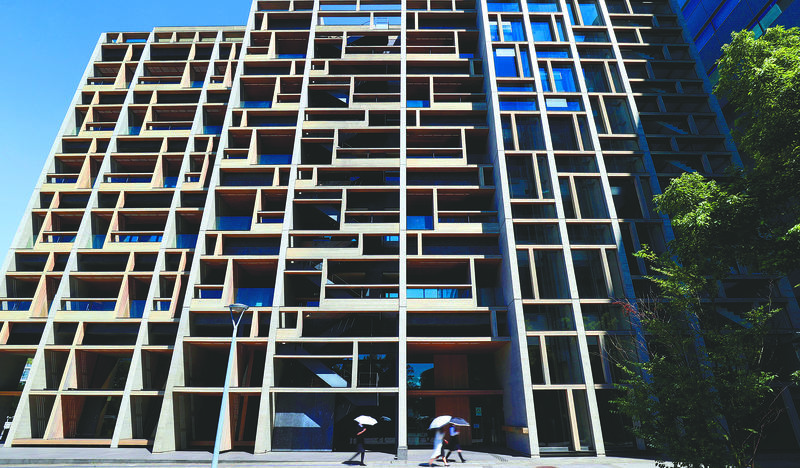
The shape of the building before me had a familiar feel to it. It reminded me of a ladderlike puzzle game I would play as a child called "amidakuji," the objective of which was for players to follow a line across a lattice pattern to decide the winner.
My friends and I determined who won or lost by drawing horizontal lines between vertical lines and tracing down the lines by turn. That childhood excitement returned when I saw this building.
The building came into sight after I emerged from the south exit of Shinkiba Station in Koto Ward, Tokyo.
In 2009, the Tokyo Mokuzai Tonya Kyodo Kumiai (Tokyo timber wholesalers cooperative association) reconstructed its Mokuzai Kaikan hall at a new location adjacent to a timber basin at the Port of Tokyo to commemorate the 100th anniversary of its founding.
The exterior of the seven-story building has a facade combining exposed concrete and wood. Over time, the color of the wooden surface has changed, creating harmony with the concrete.
As I got closer to the building, I noticed that similarly sized square planks formed layers making up the outer decks and walls.
"We are lumber dealers by trade, so we made an effort to build it with our own ready-made products," said Akira Watanabe, 79, the association's director. "For the exterior, we used pure Japanese cypress timber that measures about 10.5 by 10.5 centimeters."
As I listened to his explanation, I could feel the timber dealers' spirit, which has been passed down through the generations since the Edo period (1603-1867).
The building's structure is supported by steel-framed, reinforced concrete. More than 1,000 cubic meters of domestic wood, mainly Japanese cypress and cedar, was used for both the exterior and interior. The building serves not only as the association's headquarters, but also as a sort of showroom that demonstrates that large quantities of wood can be used in compliance with modern building regulations.
"Architects and building owners have come to have a pre-conceived notion that timber shouldn't be used for large urban buildings," said Tomohiko Yamanashi, 60, of Nikken Sekkei Ltd., which headed the design of the Mokuzai Kaikan. "But seeing is believing. Since the building's completion, [the use of wood for large urban buildings] has rapidly become more common."
The building was a continuous draw for visitors up until the novel coronavirus outbreak. Its spaces adorned with the texture of wood, such as a cypress stage, a hall and an executive meeting room, have often been used for shooting TV drama scenes, commercials and fashion magazine photos.
Business environment for lumber wholesalers has been tough for a number of reasons, including a change in the distribution system and new market players from different industries.
After the mid-1970s, the timber basin, now called Shinkiba, was relocated from Kiba in Koto Ward, which created the sight of logs completely covering the surface of the ward's canals. However, the present scenery is different, as a result of the number of association member companies falling from 579 in 1963 to 298 as of July this year.
However, "It is still significant that various timber-related businesses are concentrated in this area," Watanabe said of the strength of Shinkiba. As a symbol of this, the Mokuzai Kaikan stands tall like a guardian, watching over their businesses.
Yoshio Nakahara, 66, an association advisor who has guided 2,000 visitors yearly through the Mokuzai Kaikan, showed me around the building, the highlight being the large hall on the top floor.
Long beams made from layers of 12-centimeter square pieces of Japanese cypress firmly support the ceiling. The smooth floor spreads out elegantly.
"Even though the floor color tends to turn black, it can be made to look new again with just a little grading," Nakahara said. "Of course, it has a nice aroma as well."
In the executive meeting room, wood from cherry trees has been used, while another meeting room features walls made from walnut wood. In these rooms, I felt embraced by the warmth of the trees.
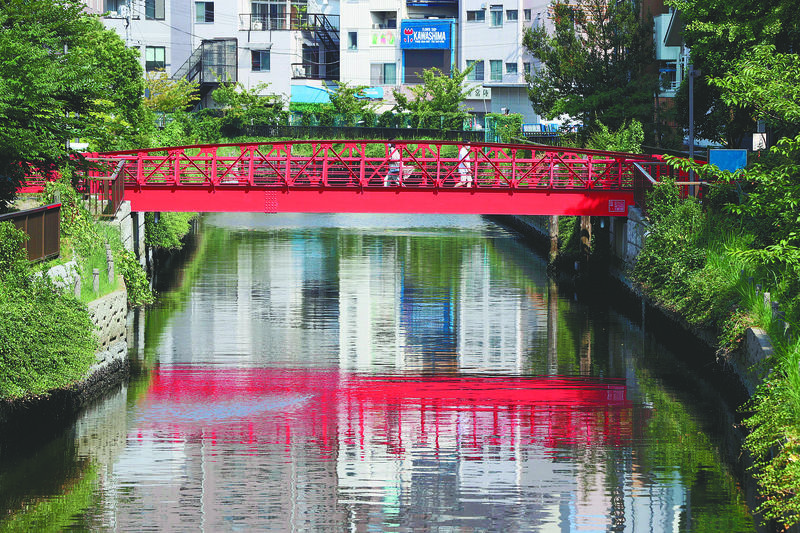
I then headed to Kiba Park, where the timber basin had been situated before its relocation. Dotted with roadside canals and temples, the surrounding area has the atmosphere of the Fukagawa district during the Edo period. In recent years, as the number of establishments such as locally roasted coffee shops has increased in an area around Kiyosumi-shirakawa Station to Monzen-nakacho Station on the subway lines, the age demographic of the people strolling in the area has expanded.
Read more from The Japan News at https://japannews.yomiuri.co.jp/