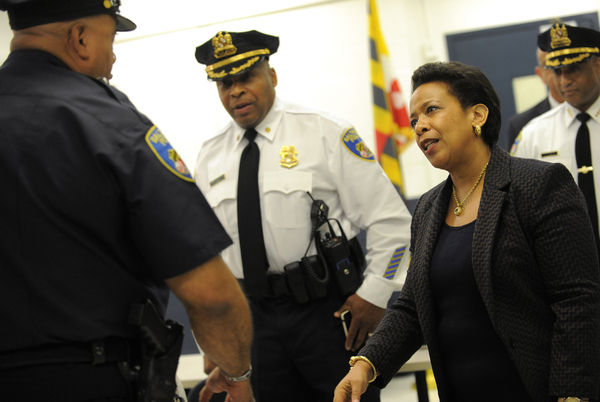
BALTIMORE _ Attorney General Loretta Lynch said Thursday that she is hopeful Department of Justice and Baltimore officials will agree to a consent decree governing police reform within the next month _ and before President-elect Donald J. Trump takes office _ but that reaching a deal depends on continued cooperation and good faith negotiations on the part of the city.
"At this point, the ball's in the city's court," Lynch said during a conversation on Politico's Playbook Breakfast.
Lynch noted that her first trip as attorney general was to Baltimore in the aftermath of the rioting and unrest that followed the death of 25-year-old Freddie Gray from injuries suffered in Baltimore police custody in April 2015 _ events that spurred city leaders to invite the Justice Department to investigate the Baltimore Police Department in the first place.
One of her last trips, she said, will also be to Baltimore, where she will provide an update on the status of the consent decree negotiations _ "and hopefully an announcement on those efforts" _ early next month.
"We are looking forward to getting a positive response from them on finalizing this consent decree," Lynch said of city officials.
The Justice Department finished delivering its proposed language for the consent decree to the city last week _ after providing individual sections at a time in recent months _ and both sides are now working through edits, according to sources familiar with the negotiations, who requested anonymity to discuss the private process candidly.
Jonathan Smith, a former chief of special litigation in the Justice Department's civil rights division who oversaw more than 20 investigations into police agencies, said it is natural for the Justice Department to want to reach an agreement before an administrative transition _ regardless of the policy stance of the incoming president _ and he was not particularly surprised that Lynch decided to weigh in.
Her involvement could be a sign that an agreement is close at hand, he said.
"There come spots in the negotiations where, for various reasons, things get bogged down and you need somebody to come in and play the role of closer," he said. "She's trying to make sure it gets pushed across the finish line."
Some observers of the reform process, including law enforcement experts and members of the city's congressional delegation, have expressed concern that it will falter if it is not finalized before Trump's inauguration on Jan. 20. They fear the Justice Department will not be as exacting in overseeing such reform under Trump, who has praised police tactics used in Baltimore and explicitly rejected by the current Justice Department, including "stop and frisk" street enforcement.
Mayor Catherine E. Pugh, who took office earlier this month, and Police Commissioner Kevin Davis have both said they want a consent decree, but have also expressed reservations.
Pugh has voiced concerns about the potential cost of the deal, and gave an awkward answer _ including a double negative _ when asked on her first full day on the job if she felt such an agreement is necessary: "I would not say the consent decree is not needed," she said.
Davis has been an outspoken supporter of reform, and Lynch said the Justice Department has been "working well" with him. But this week, Davis warned against rushing into a deal, saying, "I understand the election has introduced a new dynamic, but that shouldn't cause us to slam the gas pedal and get something wrong for a decade."
The police department referred all questions about the status of the consent decree and Lynch's comments to Pugh's office, which did not immediately respond to a request for comment Thursday morning.
On Wednesday, before Lynch spoke, Pugh said she hadn't seen the details of the negotiations, and was more concerned with getting a strong consent decree than a quick one.
"They are in negotiations. I met with Loretta Lynch. She said she was working with our team and she thought we had a good team," Pugh said. "I want to get it done."
Her spokesman, Anthony McCarthy, said Baltimore officials are working much more quickly than other cities, who have taken more than a year to negotiate agreements.
"We are moving very quickly on very complex negotiations," McCarthy said. "The mayor is committed that she wants a consent decree. However long that takes, we want a good, solid consent decree. We don't want something that's just fast. ... Things have been very, very specific. They've gone line by line on the report. The idea is creating the best consent decree."
The Justice Department has been negotiating the terms of the pending consent decree _ which would be binding and subject to court monitoring _ with city attorneys since August, when it released a scathing, 163-page report outlining a history of unconstitutional and discriminatory practices by the city police force.
The report outlined a pattern of violations of residents' rights, particularly in poor, predominantly black neighborhoods, including officers disproportionately targeting, stopping and searching black pedestrians and motorists. It also found a history of police improperly dismissing accounts of sexual assault and violating protesters' free speech rights, among other violations.
The Justice Department has praised the police department for initiating several reforms on its own ahead of any formal agreement, including new training on impartial policing and the introduction of body cameras. But it has also said that more needs to be done.
Lynch said a consent decree is the best way to ensure success moving forward, because it will establish a clear, consistent framework for reform that will be upheld by the court regardless of changes in the city administration, the police department or Justice Department leadership.
"Having that court enforceability is key and it's vital," Lynch said.
Community organizations and civic leaders have praised the Justice Department for its willingness to confront the long-standing problems in Baltimore, and have expressed hope that, under a consent decree, the Baltimore Police Department will finally begin to clean up its act.
Ray Kelly, an organizer with the No Boundaries Coalition of Central West Baltimore, said community groups and local residents have been working nonstop since before the Justice Department released its report to make sure that their recommendations for police reforms were reflected in whatever agreement is produced.
If the process stalls at this late stage, he said, it would create resentment _ and undercut efforts to keep the community engaged.
"We had hundreds of people buy into this process, saying, 'If change is possible, this is how,'" Kelly said. "If it's not possible after all that work ... people are just going to say, 'We did everything and what do we get? We get Donald Trump, and our whole push for police reform gets lost in transition."
Samuel Walker, a professor emeritus of criminology and criminal justice at the University of Nebraska, Omaha who has studied police reform, said Lynch's comments on Thursday were clearly intended to send a message that the Justice Department wants to get the consent decree signed and put in place before the Trump transition _ even if that timeline is quicker than other such negotiations.
The city should be receptive to that push, Walker said, because the police department needs to be reformed and implementing change without a consent decree will be even more difficult.
"It's going to cost money no matter which way it's done. And if they are already wary and worried about the dollar cost, I wonder whether they really have the commitment to get it done on their own," he said. "Failing to do it is going to mean more pain and suffering."