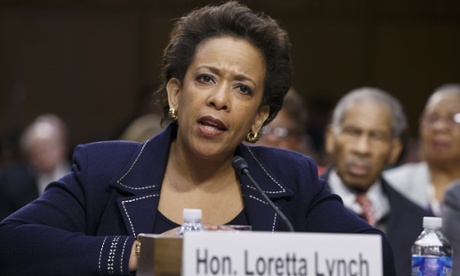
Attorney general nominee Loretta Lynch distanced herself from her would-be predecessor on Wednesday at a confirmation hearing in which Republicans struggled to get her to share their anger over executive actions on immigration taken by Barack Obama.
If confirmed to lead the Justice Department, Lynch will be in charge of administering federal law, including immigration policies. The current attorney general, Eric Holder, has attracted the ire of Republicans in part for enacting White House deferrals of deportation for some immigrants.
After several rounds of questioning in which Lynch was challenged to condemn the president’s immigration policies, Senator John Cornyn, Republican of Texas, jokingly asked her to make her distance from the current justice department explicit.
“Let me just stipulate, you’re not Eric Holder, are you?” asked Cornyn.
“No senator, I’m not,” Lynch replied, to laughter in the room.
“No one’s suggesting that you are, but his legacy is heavy on our minds here,” Cornyn said.
With family members including her father and husband sitting in the front row of a packed committee room, Lynch, 55, opened with brief recollections from her childhood in a racially segregated south. She praised her mother, Lorine Lynch, who was unable to travel from the family home in Durham, North Carolina.
“As a young woman, she refused to use segregated restrooms, because they did not represent the America in which she believed,” Lynch said. Lynch would become the second African American to serve as attorney general, after Holder, and the second woman in the role.
In the face of repeated questioning about the president’s most recent actions on immigration, which would defer deportation of an estimated 5 million individuals, Lynch pleaded non-involvement, saying the executive actions had not crossed her desk. Pressed for an opinion as to whether the deferrals represented “a massive refusal to enforce existing law”, Lynch said the actions were an attempt to prioritize which deportation cases to pursue.
Clusters of Republican questions meant to be bombshells fell like softballs to Lynch’s even and deeply studied presentation. The sharpest exchange of the morning came when Senator Jeff Sessions of Alabama, a sharp critic of the administration’s immigration policy, pressed Lynch on whether immigration was “a matter of civil rights”.
“Senator, I haven’t studied the issue enough to come to a legal opinion on that,” Lynch said. She went on to concede that immigrants’ rights were not in her observation “under the panoply” of civil rights currently enumerated by law.
“I’m surprised it took you so long to say that,” Sessions said.
Lynch was also pressed to take positions on government surveillance – as a prosecutor, she said, she recognized the value of intelligence assets – and on US torture programs created under the aegis of the Justice Department under George W Bush.
“Waterboarding is torture,” she told Senator Patrick Leahy, Democrat of Vermont.
“And thus illegal?” Leahy asked.
“And thus illegal,” Lynch replied.
Republicans also sought assurances from Lynch that she would be able to tell the White House: “No.”
“I pledge to you that I take that independence seriously,” Lynch told the panel.
“If confirmed as attorney general, I will be myself,” she said. “I will be Loretta Lynch.”