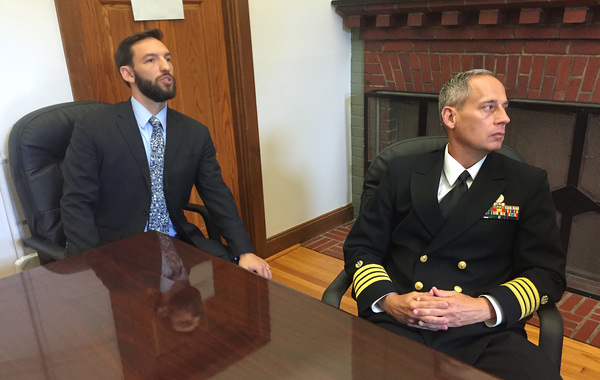
GUANTANAMO BAY NAVAL BASE, Cuba _ In the highest ranking known visit by a Trump administration official, Attorney General Jeff Sessions and the Director of National Intelligence, Dan Coats, were visiting this remote outpost Friday to get "an up-to-date understanding" of current War on Terror operations.
Sessions' deputy, Rod Rosenstein, was also on the tour, with the first stop the war court compound where the Pentagon holds pretrial hearings in the death penalty case against five alleged Sept. 11 terror attack plotters, and others accused of terrorism and war crimes.
"Keeping this country safe from terrorists is the highest priority of the Trump administration," Justice Department spokesman Ian D. Prior said in a statement issued before the VIP party landed at the base and was ferried across Guantanamo Bay.
A court hearing was postponed until afternoon to accommodate the visit.
Other attorneys general have visited the site, including Michael Mukasey for the Bush administration in 2008 and Eric Holder for the Obama administration in 2009. This visit coming more than five months into the Trump administration _ even as the White House has yet to officially rescind Barack Obama's 2009 closure order _ may be seen as a signal of support for the detention operation now holding 41 detainees and the war court where six men are in pretrial, death penalty proceedings for the Sept. 11 and USS Cole attacks.
The one-day visit was announced hours before a Saudi man was due at the war court for a presentencing hearing. Ahmed al-Darbi pleaded guilty to war crimes in February 2014, in exchange for a commitment to let him serve out his sentence of up to 15 years in his homeland starting next year.
"Recent attacks in Europe and elsewhere confirm that the threat to our nation is immediate and real," Prior said in his statement, "and it remains essential that we use every lawful tool available to prevent as many attacks as possible."
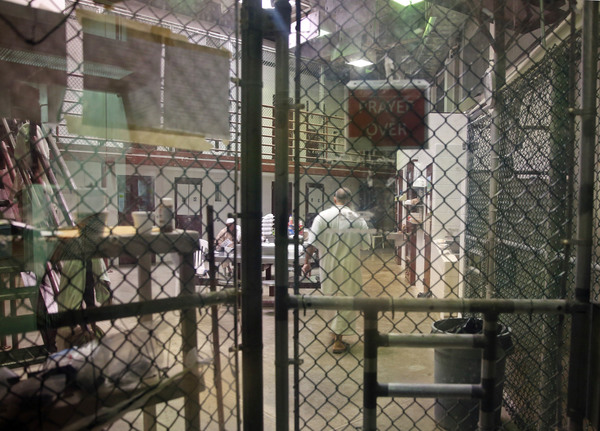
He said the goal of the visit was to meet with "the people on the ground who are leading our government-wide efforts at GTMO," using the Navy acronym from for the 45-square-mile base in southeast Cuba. "In addition to the Department of Justice's role in handling detainee-related litigation," he added, "it is important for the Department of Justice to have an up-to-date understanding of current operations."
Coats' spokesman, Timothy L. Barrett, issued a statement identical to the Department of Justice's on the trip's purpose: "To gain an understanding of current operations by meeting with the people on the ground who are leading our government-wide efforts at GTMO."
Sessions, then a U.S. senator, first visited in late January 2002 and has long been one of the most enthusiastic supporters of the prison and military commissions system, whose rules are a hybrid of U.S. military and federal legal systems.
The visit comes as the U.S. Southern Command, not so long ago run by Homeland Security Secretary John Kelly, is proposing an up-to $100 million construction project to house 13,000 temporary migrants and 5,000 support staff on the base near the airstrip. The Navy, in announcing the proposal, called it a "contingency mass migration complex."
The war court and Detention Center Zone staffed by 1,500 troops and civilians is on the opposite side of the base, requiring a ferry ride across Guantanamo Bay.
No similar mass exodus is foreseen. First, the Obama administration canceled a decades-old "wet-foot, dry-foot" policy that let Cubans who reach U.S. shores gain legal entry. Now the Trump administration is pursuing deportations of undocumented immigrants, a program championed by Sessions.
"There are no detention facilities involved in this project," Southcom spokesman Army Maj. Vance Trenkel said by email on Thursday. "This project is to assist with mass migration operations ... caused by things such as a natural disaster."
In the 1990s the base was used to shelter more than 50,000 Cubans and Haitians who were stopped at sea from reaching the United States.