The recent publication of Go Set a Watchman has sparked an outcry over one of Harper Lee’s best-loved, and now most controversial, characters: Atticus Finch. Unlike the honourable, principled incarnation more familiar to readers from To Kill a Mockingbird, Lee’s earlier version is a much more complex and in many ways uncomfortable man; one who can say things such as, “Do you want Negroes by the carload in our schools and churches and theatres? Do you want them in our world?” I will not lie; when I first found out about this sudden change (before actually reading the book) I was disappointed. That may seem weird but I was; I felt like I actually know Atticus and I trusted him and he let me down.
So at first I understood how Jean Louise feels in Go Set a Watchman, looking back on her childhood as an adult living in New York, when she first realised that Atticus was not everything he once appeared to be:
His use of her childhood name crashed on her ears. Don’t you ever call me that again. You who called me that are dead and in your grave.
But after actually reading Lee’s new book, the truth dawned on me: the Atticus Finch of To Kill a Mockingbird is pure fantasy. He was idealistic and God-like, but Scout never saw him as a real person; she was biased, she saw him as a separate entity, better than anybody and everybody else, and as readers we are also driven into believing this because we are reading a book narrated by a character who truly believed it.
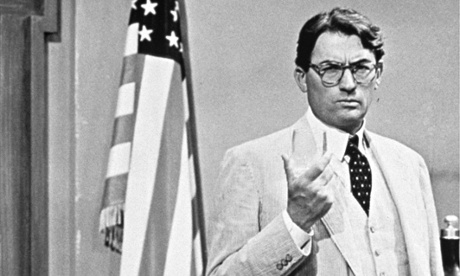
The film version has simply perpetuated the problem for whole new generations of readers. Gregory Peck played Atticus Finch in the 1962 film version of To Kill a Mockingbird and his performance was so great (Peck won an Academy Award for Best Actor) that his version of Atticus has become the authoritative one; many people, even when reading Lee’s books, have only the Gregory Peck version of Atticus Finch in their minds, a man who is so peaceful, subtle, gentlemanly and noble, a good man who only did what he thought was right. Arguably, Peck’s Atticus is even more idealised than the one we find in To Kill a Mockingbird.
When, in Go Set a Watchman, she finds out that he is human and fallible, Jean Louise struggles to comprehend this, and to combine her new understanding with the ideals of him she has always held. It’s a process I had to undergo, too, in a different way – to try to synthesize the three different versions of Atticus – and it made me realise something else, too, about To Kill a Mockingbird overall as a book.
Though To Kill a Mockingbird is undoubtedly a great book, I think there is also a certain greatness to the fact that in Go Set a Watchman Harper Lee tackles the truth that there is no true Atticus Finch – that he wasn’t real, but also that he isn’t a realistic aspiration – and in-so-doing she completely confronts racism in the South for what it really is. Although much less optimistic in many, many ways, I felt like Go Set a Watchman was a far more realistic and honest book. Instead of offering simplified scenarios – which is ultimately far more comfortable for a liberal-minded person to read – Lee’s first version of Atticus is a much more nuanced portrayal of a problem that doesn’t allow easy solutions; one which acknowledges that good people can be flawed, and that racism comes in many different forms.
Don’t get me wrong, there will always be something noble about the character of Atticus Finch – and maybe in Go Set a Watchman he is most noble of all: even if he believes some things that seem wrong or contradictory, he still went to trial to defend an innocent black man and did not let his opinions overshadow the truth.


.jpg?w=600)