Last week the BMA’s junior doctor committee voted to ballot its members in England over industrial action (Report, 26 September). This decision, not taken lightly, came about after the government announced its intention to impose a new contract on junior doctors (Report, 18 September). The BMA has raised serious concerns over the impact this imposition with have on doctors’ wellbeing and the safety of patients. But rather than work with the BMA through proper negotiations, the government has chosen to ignore those concerns.
This decision will impact more than just today’s junior doctors. Increases in tuition fees have made medicine a much less attractive option for many students. This has been made worse by the government’s decision to scrap student maintenance grants, burdening those from low-income backgrounds with further debt. Those considering a career in medicine will look at what the government is proposing to do with growing concern. If ministers really are serious about getting more people to choose a career in medicine, it is vital that they rethink their strategy and work constructively with the BMA to put in place a contract that is safe for patients, fair to doctors and doesn’t undermine the future of the NHS.
Charlie Bell and Harrison Carter
Medical student committee co-chairs, British Medical Association
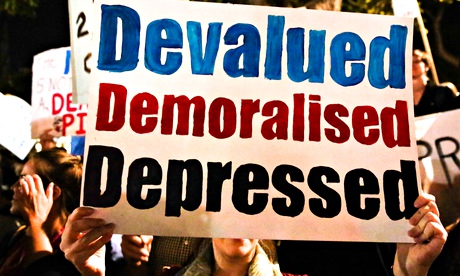
• It is striking how UK doctors are currently being portrayed by the media and government. There is an insidious undermining of the extraordinarily hard work we all do, in the presentation of us as “junior” doctors. We, the many thousands of us, are between 23 and about 40, with children, PhDs and a wealth of life experience that many may never know. We brush shoulders with life, death and immense suffering, but also joy, day in, day out. We witness the very essence of humanity, in the girl who is brought to A&E by her mother, having been repeatedly raped, in the young boy whose body was grossly disfigured after he jumped in front of a train, in the wet eyes of parents as their precious new-born baby is brought back to life, in the wise eyes of the old lady who knows she is dying of cancer and is grateful for our care.
We cannot and will not continue to be infantilised by this government and we urge the public to consider what we really do each day as doctors of this country.
Dr Lauren Gavaghan, Dr Dimitra Georgiou, Dr Elinor Hynes, Dr Tom Stockmann, Dr Hannah Turts, Dr Helen Walker, Dr Adam Kasparek, Dr Catriona Walker, Dr Sarah Johnston, Dr Charlotte Smith, Dr Unmesh Bandy, Dr Jasmine Islam, Dr Jamie Plumb, Dr Susie Fleming, Dr Heather Tannahill, Dr Sarah Howard-Knight, Dr Fran O’Neill, Dr Helen Gordon, Viv Pepper RGN
• Doctors and NHS managers face criminal prosecution if they are found to be guilty of wilful negligence. Will the same happen to Jeremy Hunt when patients needlessly die as a direct result of his enforcement of a new junior doctor contract? The medical profession has warned the government that the imposition of this contract will have disastrous consequences for patient safety in England. Surely Hunt and David Cameron have left themselves wide open to prosecution? The NHS is facing a bloodbath and these two gentleman are the culprits.
Dr Thomas McKerrell
Honorary haematology registrar, Addenbrooke’s Hospital, Cambridge
• If we work longer hours, patients are at risk. All commercial drivers, for example, work restricted hours to prevent accidents. The high level of risk in medical jobs – doctors or otherwise – should be tightly controlled to prevent “adverse outcomes” I will not go into the details of “adverse outcomes”. I’m sure we can all agree they are scary. Your health, whether you see a doctor once or 100 times each year will be adversely affected by new doctors contracts. As the system to work longer and more dangerous hours comes through, doctors will stop working in the NHS. This is because it’s not safe for you and it’s not safe for them. We have 26 medical schools in the UK creating thousands of new doctors every year- and that’s still not enough to provide a consistent nationwide service.
There are only two reasons people become doctors here: 1) they want to help people; and 2) they believe in a fair NHS. Remember doctors are not stupid. They can help people all over the world and amazingly counties such Canada and New Zealand have a far more socialist national health service than we will have in a decade. These countries are desperate for our training and expertise.
We would not initiate a short term strike if we didn’t think patient care could benefit from it.
In a decade this decision will affect you. Demoralising and humiliating NHS workers is the first step to a private healthcare service. As a body of doctors we believe your healthcare should be free at the point of delivery. That is why we stay here to provide an humanitarian service. We are trained to be compassionate, but we are smart people who can gather and assimilate data in order to realise this path for the NHS is bad for patients. Please remember that doctors in the NHS are here to serve your health needs. We do it with compassion and humility. We will not stand for a poor service for you. That is our fundamental point in this debate.
Dr Nandita Joshi
Manchester
• A junior doctor is on the verge of quitting because “he sees the moment when he is no longer able to pay his mortgage and childcare bills” (I can’t sacrifice my family for the NHS, G2, 29 September). As a retired doctor I feel that the government’s attitude to healthcare is poor at best, and the new contract being pressed onto doctors is a big mistake. But, I also feel that the said doctor’s response to this situation is ridiculous. The answer is not to go into the pharmaceutical industry or go abroad, but find an NHS job outside London. The idea that one could move to a better place to live, which is affordable and still in the UK, doesn’t seem to have occurred to him.
Something strange happens when people live in London. The idea that the UK extends beyond, and is actually a good place to be with all the normal amenities etc doesn’t seem to compute. So they might think about New Zealand, or the States, but not Newcastle or Stoke. The UK is a big place and not bounded by the M25.
Dr Steve Seddon
Market Drayton, Shropshire
• When will any politician in government recognise that they are only amateurs and must give professional practitioners like junior doctors the time and resources to carry out their expertise and dedication adequately and with needed financial support? Cutting costs may be a job amateurs can muddle through but saving and restoring lives requires special skills and knowledge. As Jeremy Corbyn might say, things can be different and doctors don’t have to take what they are given.
Robert Bailey
Bollington, Cheshire
• I remember somebody asking “where do all those scruffy medical student go to?” and “where do those glorious young doctors come from?”. They come from that intensive year of overworked transmutation as a resident doctor. As for pay, I got modestly into the red as a student, and it took me months to clamber out. We never discussed money nor did we ever think of leaving medicine. What has happened?
Maurice King
Leeds