Throughout this offseason, I’ll be reviewing the current status of all 30 MLB clubs, in reverse order of their standing on my 2021 year-end team true-talent rankings. Today, we continue with the No. 9 Atlanta Braves.
9. Atlanta Braves
Actual Record = 88-73, Projected Record = 90-71
Offensive Rating = 111.5 (3rd), Pitching Rating = 100.6 (17th), Defensive Rating = 97.9 (10th); 2021 ASB = 10th, 2020 Final = 2nd
The Atlanta Braves’ remarkable run to the 2021 World Series Championship has never quite gotten the level of hype it deserved. Consider this:
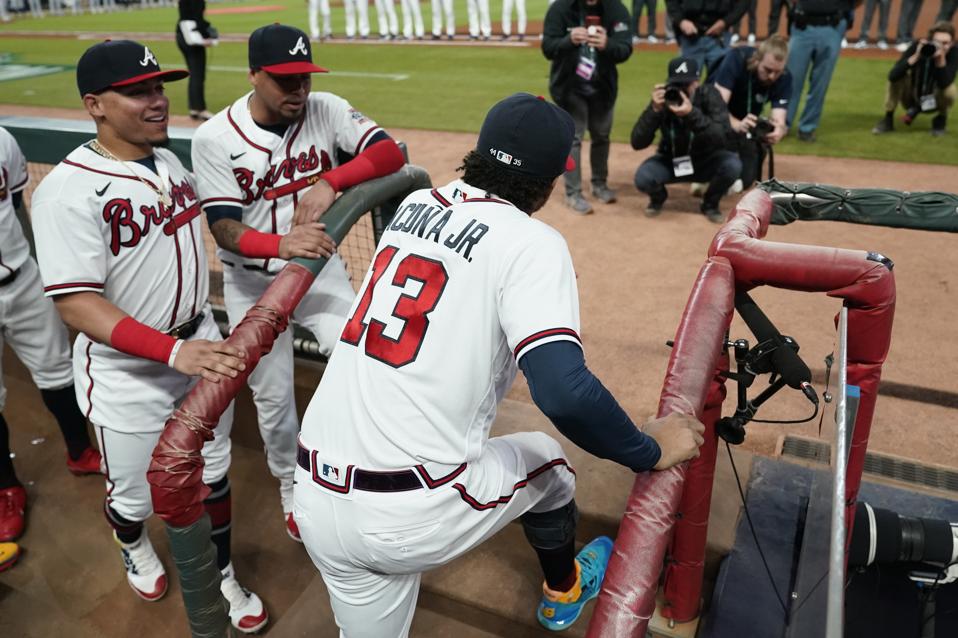
The club never reached the .500 mark to stay until August 5, and never popped over it until the next day. It kept company with the pedestrian Phils and Mets in a tepid NL East divisional chase throughout the first half, and were seemingly dealt a death blow when franchise icon Ronald Acuna Jr. suffered a season-ending knee injury on the Saturday preceding the All Star break.
Instead of hanging his head, General Manager Alex Anthopoulos, realizing that A) his division was eminently winnable, and B) all you need to have a chance to win it all is a ticket to the postseason, set about piecing together the post-Acuna Braves.
Anthopoulos literally cobbled together a brand-new outfield on the fly, bringing in four, count ‘em four new outfielders on the same day, July 30, 2021. Enter Joc Pederson, Eddie Rosario, Jorge Soler and Adam Duvall, and exit some mid-to-lower range prospects, and of course some dollars to relieve the payrolls of the non-contending Cubs, Indians, Royals and Marlins.
Were any of the acquired players stars? No, but they all brought something to the table, and perhaps most importantly, they fit together. Pederson and Rosario hit from the left side, Soler and Duvall, the right. All hit for power. In addition to their previous clubs’ collective also-ran status, they each had one key characteristic in common, at least in Anthopoulos’ eyes.
A very strong analytic case could be made that all four players were better than their numbers when these deals were made. Pederson’s .300 OBP at the time was the highest among the four players. Soler was the most obvious case among the group. Playing his first half home games in spacious Kauffman Stadium in Kansas City, Soler was carrying about a moribund .192-.288-.370 slash line.
Peeling a couple layers back, Soler was hitting the ball as hard as ever, he just wasn’t getting the results. The gap between his seasonal actual numbers and those numbers adjusted for exit speed/launch angle are striking, especially in the air. Soler hit .336 AVG-1.049 SLG (114 Unadjusted Fly Ball Contact Score) in the air for the season, but “should have” hit .438 AVG-1.324 SLG (185 Adjusted Fly Ball Contact Score). The difference was that first half in Kansas City. His second half .269-.358-.524 line as a Brave is who he is. For the full year, he posted a 100 wRC+, but a 122 “Tru” Production+ level. The Braves saw through his first half, and bought a well above average hitter for pennies on the dollar.
Rosario also took off after coming to Atlanta, batting .271-.330-.573 after a slow .254-.296-.389 first half in Cleveland. Put the two halves together, and you get a 98 wRC+, and adjust for exit speed/launch angle, and you still have basically the same player at 96 “Tru” Production+. While the Braves didn’t necessarily see Rosario as the above average hitter that Soler truly is, they believed he was a league average player, and was due to regress positively to the mean in the second half. He did just that.
Pederson and Duvall were essentially the same players after they were acquired as before. But both helped fill the power void created by Acuna Jr.’s absence, and Duvall in particular extended their lineup, pushing true power threats all the way down to the #7 slot in their order. RBI are overrated, but the fact that Duvall led the league in them counts for something.
All contending clubs have go-to strengths that they hang their hat upon. The Braves’ go-to strength is offense, and with the injury to Acuna Jr., they had every reason to take their ball and go home. To their credit, they did not. Their other remaining offensive superstar, Freddie Freeman, stepped up his game, and Austin Riley elevated his to the star level. Ozzie Albies was a steadying, durable everyday presence, and the brand new outfield fit together and made the absence of their superstar bearable.
Meanwhile, they got 61 strong starts from Charlie Morton and Max Fried, their two top-shelf rotation-mates, capable work from the other starters, and their pen kept it together in the regular season and got legendary in October. And that, my friends, is how you win a World Championship.
THE 2021 SEASON
Acuna Jr. has rapidly become one of the faces of this generation of superstars. He, Juan Soto and Fernando Tatis Jr. could well become the Mays/Mantle/Aaron of their era. If I had to pick one of the three moving forward it would be Soto, as his power numbers could absolutely explode once he begins elevating the baseball with more regularity.
Acuna Jr. already does that. He destroys the baseball in the air and on a line, and already has a very healthy fly ball rate, coupled with a low pop up rate for a power hitter. On top of it all, his strikeout rate is very manageable for a slugger. Acuna Jr. is a fully evolved superstar bat, and only turns 24 in 2022. His only flaw is a pull tendency which invites infield over-shifts, but that’s a minor point in his sea of positives. His upside isn’t terribly far above where he is now, unlike Soto.
At this moment, it remains to be seen where 1B Freeman will be playing in 2022. It was almost universally assumed that he would return to the Braves, but the lockout has at least temporarily delayed such a reunion. He is one of the foremost hitting technicians in the game, consistently putting the ball in play and racking up high liner rates annually. He hits enough fly balls while almost never popping up.
He turns 32 in 2022, and no longer is one of the premier mashers in the game, exit speed-wise. Freeman is likely to decline a la Joey Votto, with his power numbers trending down until the point that he needs to lift and pull with more frequency to remain a middle-of-the-order force. The Braves might not want to go beyond five years on Freeman, and if the market goes there, they might pivot to a younger slugger like Matt Olson in the trade market.
3B Riley finally came into his own last season. That said, his numbers got a little ahead of his present talent level. He somehow hit .305 AVG-.340 SLG on the ground despite below average foot speed, which drove his 135 wRC+ beyond his 121 “Tru” Production+ mark. That said, he’s only scratched the surface of his power potential. Riley reminds of an early version of Mike Schmidt, though that it no way implies he’ll be able to make the difficult adjustments Schmitty made in his thirties.
Ozzie Albies is the Jimmy Rollins of second basemen. On a per at bat basis he’s only a little above average, but he’s good for, you know, about 700 at bats per season. He’s a switch-hitter who pulls everything from both sides of the plate, but the negative impact of that is outweighed by the positive effect of never seeing a breaking ball ever move away from him. His contract is beyond team-friendly, so even if Albies remains a very good player and never truly becomes a star, the Braves are good.
SS Dansby Swanson is the bottom of the order version of Albies. He’s league average in most offensive respects, from K and BB rate to batted ball authority, but for a shortstop, that’s more than OK. He too appears to be the type of player to regularly provide 600 or more plate appearances annually.
Charlie Morton and Max Fried are legit co-aces. At 37 last season, Morton was a better pitcher than he’s ever been. His K rate was over a full standard deviation above league average, and he’s a clearly above league average contact manager. He routinely runs a high grounder rate, and manages contact authority well across all batted ball types. Morton had a 89 Adjusted Contact Score and 72 “Tru” ERA- last season, and ranked tied for 4th among NL pitchers in “Tru” Pitching Runs Above Average, dead even with Max Scherzer. His season ended on a sour note when a liner broke his leg in the first game of the World Series, but he’s expected to be fully healthy for Opening Day.
Fried will likely be one of the premier contact managers of his generation. His 85 Adjusted Contact Score ranked 3rd among NL ERA qualifiers, and his ability to induce more grounders and throttle fly ball authority even better than Morton is eye-catching. He’s not the biggest bat-misser, which might keep out of the inner-circle pitching elite, but the Braves will take a repeat of his 76 “Tru” ERA- from 2021.
Ian Anderson is a bit of a conundrum. His performance in the last game of the World Series is a metaphor for his overall 2021 season. His command wasn’t great, he got hit pretty hard at times, but the actual results were pretty good. He was a bit lucky on balls in play last season, allowing some hard fly ball and liner contact, with an ordinary K/BB profile. The Braves hope that modest improvements in all of those areas, coupled with his significant grounder tendency, could give them a third ace, or a second for when Morton fades or retires. Personally, he’s a league average range guy for me at this time.
The Braves’ bullpen saved their bacon in the end. Will Smith was a league average range closer during the season, but was great in October. And Tyler Matzek? What a story. From mega-prospect to out of baseball to serviceable lefty situational guy to.......two-inning lockdown World Series difference-maker? What a sport baseball can be.
DOWN ON THE FARM
The Braves have long been known for their farm system depth, but as things stand, they have no better than a middle-of-the-pack group.
Most of their top position player prospects had so-so 2021 seasons. CF Cristian Pache struggled mightily in the majors, but is a defense-first type who should eventually hit more than Ender Inciarte did. Michael Harris and Drew Waters are next in line. Both have five average to above average tools, and Harris shows glimpses of impressive power. C Shea Langeliers could entrench himself as a regular in Atlanta before all of them. He projects to hit enough, but it’s his MLB-ready defensive tools that stand out.
Ryan Cusick, the Braves’ 2021 1st round pick, has the highest upside among pitching prospects. He pushes his fastball up to 100 mph, and his curve shows promise. He absolutely dominated in his pro debut last season, and could arrive soon with more consistent command. The Braves do have some back of the rotation options on the way. Lefties Tucker Davidson and Kyle Muller looked like they belonged in brief 2021 auditions, and righties Spencer Strider, Bryce Elder and Freddy Tarnok are next in line.
OFFSEASON FOCUS
Unlike the #10 Red Sox, who made many of their offseason moves prior to the lockout, the #9 Braves have lots of work to do. First and foremost, the Freeman question must be answered. If he goes elsewhere, expect a large trade package to be offered for the Athletics’ Olson. Then, the respective fates of Pederson, Rosario and Soler must be decided, with the club forced to rely on youngsters like Pache, Waters and Harris should those players depart.