We’ve all dreamed of popping the catches on a battered flight case, inhaling the mojo of our hero’s guitar and whispering, Gollum-like: “Mine, all mine…” Unfortunately, for the longest time, there were only two ways to become the owner of a celebrity instrument.
You could place requests with a global network of vintage guitar dealers, betting on the slim chance of a private sale. Or you could talk your way past security, infiltrate the star’s dressing room and slip out of the stage door with your contraband (a fate that befell such A-list lost boys as Eric Clapton’s “Beano” Les Paul and Joe Satriani’s “Pearly” Ibanez).
But for those too impatient to wait, or too honest to steal – and too wealthy for a signature model to scratch the itch – the dawning millennium offered a third way.
“Rock star guitar auctions aren’t just a recent phenomenon,” says Amelia Walker, specialist head of private and iconic collections at the Christie’s auction house in London.
“These guitars have commanded high prices for about 25 years now. We first saw incredible results for iconic instruments when Eric Clapton sold his first group of guitars in 1999 with donations to the Crossroads Foundation – including his ’57 Brownie Strat, which made half a million dollars and set a new world record. I think that was the catalyst.”
Where Clapton led, others followed.
“Jerry Garcia’s Tiger sold a couple of years after that for almost double [$957,500],” Walker says. “Then there was Eric’s second Crossroads sale in 2004, when Blackie broke Tiger’s record by a little bit, for almost a million dollars. And records continue to be broken, particularly for guitars belonging to musicians of the ’60s and ’70s.
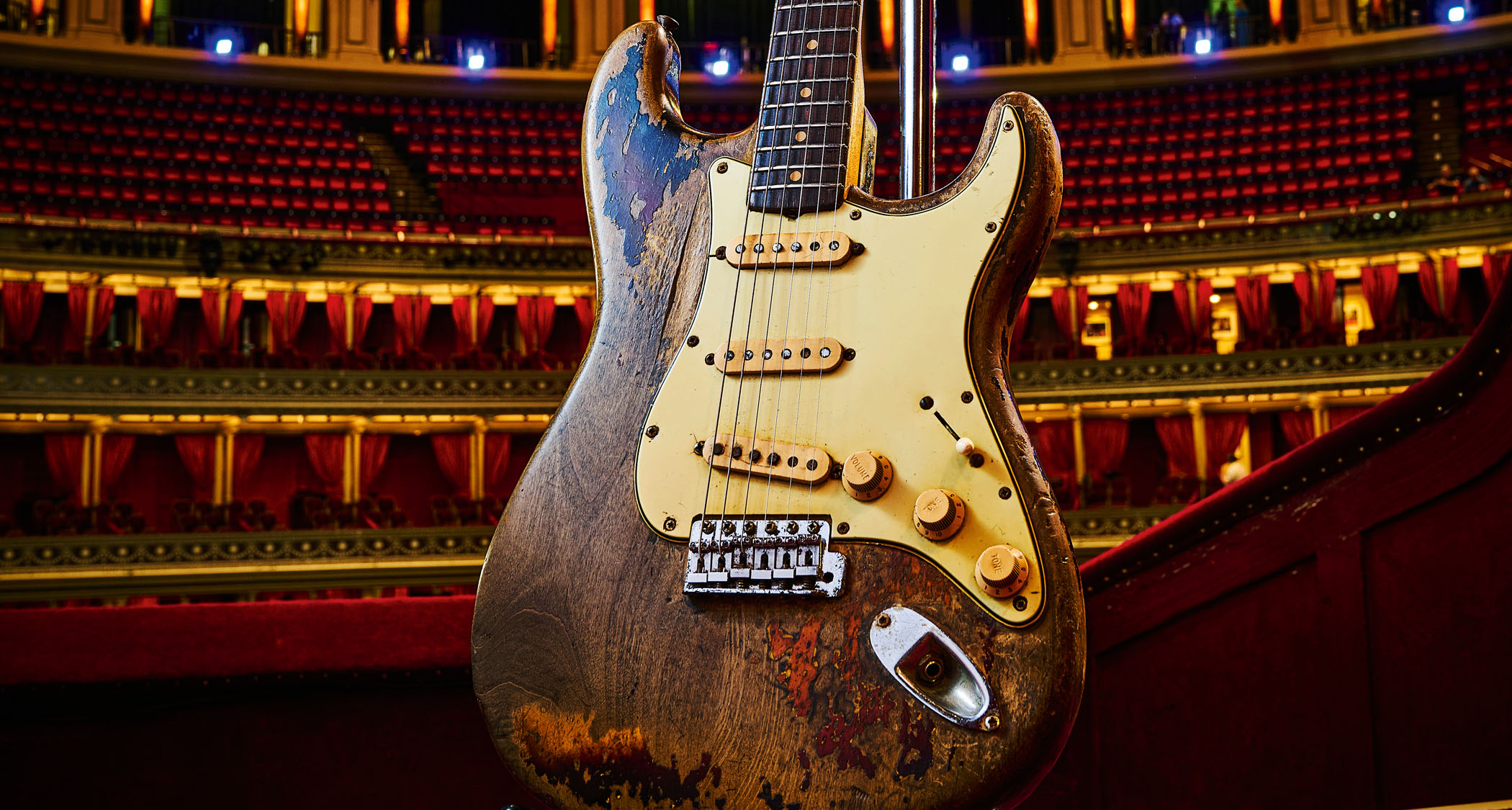
“You know, Bob Dylan’s 1964 Sunburst Strat from Newport made just under a million dollars in 2013. John Lennon’s Gibson electro-acoustic J-160E made even more in 2015. Then, of course, there was David Gilmour’s Black Strat, which absolutely smashed all records when it made just under four million dollars in 2019.”
For most of us, reading these eye-watering sums in the headlines, it’s easy to picture the typical buyer as a billionaire tech bro – and bristle at the thought of these seminal guitars trapped in glass display cases, just a fleeting brag over cigars at a Silicon Valley soirée.
But just as bad, in our mind’s eye, is the notion of these instruments being snapped up by cold, hard, dispassionate investors, who know the cost but understand nothing of their value to rock folklore, merely looking to flip at a profit.
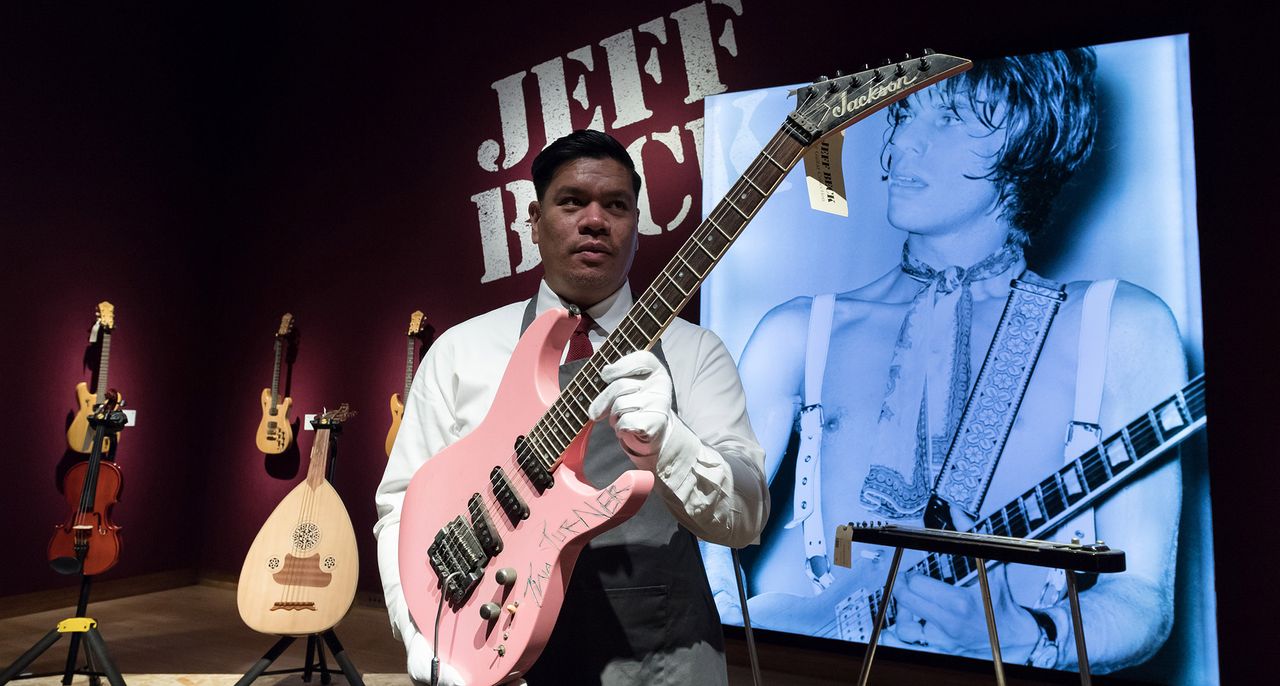
Actually, counters Walker – who helmed Christie’s recent auctions for the guitar collections of Mark Knopfler and, posthumously, Jeff Beck – what shines through when you talk to the successful bidders is their disparate backgrounds and palpable love of music.
“It’s really interesting to see the range of people who want to own these guitars and are willing to part with a really large amount of money. They’re from all over the world, all different aspects of buyers. You obviously have institutions and museums, and then high-end collectors and musicians as well.
“But it’s absolutely driven by the music and the emotional connection,” Walker continues. “At the Mark Knopfler sale, I remember seeing people in tears, sharing their memories, explaining how his songs had helped them through tough times.
“They either want to have that tangible connection with these amazing musicians, or they want to play these guitars, to give them a new lease of life. And I think that is what many of these artists want for their guitars, too. They don’t want them to be hidden under a bed. They want them to be played and create new music – while the good they can do for charity is kind of unparalleled.”

For now, there’s a long wish-list of ’60s and ’70s icons that Walker would love to see come to Christie’s. “Jimmy Page’s Number 1 Les Paul, Bruce Springsteen’s Telecasters, and Brian May’s Red Special.
The power of music is what keeps this market alive
“Then there’s John Lennon’s Rickenbackers and Paul McCartney’s Höfner bass – the one that he was recently reunited with. The Beatles are head and shoulders above the rest in terms of the number of people who have an emotional connection to their music.”
Eventually, though, the stock of iconic golden-era instruments will run dry. Does that mean the guitar auction boom will quiet down, too?
Don’t be so sure, says Walker, predicting that as the decades roll onward, the tools of more contemporary stars will come under the hammer. “It’s not just about ’60s and ’70s musicians anymore. It’s starting to be later generations, and I think that reflects the people who are bidding on these instruments now. They’re not just baby boomers.
“What’s been really interesting in the last five years,” she continues, “is that we’ve seen amazing prices for guitars belonging to guitarists of later generations. Kurt Cobain’s guitars – his Martin from MTV Unplugged and the Smells Like Teen Spirit Mustang – hold the top two spots in the records now.
“There have been high prices for Britpop and Noel Gallagher’s guitars. Taylor Swift’s guitar sold for a huge amount, and that was one she’d only signed; I don’t think it was even necessarily played at a show. The power of music is what keeps this market alive, I think.”
Finally, then, in the hypothetical scenario that we had a million dollars to invest, should we sink it into a celebrity-owned guitar?
“It’s such a difficult question,” Walker says. “It depends on the artist, and it depends on the instrument. There are so many factors. But the fundamental rule – and I always say this to anyone who’s thinking about bidding at auction – is that you’ve got to love it. You’ve got to have a connection with the object, or you’re not going to want to have it in your house.”
- This article first appeared in Guitar World. Subscribe and save.