At least 39 people have died in a high-speed train collision in southern Spain and rescue efforts are ongoing, police said on Monday.
The collision occurred when the tail end of a train traveling between Malaga and Madrid with some 300 passengers went off the rails near Cordoba at 7:45 pm on Sunday.
It slammed into an incoming train from Madrid to Huelva, another southern Spanish city, according to rail operator Adif.
Earlier in the morning, Andalusian regional leader Juan Moreno said 75 passengers were hospitalised, 15 in serious condition.
Most were taken to Cordoba, about 390 kilometres south of Madrid.
The Spanish Red Cross set up a help centre in the town of Adamuz, near the crash site, offering assistance to emergency services and people seeking information.
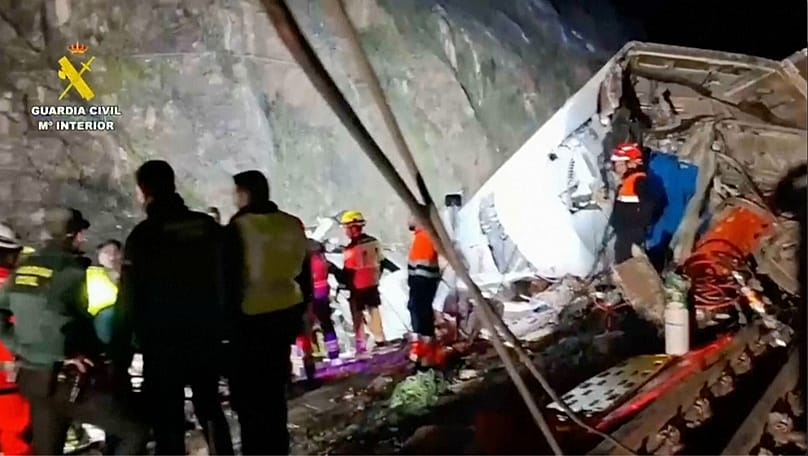
Members of Spain's civil guard and civil defence worked on site throughout the night.
Video and photos showed twisted train cars lying on their sides under floodlights. Passengers reported climbing out of smashed windows, with some using emergency hammers to break the windows, according to Salvador Jiménez, a journalist for Spanish broadcaster RTVE, who was on board one of the derailed trains.
He told the network by phone that "there was a moment when it felt like an earthquake and the train had indeed derailed."
Officials call accident 'strange'
Spain's Transport Minister Óscar Puente said early on Monday that the cause of the crash was unknown.
He called it "a truly strange" incident because it happened on a flat stretch of track that had been renovated in May.
He also said the train that jumped the track was less than 4 years old. That train belonged to the private company Iryo, while the second train, which took the brunt of the impact, was part of Spain’s public train company Renfe.
According to Puente, the back part of the first train derailed and crashed into the head of the other train, knocking its first two carriages off the track and down a 4-meter (13-foot) slope. He said the worst damage was to the front section of the Renfe train.
When asked by reporters how long an inquiry into the crash's cause could take, he said it could be a month.
Prime Minister Pedro Sánchez declared three days of mourning on Monday and vowed a full investigation into the cause of the crash.
"We will uncover the answer and once the cause of this tragedy is determined, we will present it with absolute transparency," he told reporters in Adamuz near where the disaster happened.
Spain leads Europe in high-speed trains
Spain has the largest high-speed rail network in Europe for trains moving over 250 kph, with more than 3,100 kilometres of track, according to the European Union.
The network is a popular, competitively priced and safe mode of transport. Renfe said more than 25 million passengers took one of its high-speed trains in 2024.
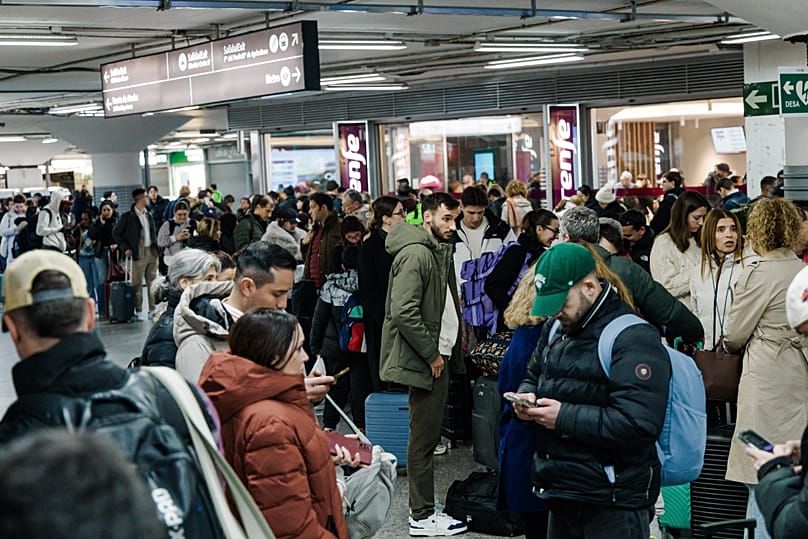
Train services between Madrid and cities in Andalusia were cancelled on Monday.
Spain's worst train accident this century occurred in 2013, when 80 people died after a train derailed in the country’s northwest. An investigation concluded the train was traveling 179 kph on a stretch with an 80 kph speed limit when it left the tracks.