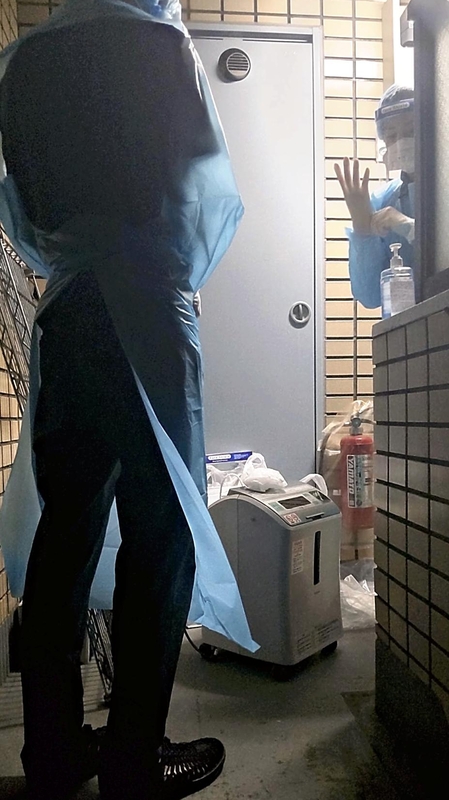
The number of people who have tested positive for the novel coronavirus but are recuperating at home is surging in the Tokyo metropolitan area, amid a shortage of hospital beds caused by the spread of the pandemic.
Cases have emerged in which people developed trouble breathing but could not be admitted to a hospital, so a nurse or other medical specialist hurried to their home to administer oxygen.
On a weekend evening in early August, a home-visit nurse and a medical specialist were heading to a house in Setagaya Ward, Tokyo, where a male patient in his 30s was recuperating. While they were in the car, they were alerted by cell phone that the patient had collapsed when returning from the bathroom and was unable to move. The call came from a clinic that had examined the man online shortly before the accident.
The car got caught in traffic several kilometers from the patient's home, prompting the nurse to get out and start running toward the patient's home.
"Many [COVID-19] patients can suddenly become very ill. Visiting them at their homes is always a tense experience," said Masashi Nakagawa of Sophiamedi Corp. in Shinagawa Ward, Tokyo. Sophiamedi has been subcontracted by five municipal governments in the Tokyo metropolitan area, including Setagaya Ward, to advise people recuperating at home and dispatch nurses to their residences.
Arriving at the home of the Setagaya Ward patient, the two personnel hastily put on semitransparent protective clothing for infectious diseases in front of the entrance. They then took a ventilator inside.
The patient had been recuperating at home from late July. He had measured his blood oxygen level that day at 91% to 92%, much lower than a normal level of 96% or higher. The man therefore got an online medical exam by a doctor, who determined that he needed to be treated with oxygen. No hospital could accept him, so the Sophiamedi staffers were sent to his home.
They found the man lying on the floor. His breathing was shallow and fast at 30 breaths per minute, and he was too weak to speak. When they gave him oxygen through a nasal tube, his blood oxygen level rose to 95% in 15 minutes.
He became able to sit up, and his facial expression eased somewhat. The Sophiamedi personnel told him and his family how to use the ventilator and left after about 30 minutes. They checked on him every three hours, even late at night, and the man was able to be hospitalized the following day.
Normally, home-visit nursing is used by people in relatively stable condition, such as people with a chronic disease or elderly people in need of care. Therefore, some home-visit nurses are not accustomed to protecting themselves from an infectious disease.
"A doctor's visit and home-visit nursing are among the few support measures left to us right now, but the fact is they're not suited to COVID-19 patients, whose condition can deteriorate rapidly," said Tetsuya Matsumoto, a professor at International University of Health and Welfare specializing in studies on infectious diseases.
"We need a recuperation facility like a field hospital, even if it's makeshift, and to create a new system under which patients and medical staff are gathered there so that patients can be treated quickly if they suddenly become seriously ill," Matsumoto said.
Read more from The Japan News at https://japannews.yomiuri.co.jp/