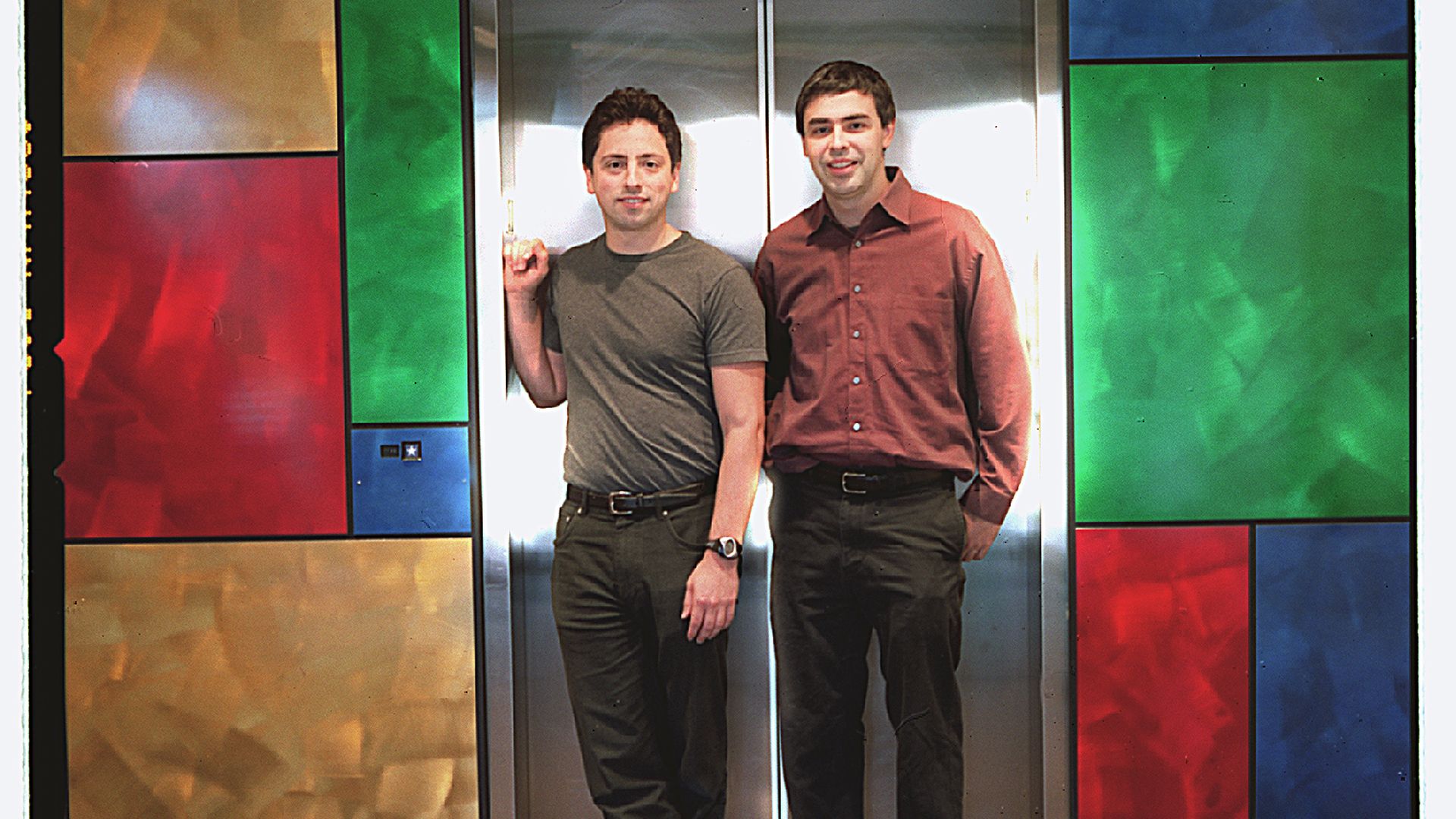
Yesterday's announcement that Google's founders, Larry Page and Sergey Brin, were leaving their executive posts at Google's parent company Alphabet was a surprise only in timing.
What's happening: Page had stepped back from Google itself in 2015. From their perches at Alphabet — Page as CEO, Brin as president — the two founders oversaw the company's "other bets" on advanced technologies like self-driving cars and drones. Googlers have said that they became less and less a presence inside the company.
- Now they're dropping even that level of engagement, retaining their board seats but handing operational responsibility for both Alphabet and Google over to Google CEO Sundar Pichai.
- What they are doing can really only be described as retiring — though that word hangs a little uneasily on men who are 46 years old.
The big picture: Page and Brin's move marks a transition in which big tech is passing from the control of founders to the stewardship of successor technocrats.
- Apple's Steve Jobs died a decade ago. Bill Gates is long retired from Microsoft. Of the five dominant tech firms, only Amazon and Facebook remain under the direction of their founders.
How it works: Silicon Valley has long embraced the thesis that founders, not investors, are best equipped to to shape their companies' destiny. Google is where this approach most definitively played itself out.
- Brin and Page designed Google's corporate structure with the idea that what happened to Steve Jobs — who got booted out of Apple by his own hand-picked CEO and board in 1985 — should and would never happen to them.
- They granted themselves special stock with extra voting privileges that assured they would maintain an outsize influence over the company even as it took outside investment.
- Google's fabulous success taught tech entrepreneurs to adopt this structure whenever they could. When Mark Zuckerberg built Facebook, he could and did.
Between the lines: Page and Brin's retirement raises uncomfortable questions about what happens to this structure as companies age.
- The founding pair are becoming something like absentee owners now, retaining control over their company without managing it.
- Yes, they're still the founders who built it. But they won't live forever (unless Alphabet's "bet" on life-extension tech, Calico, really delivers).
- Assuming their children inherit all that super-voting stock, Brin and Page will not only have founded a company, but a dynasty.
- The lawyers who designed the super-voting share structure borrowed it from the newspaper publishing industry. There, it helped keep families in control of their inheritances — but left companies ill-managed and ill-equipped to respond to waves of technological change.
Our thought bubble: The industry's founder-power corporate arrangements have succeeded at keeping many stellar startups from being seized by short-term-minded investors. But on a longer horizon, they look more like a plan for the establishment of hereditary corporate control — an incongruously archaic concept for a forward-looking industry.