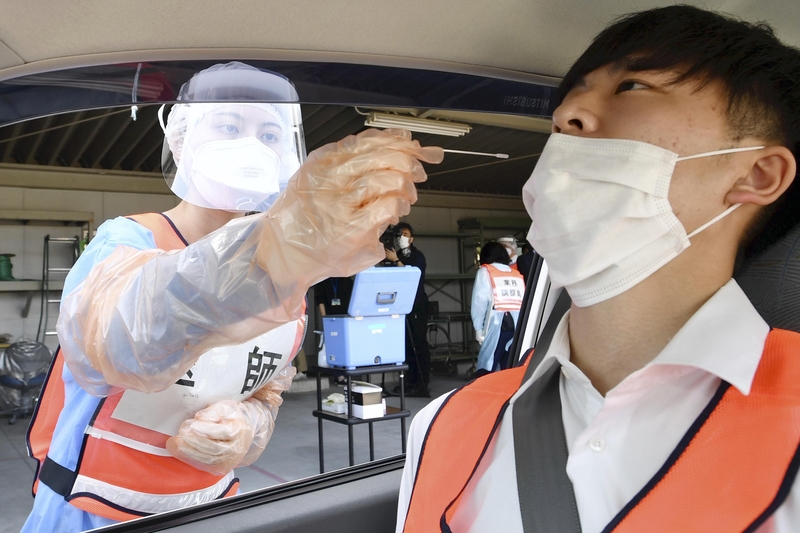
Since mid-June, 70 to 80% of people in Tokyo who tested positive for the novel coronavirus have been under 40 years old. The government is looking for ways to expand testing amid growing concern that the spread of the virus is being exasperated by people who have been infected but show no symptoms.
Testing capacity was unable to keep up with a spike in deaths and severe illness among elderly patients when the outbreak expanded across Japan in March and April. Many people who were infected but not showing symptoms were not tested, so the reality of the situation was not known.
When infections began climbing again in Tokyo in June, the metropolitan government began testing people who had been in close contact with coronavirus patients but were not showing symptoms. Many of the asymptomatic cases were young people. As a result, the risk of the activities of young people exasperating the spread of the virus has emerged.
In June, Prof. Hitoshi Oshitani of Tohoku University, a member of the government's coronavirus subcommittee on measures, and other researchers compiled a paper on 61 clusters comprising at least five cases that had been confirmed in Japan by early April. According to the paper, 22 people were identified as the sources of the clusters. Half of them were young people aged 20 to 39 years old. Of the 22 patients, 9 were found to be asymptomatic at the time the clusters first emerged.
A study in Chongqing, Sichuan Province, China, found that 23% of hospitalized patients remained asymptomatic throughout their time in hospital and 14% of them had infected others.
It is unclear how many people infected with the virus are asymptomatic but airport quarantines provide a useful yardstick.
All passengers entering Japan from countries impacted by the coronavirus pandemic have to take polymerase chain reaction tests upon arrival, even if they are not showing any symptoms. According to data compiled by the Health, Labor and Welfare Ministry, 446 passengers had tested positive as of July 18, about 0.4% of the total. Of them, 90%, or 401 travelers displayed no symptoms.
Local governments are struggling to cope with the situation.
A public health worker who had been dispatched from Takamatsu to assist efforts in Kumamoto Prefecture after torrential rains caused widespread damage in the Kyushu region tested positive on July 13 but was asymptomatic.
Kagawa Gov. Keizo Hamada said, "I regret the trouble that has been caused," confirming that support workers would be tested before being dispatched in the future.
Testing capacity has improved since spring. More than 10,000 PCR tests are conducted every day in Japan, and antigen tests that provide results in a short time have also become available.
The viral load detected in saliva and mucus at the back of the nose of infected patients can vary depending on the number of days after infection or onset. The government has approved the use of saliva-based PCR tests and precise antigen tests in symptomatic patients within nine days of the onset of symptoms.
Health minister Katsunobu Kato announced on Friday that people who aren't displaying symptoms would be able to take such tests.
On Thursday, a government subcommittee proposed allowing tests to be conducted at public expense under the Infectious Diseases Law on people at high risk of contracting the disease, such as employees of medical institutions and facilities for the elderly where infections had been confirmed, and employees of hospitality-related businesses, such as host and hostess clubs.
However, if the number of people eligible for the tests is expanded, it will strain the screening system and may delay the testing of people showing symptoms.
Also, there are limits to the accuracy of the tests. Expanding the tests may increase the risk that asymptomatic cases are missed or false positives identified, which could exasperate the spread of infections or lead to unnecessary hospitalization and treatment.
Prof. Hiroyuki Kunishima at St. Marianna University School of Medicine said, "There is no limit to the number of tests anxious people will want to take to ease their concerns. A consensus must be reached to determine how many resources should be reserved for the testing of individuals who aren't displaying symptoms."
Read more from The Japan News at https://japannews.yomiuri.co.jp/