

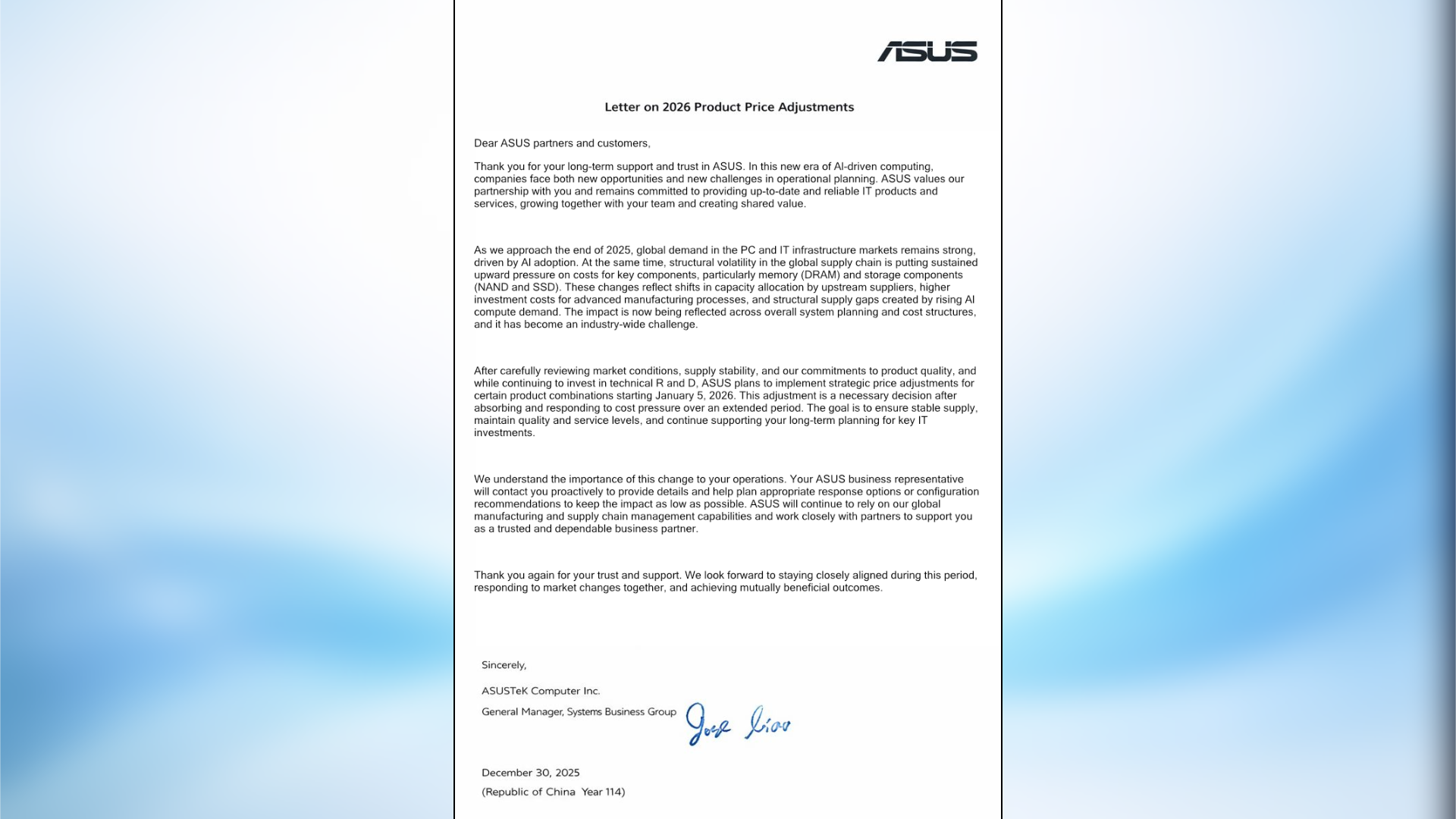
It was likely only a matter of time, given current market conditions and the growing influence of AI across the industry. Still, ASUS has now confirmed upcoming price adjustments in a private document intended for internal use, and not intended for the public to see.
The increases are set to begin on January 5, 2026, according to the document.
While ASUS has not yet confirmed which products will be affected, it has made clear that this will not be a blanket price hike. Instead, the company says it is implementing targeted, strategic adjustments across select product combinations.
Why ASUS says prices are rising and what’s driving the change
It is tempting to almost point and laugh at AI as it fumbles while also feeling the very real frustration of it pushing PC prices ever higher. Component pricing has become increasingly volatile, and ASUS is now acknowledging the pressure this is putting on the broader market.
ASUS specifically states:
After carefully reviewing market conditions, supply stability, and our commitments to product quality, and while continuing to invest in technical R and D, ASUS plans to implement strategic price adjustments for certain product combinations starting January 5, 2026. This adjustment is a necessary decision after absorbing and responding to cost pressure over an extended period. The goal is to ensure stable supply, maintain quality and service levels, and continue supporting your long-term planning for key IT investments.
Liao Yi-Xiang
ASUS also mentions explicitly "... upward pressure on costs for key components, particularly memory (DRAM) and storage components (NAND and SSD). These changes reflect shifts in capacity allocation by upstream suppliers ..." referencing the RAM/DRAM shortage driven by AI.
While the exact impact on individual products has yet to be confirmed, speculation has already begun around devices such as the ROG Xbox Ally, where memory and storage are integral to the overall configuration and cost.
ASUS frames the situation as a system-wide issue rather than a component-specific problem. The company points to structural volatility in the global supply chain, shifts in upstream capacity allocation, and rising AI-driven demand, which it says are now affecting system planning, configuration decisions, and the long-term stability of pricing across consumer hardware.
With January 5, 2026, just around the corner, we will not have to wait long to see which products are affected and to what extent. For now, the full impact remains unclear.
That said, if price adjustments do land where many expect, the next few days may represent the last chance to pick up an Xbox Ally X or Xbox Ally at what could be considered a relatively reasonable price in a few days' time.

Would you rather accept higher prices in exchange for continued AI development, or see the industry scale back AI features in favor of cheaper hardware and a more stable market?
Let us know by taking part in our poll or leaving us a comment with your thoughts.

Follow Windows Central on Google News to keep our latest news, insights, and features at the top of your feeds!