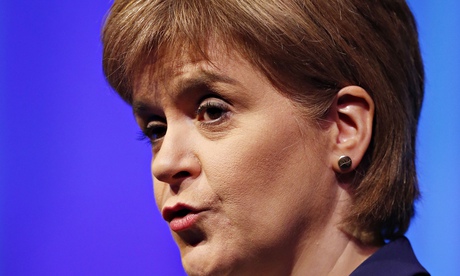
The favoured parlour game at the SNP annual conference in Aberdeen is counting the property dealers and corporate lobbyists who toiled once to carve out the party’s role in UK politics as the flag-bearer for social justice. And when you stroll past the stall that belongs to the Scottish Police Federation you wonder how many more Scottish justice secretaries they might be able to cram into one of their cupboards. That, though, is your whack if you are seeking anything that even vaguely resembles political theatre.
It’s not a bad position to be occupying when you’re the party of government and less than seven months away from a national election that the latest polls indicate will deliver you an historic second successive working majority. Not only does the party seem unassailable in Scotland for a generation but Nicola Sturgeon is secure also on the domestic front in the knowledge that the grip she exerts on party discipline is greater even than that which her predecessor, Alex Salmond, possessed.
Yes, there was a mild flutter of interest during Friday morning’s debate on fracking and whether the party ought to stick with its current position of imposing a moratorium on drilling or switch to one that favours an outright ban. This being the SNP, the road less radical was, of course, stubbornly adhered to.
The most striking aspect of Aberdeen 2015, though, was the absence of the word “independence” from the foyer chats and what passes for debate on the SNP conference floor. Sturgeon had dealt with that firmly last week in an interview with the BBC’s Laura Kuenssberg in which she was widely believed to have put the prospect of a second referendum on Scottish independence on “the back burner”.
This was the latest of a series of comments on the subject of an indyref2 made by Sturgeon. Last month, during interviews to mark the passing of the year after indyref1, she began the task of taking some wind out of the independence sails by telling me and others that several “triggers” would require to be in place before she might contemplate a second referendum: among these being Britain taking Scotland, against her will, out of Europe and the Tories maintaining their course to hit Britain’s most vulnerable as the most direct way of wiping out a debt incurred by the nation’s irresponsible and spendthrift rich.
In these interventions, Sturgeon is deploying an adroit and astute political strategy. As well as lowering the temperature on the prospect of an early referendum among the most zealous nationalists she has also succeeded in spiking the guns of those unionists who insist on bringing up the SNP’s previously stated “once in a generation” position, though I’ve always been curious as to why the SNP’s retort to this hasn’t simply been: “That was then, this is now.” After all, the Labour party has changed direction and shifted its position on so many issues in the last 18 years that it now currently possesses more positions than Kama Sutra, several of which the puritan Jeremy Corbyn, to his credit, is now urgently trying to ditch. Having been attacked by Labour and the Lib Dems for obsessing about indyref2 Sturgeon has, in a short space of time, manipulated her opponents into allowing a free vote for their members when the curtain rises on indyref2.
Sturgeon has also indicated that she would have to be convinced that many of her party’s supporters who voted No in the first referendum had changed their position on the UK’s future constitutional arrangements before she would move for a second one. Several commentators have since suggested that recent polls indicating 53% support for independence would have to shift up by around another 7% for that to happen. Such an analysis, though, is too simplistic. It is unlikely that a figure of 60% will ever be attained, even in an opinion poll. Instead, as Sturgeon must acknowledge, starting a second referendum campaign on a figure of 50% support for Yes is 20% better off than her side enjoyed as the first campaign got underway.
She and her advisers (well, those who have resisted the lure of the “social justice” conglomerates) must also know that victory in the second, and final, referendum campaign rests on their ability to construct an alternative currency option, preferably a new Scottish currency underwritten by solid international investors and reinforced by the continuing strength of whisky exports, the tourism sector, free and unlimited nationwide broadband and a flexible tax system.
I fondly imagine there to exist, holed up somewhere nice in Scotland, a small and perfectly formed cadre of economic thinkers whose task for the next five years is to create a credible fiscal strategy for indyref2 before 2021. Along the way, it helps when the rest of us, as we were at prime minister’s questions last week, are treated to the sight of millionaire Tory MPs delighting in the struggles of Britain’s poor people as they cope with welfare and invalidity benefits.
It will also help the Yes campaign if Sturgeon’s government ever gets round to carrying out a root-and-branch reform of Scotland’s dysfunctional police force or attaining success in closing Scotland’s wretched attainment gap in education or ending the postcode lottery in provision of consultants and GPs. Noticeable movement on ending the hegemony of the privileged at the top of Scottish society wouldn’t go amiss either and it was good to see ordinary SNP members on Friday from the floor effectively demand that the leadership toughen up their land reform proposals
I have no doubt a second referendum on independence will take place – and before 2021. And I have never been more passionate about the need for Scotland to be solely responsible for its own destiny, despite the economic sacrifices that will entail. Any time that commitment wavers I’ll play a recording of Theresa May’s vile address to the Tory conference. And if the SNP’s scarecrow division of the semi-deluded can cope with the idea that the party is not above criticism and that the media are not part of a sinister unionist command structure then we can all have a jolly nice time together on the journey.