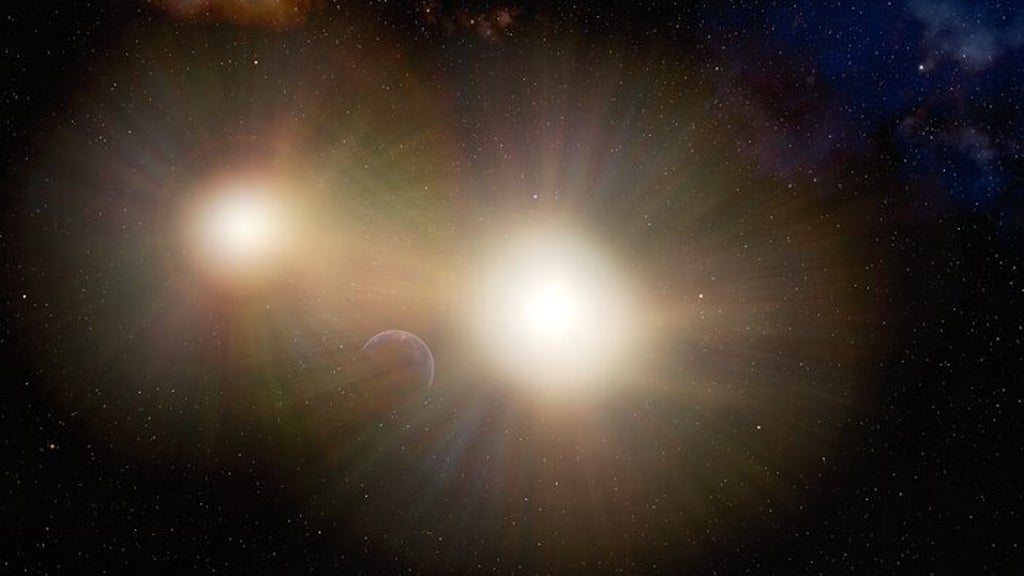
Scientists searching for planets outside our solar system could be missing nearly half of all the Earth-sized planets in our universe.
New research from the Gemini Observatory and Kitt Peak National Observatory suggests that Earth-sized planets could be undiscovered in binary star systems, hidden by the glare from their suns – with roughly half of all stars in the universe located in systems like these.
The planet-star pairs can be so close together that, when studied by Nasa’s TESS (Transiting Exoplanet Survey Satellite), they may be mistaken for single bodies unless observed at an extremely high resolution.
TESS uses a detection method called transit photometry, which looks for periodic, repetitive dips in the visible light from stars caused by planets passing in front of them. TESS has identified 2,601 possible exoplanets so far, of which 122 have been confirmed.
Previous findings include a planet orbiting the corpse of its star and a strange alien world notable for how cold, and small, the planet is.
Recommended
Scientists utilised the `Alopeke and Zorro instruments on the Gemini North and South telescopes in Chile and Hawai‘i to inspect a sample of exoplanet host stars in greater detail using a technique called speckle imaging, which allows astronomers to see past the blur of the atmosphere by taking many observations in rapid succession.
“Their transits are ‘filled in’ by the light from the companion star,” Steve Howell, of Nasa’s Ames Research Centre, said. It is this blurring effect is what causes stars in the night sky, visible from Earth, to twinkle.
Astonishingly, it was discovered that 73 stars previously thought to be single entities are in reality binary star systems. The scientists then compared the sizes of the detected planets in the binary star systems to those in single-star systems, and found that while there were many large and small exoplanets orbiting single stars but only large planets in binary systems.
This new finding means that astronomers will have to use even more observational techniques when investigating that a binary star system has no Earth-like planets
“Since roughly 50 per cent of stars are in binary systems, we could be missing the discovery of — and the chance to study — a lot of Earth-like planets,” Katie Lester of Nasa’s Ames Research Centre, said.