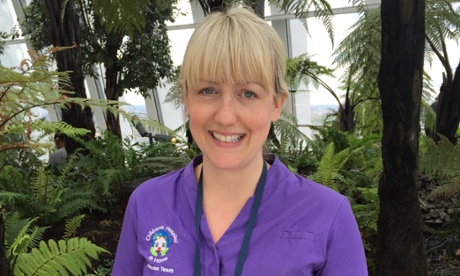
I love being a paediatric nurse – it’s part of who I am. I’m back from maternity leave and have started a new role as a children’s asthma specialist nurse, for the Croydon children’s hospital at Home Community Team. It’s my 10th job since qualifying as a paediatric nurse. It was the 10-minute commute, team and culture of flexible working that sealed the deal. I received a call 15 minutes after leaving the interview to offer me the post. I’d only got to Tesco Express. They said they were bowled over by me. It’s the nicest thing that’s ever been said to me on being offered a job.
I wake up at 6.30am trying not to wake my two children till later; once they’re awake it’s all go, so I try and get a head start. I work flexibly, compressing my hours over three days. I arrive at the health centre I’m based at for 8.30am on the days I don’t do the nursery run.
As we are a newly established team, a large part of my work involves networking with other professionals to raise our profile and secure referrals. Having contacted every school and GP surgery in Croydon to promote our service, checking our inbox for new referrals is the first job of the day. In a working day I could be home visiting, liaising with and training other professionals, contacting families, making adjustments to our documentation and finding resources to support our teaching, while ensuring we meet the service specifications.
During a home visit we assess a child’s asthma control, inhaler technique, consider the impact of their home environment on their day-to-day life, and confirm they are on the optimum medication regime in accordance with guidelines. Smoking cessation is one of the health promotion topics we discuss, as it’s often the most important action a parent can take to improve their child’s asthma.
A child might never have been shown how to use their inhaler properly, meaning their medication is ineffective. This can resultin an exacerbation of their symptoms and often needless hospital presentations. Asthma is, in most cases, manageable and shouldn’t stop a child doing anything; if it does, it’s not being properly controlled. Sadly we know from the National Review of Asthma Deaths 2014 that poorly controlled asthma can cause deaths.
As for all healthcare professionals, safeguarding children is a key element of our role – a child’s welfare is always at the heart of our work. I might be the only professional that ever sees a child and their family at home. We need to be assessing risk, while working in partnership with families.
It’s a privilege to visit people’s homes, you see them differently in their own environment. It’s not without challenges, in the past I’ve delivered home visits in the company of chameleons, terrapins and budgies. I had to edge past a huge pitbull terrier when I was six months pregnant; all I could do was look at the size of its jaw. There was even a Japanese akita which howled its way through one visit.
There are approximately 3,750 children living with asthma in Croydon. We have the second highest rate in London of emergency admissions relating to asthma in children. As a team we offer a single home visit to children, young people and their families to provide education and support to improve their self-management skills. Our aim is to reduce hospital admissions by 40% in the next year. It feels quite a hill to climb, but it’s based on the Hounslow model, where the team successfully achieved this outcome.
We are now on Twitter (@CHAHAsthma); social media offers us the opportunity to network and share resources with other professionals involved in asthma care. Once I’ve finished work I head home for stories and cuddles with my little ones.
There’s just three of us in the specialist asthma team, I feel like I’ve known my new colleagues for years, they are both mums with children too, so we have that shared understanding. They’re also very funny. I know it’s a new job, but it has a different feel to it, maybe I’ve finally found the right team.
If you would like to be featured in our “Day in the life of...” series, or know someone who would be great to include, please email healthcare@theguardian.com