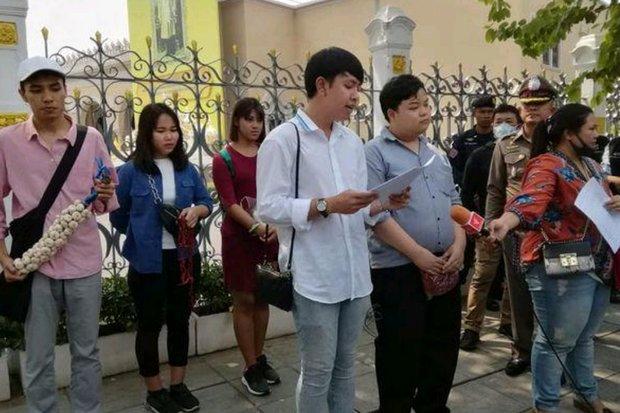
The arrest of two democracy advocates at Government House on Saturday is a black mark on this government and law enforcement.
The two young people who quietly called for the resignation of Prime Minister Prayut Chan-o-cha are the first victims of the new public assembly law. Until now, this law has been dormant because it was superseded by military edicts. Now that the public are supposedly free to campaign, speak and rally, authorities have quickly stepped in to draw new lines in the sand.

Obviously, the key word in that last sentence is "supposedly". One would think the order by the National Council for Peace and Order (NCPO) to lift restrictions on political gatherings would return the country to constitutional rule. That would mean full freedom of speech, of media, of public gathering and of petitioning the government. Saturday's arrest of the two demonstrators is something different.
The law passed through the junta-appointed National Legislative Assembly in May 2015. It is, by a magnitude, more repressive of public freedoms than any such law, edict or regulation in recent history. In many ways, it is even more restrictive than the regime's overreaching third order of 2014, which shut down most public freedoms. Except for the black periods of military-type law since the 1973 student uprising of Oct 14, the new law is decidedly worse. It is a shame that civil rights groups and civil society failed to oppose it when it was still before the military's version of a national parliament.
As the nation and the two pro-democracy advocates discovered on Saturday, the public assembly law actually prevents citizens from exercising their legal right to petition the government. As enforced by handcuffs, the law now forbids whatever police decide is a "demonstration" within 50 metres of the Government House fences and gates. Charges against the two also state that they failed to inform authorities 24 hours in advance of going to Government House.
This is scandalous on the part of the Dusit police station. The public know full well, as does the actual arresting officer and station commander, Pol Col Somyot Udomraksasap, that two people and their friends approaching Government House peacefully would not be molested. They know the real crimes of the two arrestees -- their known opposition to the military coup and resulting regime, and their call for Prime Minister Prayut to step aside for the period of the election campaign.
This latter call is not unique. There is strong support from political and pro-democracy groups and citizens for Gen Prayut to display his faith in the democratic process. The four of his ministers directly involved in the Palang Pracharath Party (PPRP) have already resigned from the cabinet. Gen Prayut refuses even to put the cabinet in caretaker status, as tradition demands. Calls for him to physically recuse himself from government are legitimate, however controversial.
If the prime minister and government are sincere about putting Thailand back on a democratic course, they must quickly show evidence of that. All charges against the two demonstrators should be dropped. And the government should make it clear that peaceful groups have every right to appear at Government House to petition their government.